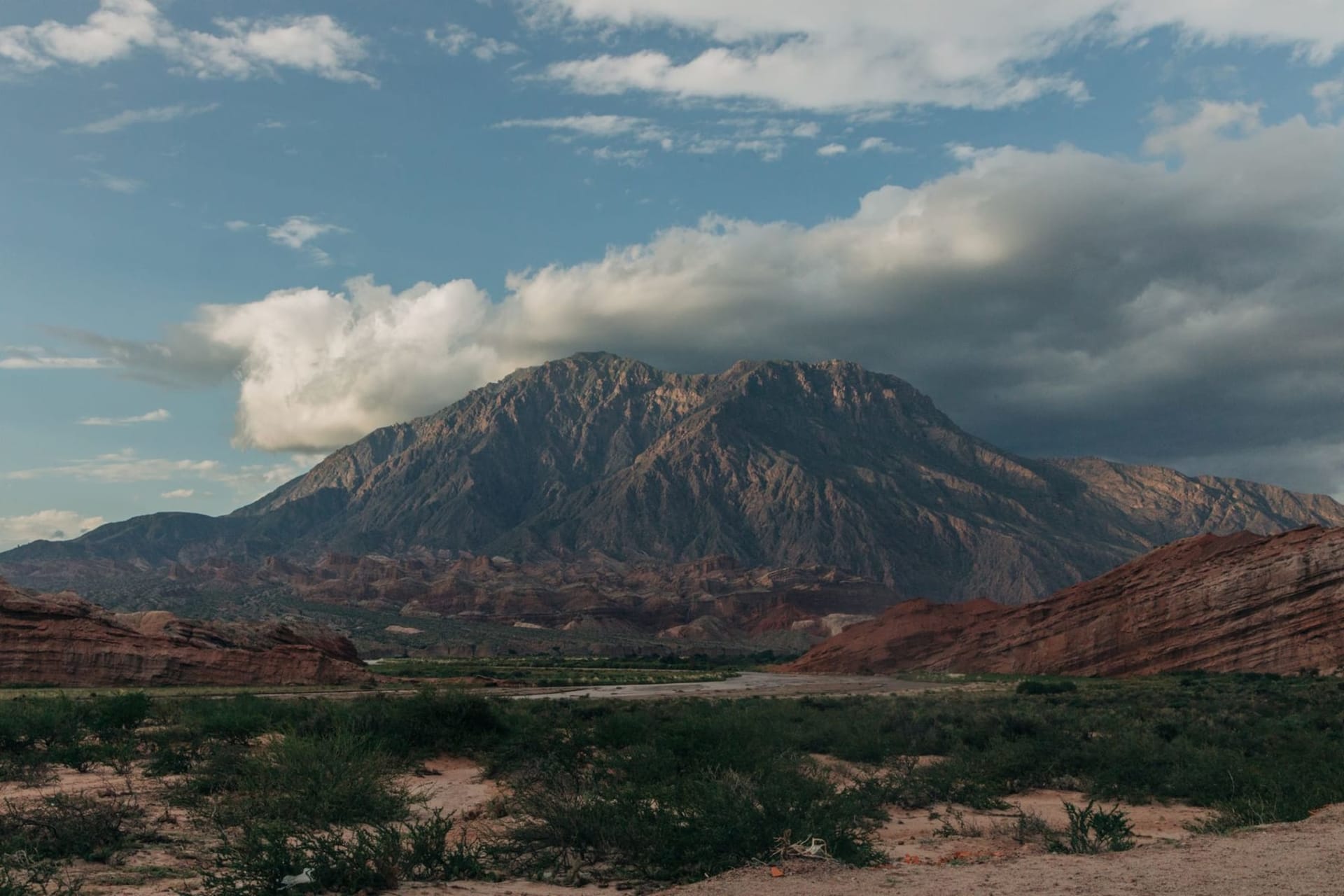
Salta City
"Salta wears its beauty without any fuss, the way the Andes wear their snow."
La Linda, they call it — this northwestern city of colonial churches and empanadas framed by Andean hills.
There is a quality of light in Salta that I did not expect — something to do with altitude and latitude conspiring together, burning the afternoon into the color of old terracotta. I stepped off the bus from Jujuy with dust still in my teeth and looked up at the Cathedral on Plaza 9 de Julio, that candy-pink confection of colonial symmetry, and thought: this city is not trying to impress anyone. It simply is.
La Linda, they call it. The Beautiful One. For once, a nickname that earns its keep.
The Weight of the Plaza
The Plaza 9 de Julio is the kind of square that still functions as a square — old men on benches, schoolchildren crossing in formation, a vendor selling turrón from a folding table. Lia and I sat under the jacaranda shade with cortados and watched the pigeons compete for territory around the equestrian statue. The Cabildo, white and colonial and slightly too perfect, faced us from across the cobblestones. We’d both been in enough Latin American plazas to have grown numb to them. Salta’s central square managed to undo that numbness in about twenty minutes.
What does it is the containment. The hills hold everything in — Cerro San Bernardo to the east, Cerro 20 de Febrero to the north — so the city feels cupped rather than sprawled. You don’t lose yourself here. You find yourself oriented, always, by terrain.
Empanadas at Eleven in the Morning
Someone in Jujuy had told me: eat empanadas salteñas before you do anything else. So we did, at a place on Caseros with plastic chairs and no menu on the wall — just a woman at the counter who asked how many and expected you to know the answer. We said six. She was right to look skeptical; we ordered four more.
The salteña empanada is baked, not fried, and inside: beef with potato, hard-boiled egg, cumin, and enough fat to make the pastry glisten. Nothing about them is subtle. They tasted like someone’s grandmother’s practical solution to cold mountain winters, which is exactly what they are.
The unexpected thing: I found the best ones not at lunch but at eleven in the morning, in a bakery on Balcarce still warm from the oven, wrapped in paper and eaten standing on the sidewalk with grease on my wrists and the Andean sky already blinding overhead.
What the Hills Contain
We took the teleférico up Cerro San Bernardo on our second afternoon — mostly because Lia wanted the perspective, and she was right to insist. The city lays itself out below you like a lesson in colonial urbanism, grid and campanile and plaza repeated to the foothills. We walked back down through the steep Parque San Bernardo, past waterfalls and subtropical vegetation that feels improbable this close to desert, and I kept stopping to look at the bougainvillea crawling over stone walls in a shade of violet that seemed too saturated to be real.
The contradiction is the point. Salta sits at the edge of the puna, the high plateau — arid, enormous, geological in scale. The city itself is lush, irrigated, fragrant with jasmine in the evening along the pedestrian stretch of Florida. The Andes loom and the bougainvillea blooms and neither seems to notice the other. I appreciated the lack of drama.
When to go: I was there in late April and the light was perfect — dry, clear, mild in a way that felt deliberate. April through June and September through November are the sweet spot, before the summer rains roll in from December through March. I’ve heard Carnival in February is worth the humidity, but crowds were never really our thing.