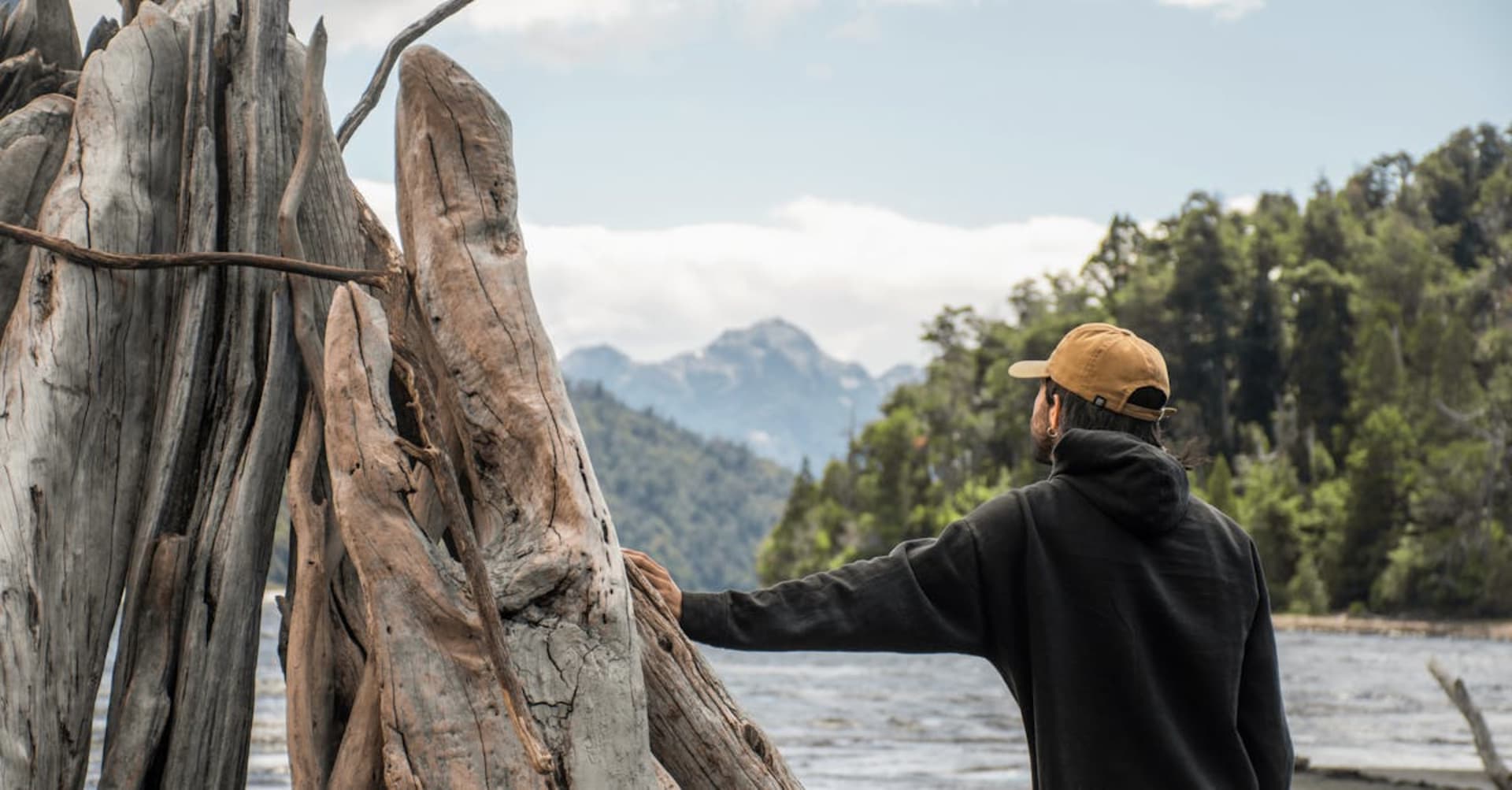
Patagonia
"Patagonia makes you feel small in the way that only the greatest landscapes can."
The end of the world — vast steppe, glaciers calving into lakes, and winds that shape everything.
There is a particular silence in Patagonia that is not really silence at all. It is the sound of wind — relentless, horizontal, older than memory — and the first time I felt it properly, stepping off the bus in El Calafate with my jacket open like an idiot, it nearly knocked me sideways. I had read about Patagonian wind. Reading about it is completely useless. It pours across a steppe so vast that the eye gives up trying to find the horizon and simply surrenders, and after a few days here, I noticed I had stopped trying too. Patagonia is where the continent runs out, and it feels like it.
Lia and I reached Perito Moreno on our second day, arriving early to beat the tour groups. The glacier earns everything written about it. A wall of ice five kilometers wide and sixty meters tall, its face is a fractured cathedral of blue — not the blue of sky or sea but a deeper, denser blue, the blue of compressed millennia. From the steel walkways that zigzag across the facing hillside, we stood and watched the ice groan and shift and, with a crack that landed in my chest before it reached my ears, calve a massive serac into the milky turquoise water below. The wave rolled toward shore. A column of mist climbed. Lia grabbed my arm. Neither of us said anything for a while. The glacier is still advancing — one of the few on Earth still doing so — and there is something profoundly reassuring about standing before a force that has not yet learned to retreat.

El Chaltén came next, and this is where Patagonia gave me something I didn’t expect: the best day of hiking I have ever had. The Laguna de los Tres trail climbs through lenga forests that were still burning scarlet when we passed through in late April, then opens onto a glacial cirque where the granite towers of Fitz Roy rise so abruptly above you that the scale takes a moment to register. I had seen photographs of this place. The photographs are liars — not because they exaggerate, but because they flatten everything into a postcard and strip out the cold and the silence and the sensation that the peaks are actively leaning over you. We crossed into Chile’s Torres del Paine on a day trip from the Argentine side, the same mountain range in a different country, its own trio of granite spires mirrored in lakes so green they looked painted. Both parks share a mood: austere, immense, completely indifferent to whatever you came here hoping to feel.

We drove a stretch of Ruta 40 in a rented car with two bald tires and a heater that worked intermittently, and it was one of the best decisions of the trip. Long hours of unpaved road crossing a steppe populated by guanacos — tawny, elegant, built like llamas that got ideas above their station — that watched us pass with absolute aristocratic calm. Rheas sprinting across the scrub on legs that seemed borrowed from a different animal. Near the coast, Punta Tombo stopped us for half a morning: the largest Magellanic penguin colony outside Antarctica, half a million birds waddling between burrows with the fussy determination of people late for a meeting. We crouched in the wind watching them for longer than either of us expected. Peninsula Valdes, a few hours north, offered southern right whales offshore, elephant seals hauled out on gravel, and orcas that beach themselves deliberately to hunt sea lion pups. Nature at its most unapologetically theatrical, and we sat on the headland and watched the water for close to two hours.
We spent a night on an estancia east of El Calafate — the kind of place that appears on no itinerary I had ever read, recommended by a man at a gas station who wrote the name on a receipgt. Cordero al asador slow-roasted over an open fire, mate passed around the wood stove while the wind hammered the corrugated roof, and gauchos who moved with the unhurried competence of people who have never needed to prove anything. Their hospitality had the particular warmth of people who understand, from daily experience, what isolation actually means.
Ushuaia came last, and it deserves to. The land narrows down there, the forests thin to wind-bent flags, and the light takes on a quality I have not found anywhere else: pale, crystalline, stretched so thin by latitude that it barely seems to belong to the same sun. I stood at the southernmost point of the Americas and watched the grey water churn south toward Antarctica, and the phrase “end of the world” — which I had always found a bit precious — stopped being a cliche and became a physical sensation. Some places change what words mean when you are actually inside them.
When to go: November through March for the warmest weather and longest days, with December and January being peak season. Shoulder months of October and April offer fewer crowds and dramatic light — we were there in late April and it was nearly empty, the autumn colours still holding. The wind is fierce year-round and arrives without warning. Layer everything and anchor your hat.
What most guides get wrong: Every itinerary I read before going was built around El Calafate and El Chaltén as endpoints. The drive between them — and the Ruta 40 stretches beyond — is not connector tissue, it is the point. Patagonia’s scale only becomes real when you are in a car watching the steppe scroll past for four hours without a building in sight. Budget time for the road itself.