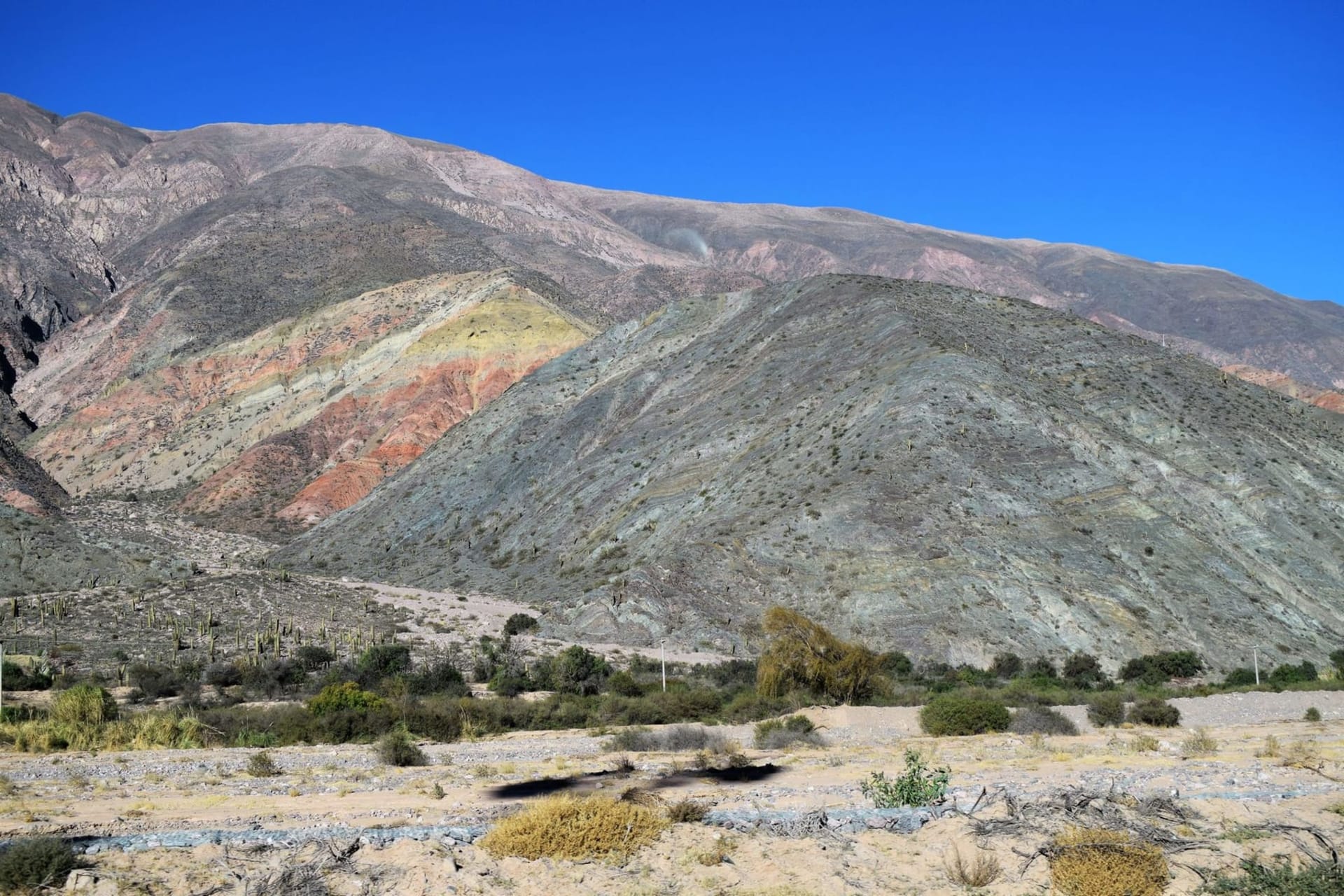
A UNESCO-listed Andean gorge in Jujuy with villages of mud and straw, colonial churches, and mountains in fourteen colors.
We drove north from Jujuy city on Ruta Nacional 9 as the valley walls closed in around us. The road followed the Río Grande upstream, past Purmamarca with its famous Cerro de Siete Colores, past roadside stands selling quinoa and llama jerky wrapped in paper. By the time we pulled into Humahuaca itself — the gorge’s main town, the one that gives the quebrada its name — the afternoon light had already turned the mountains behind us a shade I had no word for. Somewhere between rust and embers.
Adobe and Altitude
Humahuaca sits at 2,940 meters. I felt it in my temples before I felt it in my legs. The streets — Calle Buenos Aires, Calle Corrientes — are narrow and unpaved at the edges, the kind of streets where a donkey loaded with firewood is not a surprise. The buildings are mud-brick, low, painted in pigments that look borrowed directly from the hillside: terracotta, bone white, a faded colonial yellow. The Catedral de Nuestra Señora de la Candelaria stands at the top of a long staircase on the main plaza, its whitewashed facade catching the late sun like a struck match.
We ate at a small comedor off the market square. Locro, the Andean stew of white corn, pork, and squash, arrived in a clay bowl that was still bubbling. Lia wrapped her hands around it and said nothing for a full minute. Sometimes silence is the most honest review.
The Mountain That Wouldn’t Stay Still
I had read about the Cerro de los Siete Colores at Purmamarca before arriving. What I had not read, and what nobody warned me about, was the Serranía del Hornocal — the Hill of Fourteen Colors — reachable by a dirt track that climbs to 4,350 meters above sea level. We went at sunrise, before the tour vans. Standing at the mirador in near-silence, I watched the light migrate across the ridges, igniting each mineral layer in sequence: chalk, sulfur, copper oxide, iron. The colors did not sit still. They shifted with every cloud that crossed the sun, every degree the morning advanced. I stopped counting at fourteen because the mountain had already started over.
The surprise was not the colors themselves. It was that they made me feel watched — as if the geology was the subject and I was the ornament.
Getting the Timing Right
We went in June, which turned out to be exactly right. The dry season — roughly May through October — is when the altiplano skies go cloudless and the afternoon light turns the mountains to stained glass. We’d heard Carnival week in February is worth the trip for the spectacle, but also exhausting in ways you can’t fully prepare for. I’ll take the quiet months.
When to go: May through August offers the clearest skies and the most dramatic light on the colored mountains, with cold nights and warm, dry days. Get to the Serranía del Hornocal at first light — an hour later and the tour groups will have already found you.
What most guides get wrong: Every article leads with the Cerro de Siete Colores in Purmamarca, which is beautiful, but it’s also ringed by souvenir stalls and visited by every bus that passes through. The Serranía del Hornocal is harder to reach, requires your own transport up a steep dirt track, and at 4,350 meters will make you breathe slowly and speak carefully — but it’s the one I still think about.