
El Chalten
"Fitz Roy appears through the clouds like a hallucination — too dramatic to be real."
Argentina's trekking capital — a tiny village beneath the jagged spires of Mount Fitz Roy.
El Chalten is less a town than an agreement — and the moment Lia and I arrived, we understood it immediately. A handful of streets, a few dozen buildings, a scattering of hostels and brewpubs: that’s all anyone has decided is necessary to serve as base camp for some of the most dramatic mountain scenery on Earth. Founded only in 1985, partly as a sovereignty gesture in a border dispute with Chile, it has since become Argentina’s official trekking capital, and every person we crossed on those streets had the same look — muddy boots, full memory cards, something faraway in the eyes that hadn’t been there before.
The reason for all of it — the town, the trails, the pilgrimage — is Monte Fitz Roy. Rising to 3,405 meters, its granite spires pierce the Patagonian sky with a violence that feels both geological and personal. The mountain spends much of its time hidden behind cloud, which only amplified the impact the first time I watched it reveal itself. Climbers I spoke to in the hostel described that moment — seeing Fitz Roy clear — as something closer to a religious experience than a scenic view. The Tehuelche people called it Chalten, the smoking mountain, for the clouds that perpetually wreathe its summit, and I kept coming back to that name. It carries an animist accuracy the European one simply does not.
The classic trek to Laguna de los Tres is the signature experience, and I did it twice — once to see it, once because I couldn’t help myself. The trail climbs steadily from the village through lenga forest, crosses open steppe with the Fitz Roy massif growing larger with every kilometer, then makes a punishing final ascent up a moraine wall. My legs were burning by the time I reached the top. And then I stopped thinking about my legs. A milky turquoise glacial lake, cradled in a cirque of granite, with Fitz Roy and its attendant spires — Poincenot, Rafael, Saint-Exupery — towering directly above. The image is so iconic it was adopted as the logo for the Patagonia clothing brand, and yet standing there, I understood why no photograph has ever quite captured it. The scale defeats the lens. The silence defeats the caption.
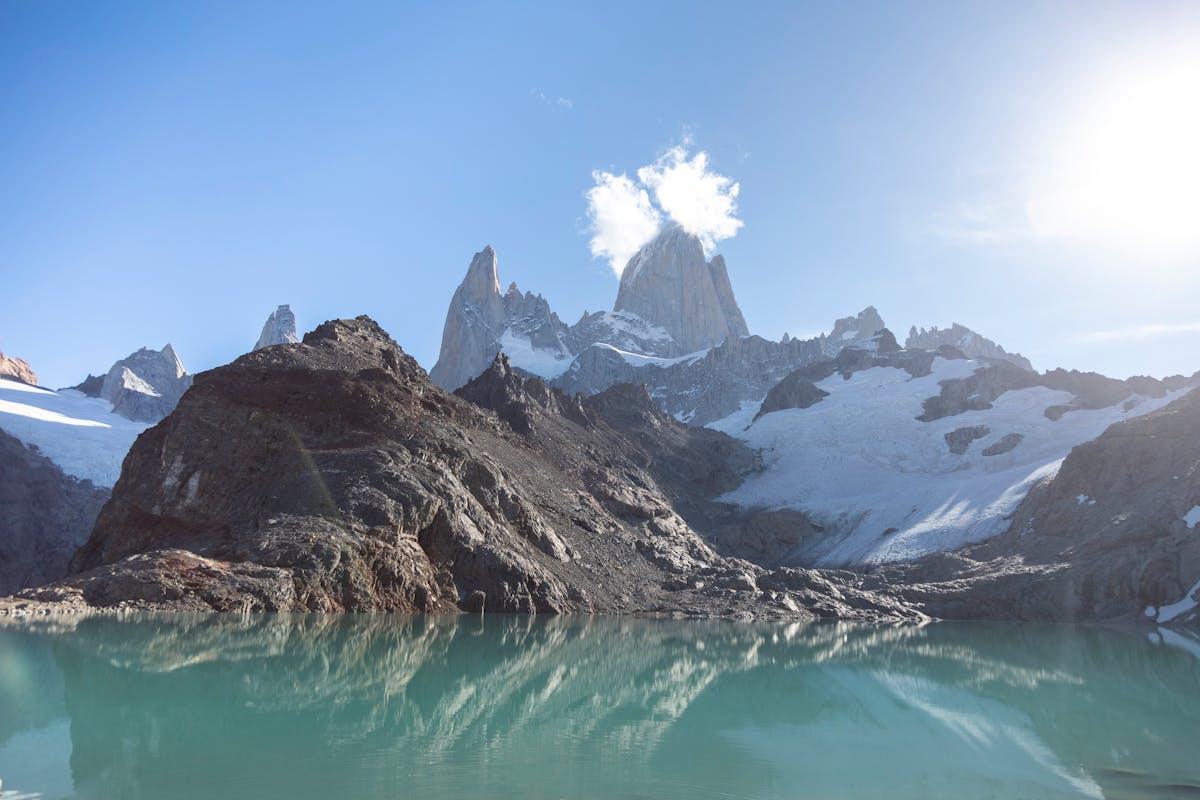
On the second visit, Lia and I set our alarm for 4 a.m. and hiked the final stretch by headlamp in the dark. Cold, stumbling, questioning the decision. Then the alpenglow hit — the first light of day striking Fitz Roy’s east face and turning the granite from grey to gold to a deep, burning rose. It lasts only minutes. The crowd of hikers around us watched in a hush that bordered on reverence, and I felt it too: the particular silence of people witnessing something they know they’ll spend years trying to describe. I’ve seen a lot of sunrises. That one was different.
The trek to Laguna Torre, on the other side of the valley, offered a completely different character. I did it on a grey afternoon when the forecast looked uncertain, and I don’t regret it. The trail follows the Rio Fitz Roy through forest and along a windswept valley to a lake at the base of Cerro Torre — a needle of rock so improbable that its first claimed ascent in 1959 remains disputed to this day. Cerro Torre is thinner than Fitz Roy, more gothic, more openly defiant of gravity, and the glacier calving into the lake at its feet added a dimension of cold, blue drama that felt less like a hike and more like a reckoning.
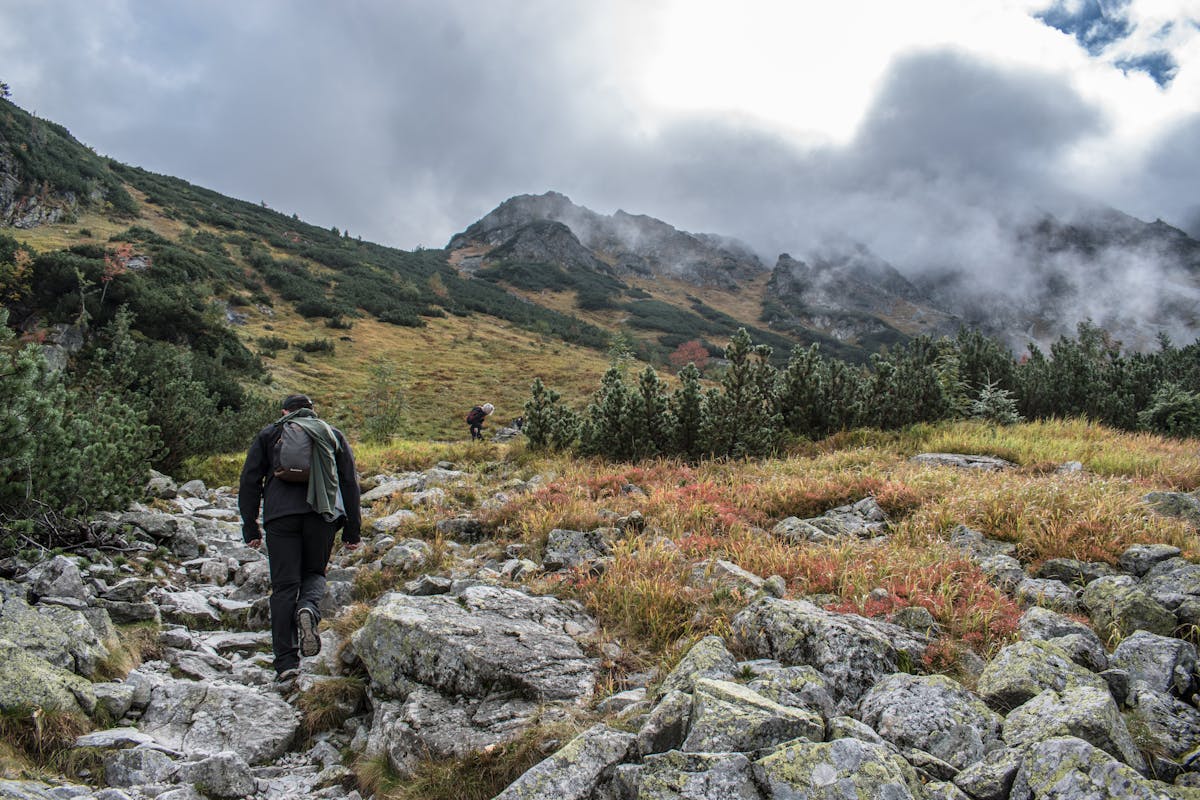
I didn’t attempt the Huemul Circuit — a challenging four-day loop with glacier crossings, tyrolean traverses over rivers, and stretches of unmarked terrain — but I met people who had, and they all spoke about it the same way: quietly, carefully, like something had changed. It’s not for beginners, and it offers a solitude and rawness that the day hikes simply cannot match. A reminder that beyond the well-trodden paths, Patagonia remains genuinely wild and genuinely indifferent.
The village itself surprised me with its warmth. After a day on the trails, Lia and I would converge with everyone else on the handful of restaurants and cervecerías, and strangers became companions over plates of Patagonian lamb and pints of craft beer brewed with glacial water — a detail that sounds like marketing but somehow tastes true. Gear dried on every available railing. Trail conditions were discussed with the seriousness of weather reports. And through it all, the mountains loomed at the end of every street, visible from every table, present at every conversation, reminding everyone — including me — why they had come.
When to go: October through March offers the best hiking conditions, with the longest days and most accessible trails. January and February are peak season, bringing crowds but also the most stable weather windows. I went in late November and found a reasonable middle ground — some wind, some clouds, and enough trail space to feel like the mountains were mine. Wind is a constant companion in Patagonia and can be fierce; always carry layers, rain gear, and genuine patience. Shoulder months offer thinner crowds but less predictable skies.
What most guides get wrong: Every guide tells you to do Laguna de los Tres. None of them tell you to do it twice. The first time you arrive and your brain can’t fully process it. The second time, a day or two later, you actually see it. If your schedule allows even one extra day, use it for a second pass — early morning for the alpenglow, or a late afternoon when the afternoon light goes gold on the rock face. The mountain is different every hour. That’s not a cliché. I watched it change from our hostel window every morning and it was never the same twice.