
There is a moment, arriving in Salta’s central plaza at dusk, when the cathedral facade catches the last amber light and the surrounding colonial buildings seem to exhale the warmth they have stored all day. This is a city that has earned its nickname — Salta la Linda, Salta the Beautiful — not through grand spectacle but through an accumulation of quiet graces: wrought-iron balconies trailing bougainvillea, terracotta rooftops stepping up the hillsides, and a pace of life that still bends around the afternoon siesta. The teleferico rises from the city center to the summit of Cerro San Bernardo, where the entire valley unfolds below — a bowl of green ringed by the first rumpled foothills of the Andes.
But Salta’s deepest magic lies beyond the city, in the vast and ancient northwest. The Quebrada de Humahuaca, a UNESCO World Heritage Site, carves a canyon through millions of years of geological time. Its walls display sedimentary layers in rust, ochre, violet, and cream — a stratigraphy so vivid it looks hand-painted. At Purmamarca, the Cerro de los Siete Colores rises above the village like a geological hallucination, its seven distinct mineral bands shifting in tone with the hour and the angle of the sun. Vendors spread textiles across the dusty plaza below, their woven llamas and condors echoing patterns that predate the Spanish arrival by centuries.
Higher still, the Tren a las Nubes — the Train to the Clouds — crosses the Polvorilla Viaduct at over four thousand meters, a steel arc suspended above a silent desert canyon. The journey from Salta climbs through cactus-studded valleys and past remote settlements where the air thins and the sky deepens to an impossible cobalt. It is one of the highest railways on Earth, and the landscape it traverses belongs more to the altiplano than to anything recognizably Argentine.
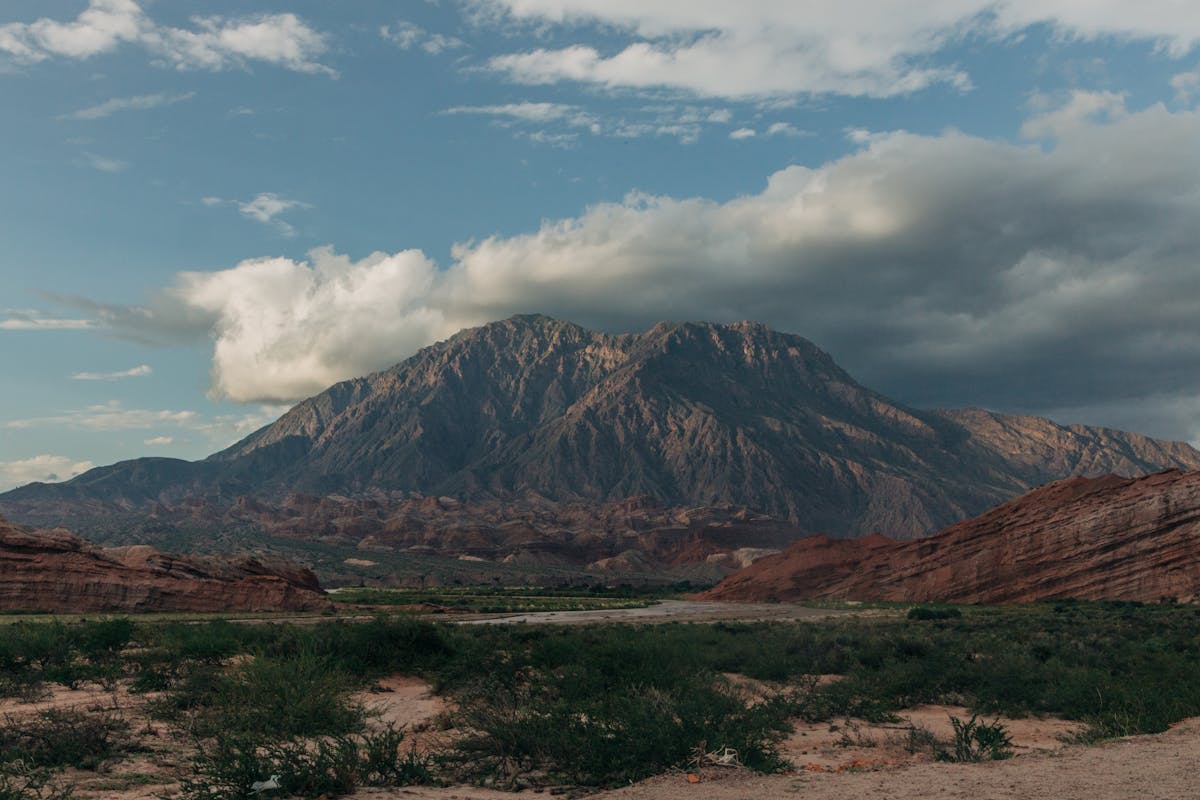
To the south, the Valles Calchaquies open into wine country of a very different character from Mendoza. Cafayate sits at the heart of this region, its vineyards threaded along the valley floor at altitudes that produce Argentina’s finest Torrontes — a white wine of bright floral aromatics that thrives nowhere else quite so well. The Quebrada de las Flechas, on the road from Salta, channels travelers through corridors of tilted rock that jut from the earth like petrified fins, a geological drama that makes the drive itself an event.

Back in the city, the culinary tradition centers on the empanada saltena — baked rather than fried, filled with seasoned beef, hard-boiled egg, olive, and potato, crimped by hand along the edge. Every family claims a superior recipe; every corner bakery proves them partially right. In the evenings, the penas — folk music venues tucked into colonial courtyards — fill with the sound of bombo drums and charangos, keeping alive the Andean musical traditions that connect this corner of Argentina more closely to Bolivia and Peru than to Buenos Aires.
The colonial architecture of the city center rewards slow wandering. The Iglesia San Francisco, with its towering terracotta bell tower, is among the most photographed churches in Argentina. The MAAM museum houses the remarkably preserved Llullaillaco mummies, Inca children found at the summit of a six-thousand-meter volcano — a haunting encounter with the deep past of these mountains. Salta is a city that serves as both destination and doorway, beautiful in its own right and gateway to a northwest that feels like another continent entirely.
When to go: April through November offers dry skies and comfortable temperatures, ideal for exploring the quebradas and high-altitude routes. July is peak season with cool, crisp days. Summer (December through March) brings heavy rains that can wash out mountain roads and obscure the views that make this region extraordinary.