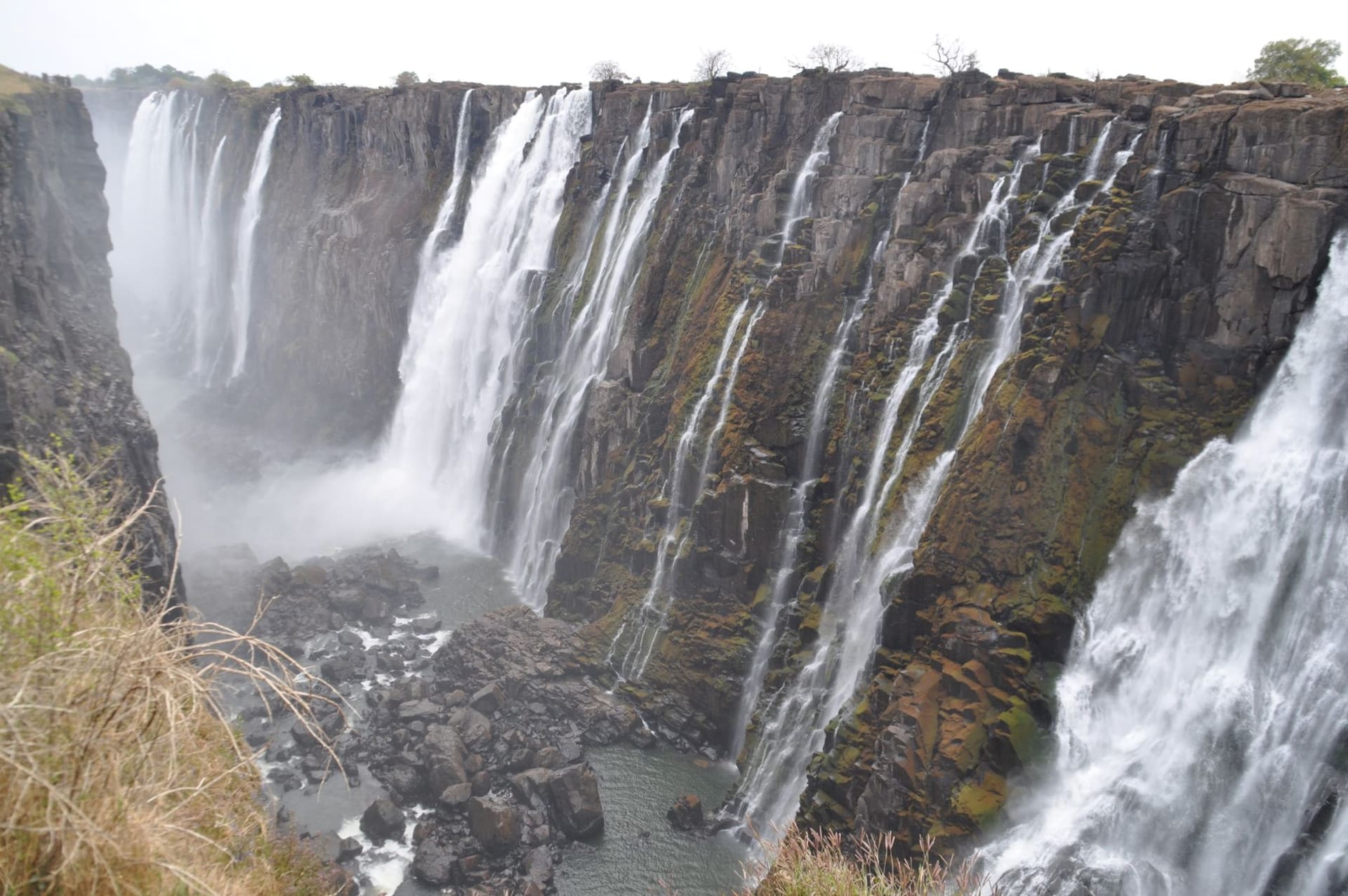
Kalandula Falls
"The sound reaches you before the view does. That's how you know it's serious."
One of Africa's largest waterfalls by volume — the Lucala River's entire force dropping 105 metres in a wall of water that you feel before you see.

The falls announce themselves acoustically. We were still a kilometre away, driving through dense miombo woodland on a red laterite track, when I heard it — not heard, exactly, but felt: a low vibration in the air that became progressively louder until it was not background sound but the only sound, and then the trees opened and the Lucala River was suddenly below us, all 400 metres of its width, falling 105 metres into the gorge in a continuous wall of churning white water. My driver had made this trip before. He did not say anything. He just stopped the car and left the engine off and let the falls explain themselves.
Kalandula is the kind of scale that photographs consistently fail to communicate. The falls are approximately 400 metres wide and drop 105 metres — numbers that place them among Africa’s largest by volume, behind Victoria and a handful of others. But the numbers matter less than the experience of standing at the rim, where the mist comes up so fast and thick that within a minute you are wet to the skin without rain, and the spray has its own wind, and the air tastes like stones and water and something mineral that the earth gives up under pressure.

The access to Kalandula is part of the experience. The falls are about 360 kilometres south of Luanda, near the provincial capital of Malanje, and the journey involves stretches of unpaved road through north-central Angola’s woodland interior — a landscape that doesn’t get much attention from travel writers, which is their loss. The miombo woodland here is extraordinary in the rainy season, when it goes vivid green and the rivers run full and the ground is covered in wildflowers, but even in the dry season the woodland carries a quiet richness: weaverbird nests hanging from umbrella thorns, bright birds cutting across the track, villages where children sprint alongside the car for the sheer pleasure of running.
We arrived in the late afternoon, which was both accidental and fortunate. The light at that hour hits the mist from Kalandula at an angle that produces a consistent rainbow — not the occasional, tentative rainbow of other waterfalls but a fixed arc that sat in the spray for the full hour I stood there watching it. The gorge below the falls is not visible from the upper viewpoint; the mist is too thick. You know there is a river down there, receiving all that water, but you take it on geological faith. The sound is the proof.

There is a small campsite near the falls and the option of a guesthouse in Malanje, which is a city worth pausing in for its own reasons — a compact provincial capital with a covered market where the produce is extraordinary, the highlands having been Angola’s breadbasket for centuries before and after the war. I ate dinner in Malanje at a place that served mutuá — a fish stew made with fresh river fish, tomato, and dendê — with funge, the stiff cassava porridge that Angola runs on, and went to sleep under a ceiling fan with the sound of the falls still moving through my memory.
When to go: The falls are most dramatic during or just after the rainy season (November through April), when the Lucala carries its full volume and the falls reach their greatest width and force. However, the access roads are significantly more difficult in this period and require 4WD. The dry season (May through October) offers easier access and clearer views with less mist — but the falls are still impressive. The late afternoon light in any season produces the rainbow in the spray; plan to arrive by 4pm.
Keep exploring
More from Angola
 angola
Kissama National Park
A park rebuilt from near-zero after the civil war, where elephants flown in from Zimbabwe now roam a landscape learning to remember itself.
Explore angola
Luanda
Angola's capital roars with diesel, music, and salt air — a city of staggering contradictions that somehow coheres into something magnificent.
Explore angola
Lubango
Angola's highland city sits at 1,700 metres where the air is cool, the light is extraordinary, and a giant Christ statue keeps watch over the whole plateau.
Explore angola
Miradouro da Lua
An eroded badland of ochre cliffs about forty kilometres south of Luanda, where wind and rain have carved the earth into something that looks convincingly like the surface of the moon.
Explore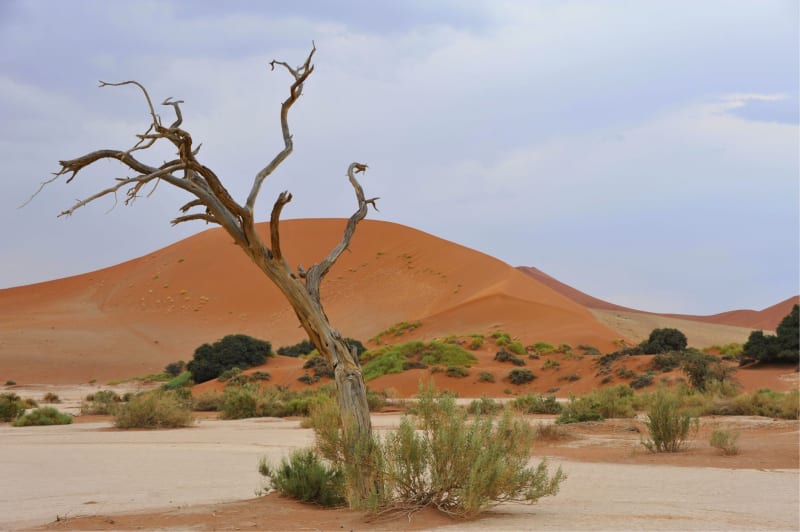 angola
Namibe
Where the Namib Desert walks into the Atlantic Ocean — a fishing town at the edge of everything, scrubbed clean by wind and indifference.
Explore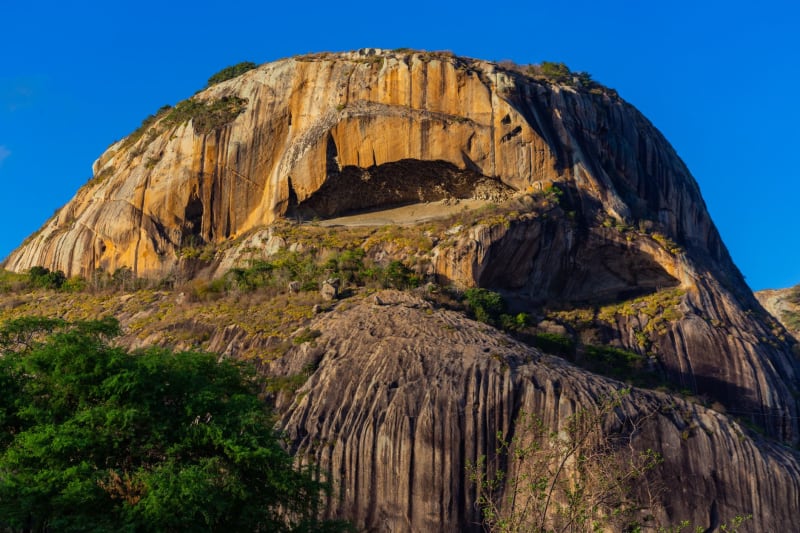 angola
Pungo Andongo
Giant black granite monoliths rising from the savanna where Queen Nzinga held her resistance — geology and history occupying the same strange ground.
Explore