Sultanhanı Caravanserai
"Eight hundred years of Silk Road traffic and I had the entire courtyard to a stork."
I drove out from Aksaray on a road that ran dead straight across the steppe, the kind of road that makes you feel the plateau has been measured and found to be exactly as flat as it looks. After forty kilometres of this, Sultanhanı appeared on the left — a stone mass in the middle of nowhere, low and long and slightly beige against the bleached summer grasses. I had read that it was the largest caravanserai in Anatolia and the third-largest Seljuk caravanserai in the world, but none of those facts had prepared me for the gateway. The portal rises maybe fifteen metres, carved limestone covered in interlaced geometric and floral relief so dense it looks embroidered rather than chiselled. I stood there long enough to become self-conscious about it.

The caravanserai was built in 1229 under Sultan Alaeddin Keykubad I of the Seljuk Sultanate of Rum. The logic of it is exactly what you’d expect from a sophisticated state taking trade seriously: stations every forty kilometres along the main routes — a day’s journey for a loaded caravan — where merchants and their animals could rest, eat, and be safe for free, courtesy of the Sultan. Sultanhanı was the relay between Konya and Kayseri, one of the busiest stretches of the Silk Road’s Anatolian arc. On the afternoon I visited, I had the entire complex to myself, except for a stork that had nested in one of the towers, standing motionless on one leg while I walked beneath it. This detail, absurd and perfect, is the one I keep returning to when I think about what it means for a place to have outlasted its purpose.
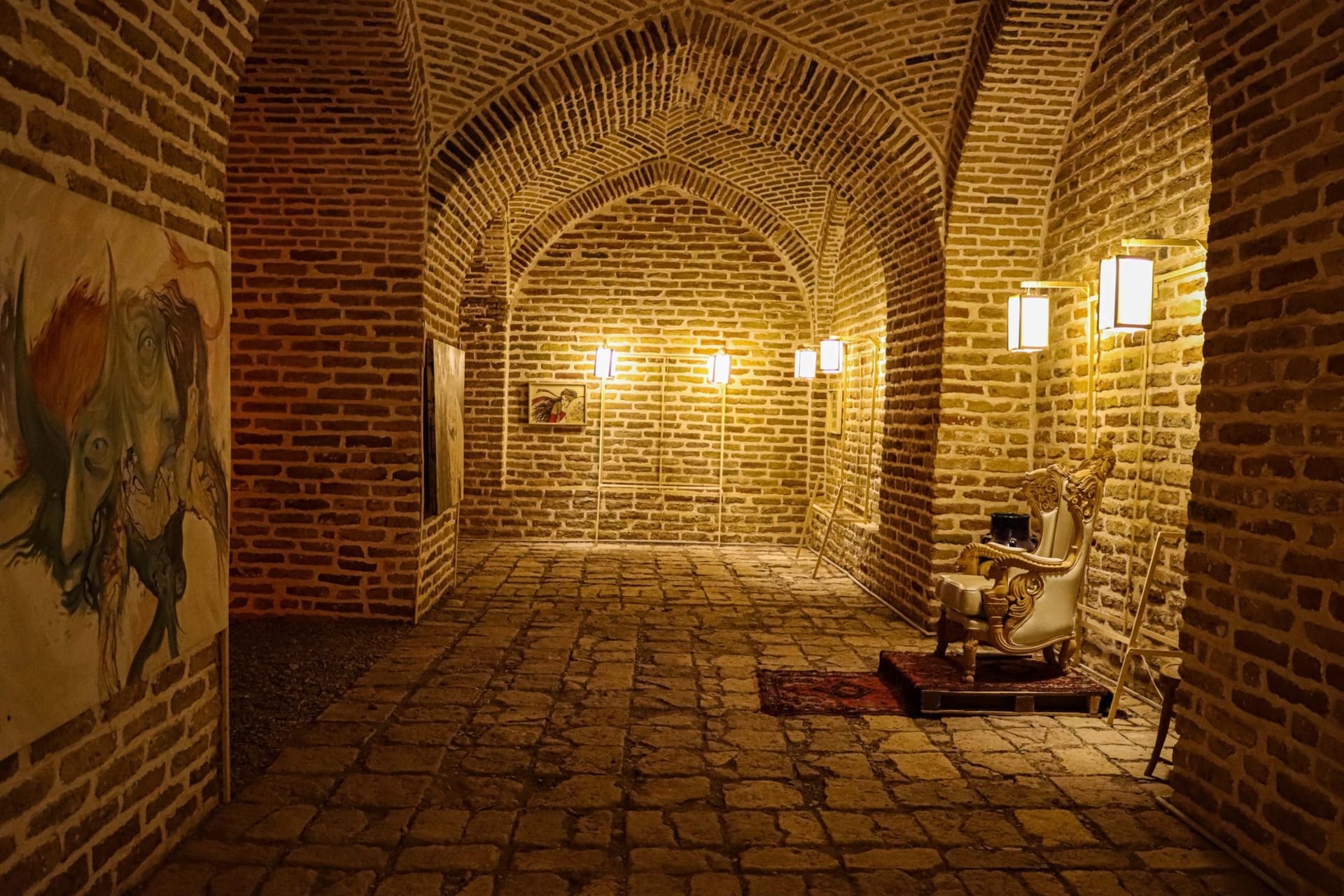
The interior divides into an open courtyard and a covered hall. The courtyard once housed animals — camels, horses, mules — in the surrounding stalls, and the central kiosk mosque on its raised platform provided religious services at all hours. The covered hall, a forest of stone arches dimming toward the back, was for merchants and their goods. The stone is thick and the temperature inside drops immediately. Even in August, standing in the middle of the hall with the arches receding in both directions and the light from the central lantern tower falling in a long cone, it felt genuinely cool.
There is a small ticket office and a modest café that appeared to be selling çay primarily to the man running it. The restorations, which have gone through several phases, have stabilised most of the structure without overpolishing it — the stone still looks like stone, not like a reconstruction. I spent nearly two hours here, which is either a lot or a little depending on your relationship to places that have simply endured. The stork flew off as I was leaving, heading southeast toward the steppe with a slow, mechanical wingbeat, and I watched it until it became too small to follow.
When to go: April through October is accessible; the site is open year-round but winter visits mean cold stone and limited services. Spring and autumn mornings offer the best light on the portal stonework. Combine with the Ihlara Valley for a full day — Aksaray is 45km west.