Ghardaïa
"In the M'zab Valley, the 11th century didn't end — it just found somewhere quieter to continue."
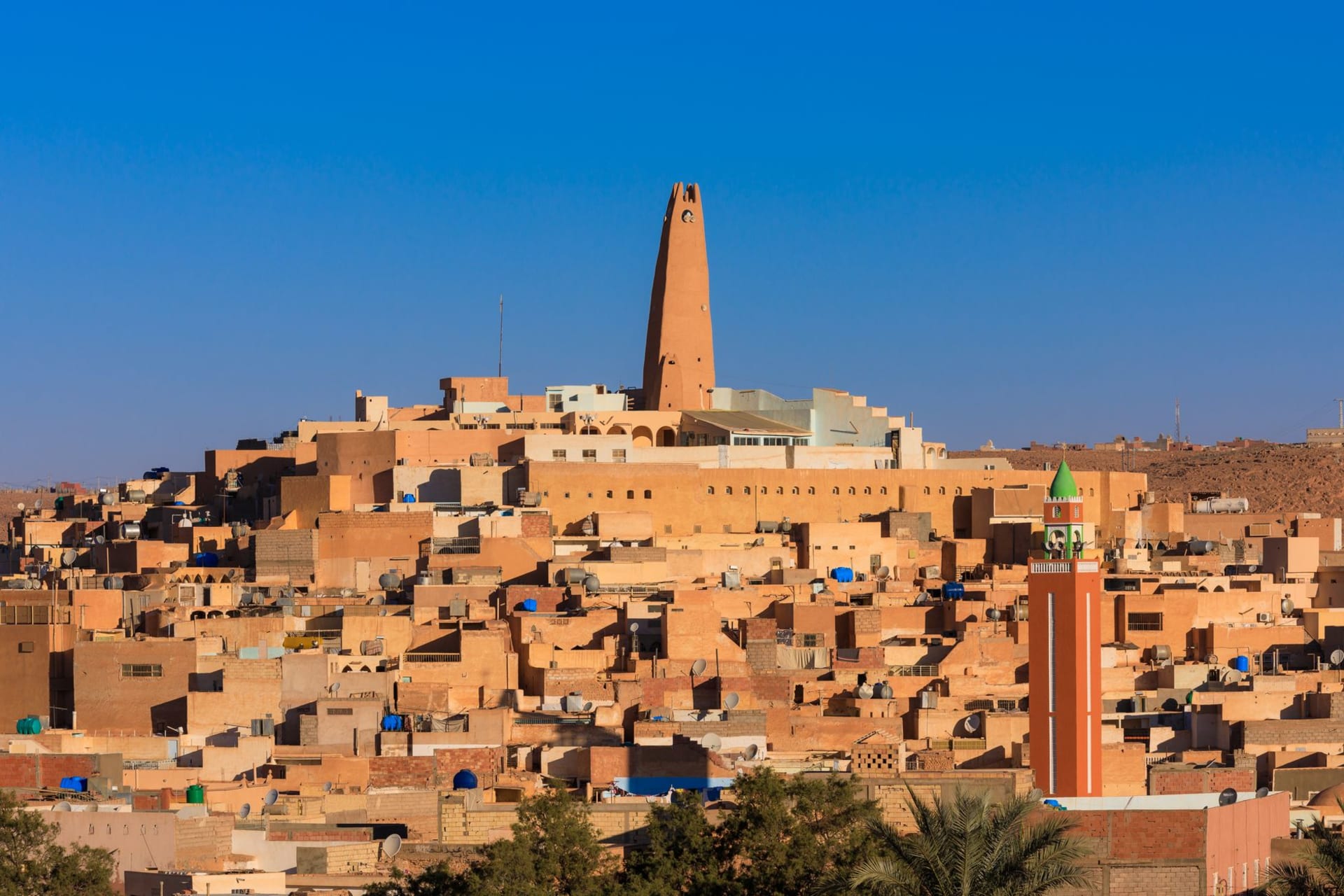
The valley appeared below me as I crested the road from Algiers — a deep ochre cut in the desert floor, and inside it, five towns rising in concentric circles around their mosques like something grown rather than built. I had read the descriptions: UNESCO, Ibadi Islam, Mozabite architecture, the remarkable preservation. None of it prepared me for the visual impact of Ghardaïa from above, which is the only way to actually see it. The town looks like it was dreamed up by someone trying to solve the problem of collective living in a desert with no margin for error — every curve of the alley, every shared wall, every pointed minaret placed with a precision that takes on different meanings once you understand it wasn’t aesthetic but survival.
The Mozabite people have lived in the M’zab for a thousand years. They’re a distinct Berber community following the Ibadi strain of Islam — older, stricter in some ways, but organized around a communal logic that produces what I can only call functional beauty. The streets are designed to channel winter floods down specific routes. The buildings share walls to minimize heat absorption. The mosque rises at the highest point of each town not only spiritually but practically, as a navigational anchor visible from anywhere below. Everything has a reason, and the reasons are the aesthetics.

The market was where it got complicated and wonderful. The Ghardaïa market has operated on roughly the same terms since the 11th century — not as a slogan, but as a demonstrable fact. Merchants sit in the same family stalls their grandfathers occupied, selling spices in cones of paper, silver jewelry worked in patterns I couldn’t find in any other Algerian market, dates in five different varieties laid out in baskets. There’s a silence in the market that surprised me — not an unfriendly silence, but a mercantile focus, a sense that the transaction deserves attention. I bought saffron and a small silver bracelet and felt like I’d stumbled into a trading economy that predated everything I considered normal about commerce.

I spent two days walking between the five towns of the M’zab — Ghardaïa, Melika, Bou Noura, El Atteuf, Beni Isguen — each separated by a few kilometers and each with its distinct character. Beni Isguen was the most traditional, its gates actually closed at sundown, entry for outsiders restricted. Even standing at the edge of it I felt the logic: some things stay intact precisely because they’re allowed to remain closed. Melika, climbing its hill above a white cemetery, was the one that stopped me completely. At dusk the light came in sideways and the town turned copper and everything was very still, and I had the uncanny feeling that the town was entirely indifferent to whether I found it beautiful or not.
When to go: October through March, when the desert air has cleared and temperatures are manageable. The early morning market in Ghardaïa opens before six and winds down by eleven — get there early. Summer is brutal; the M’zab Valley amplifies the Saharan heat into something genuinely dangerous.