
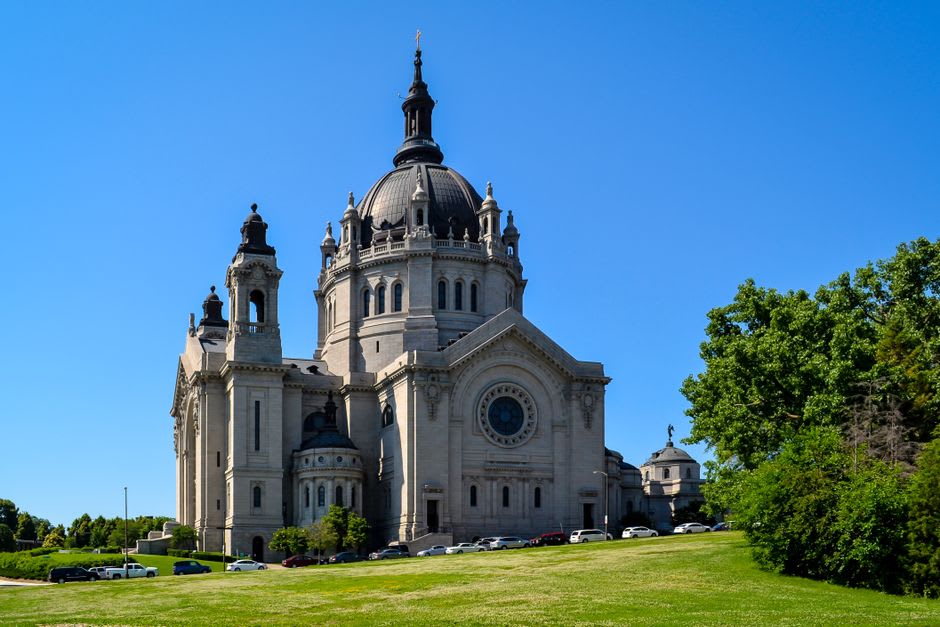
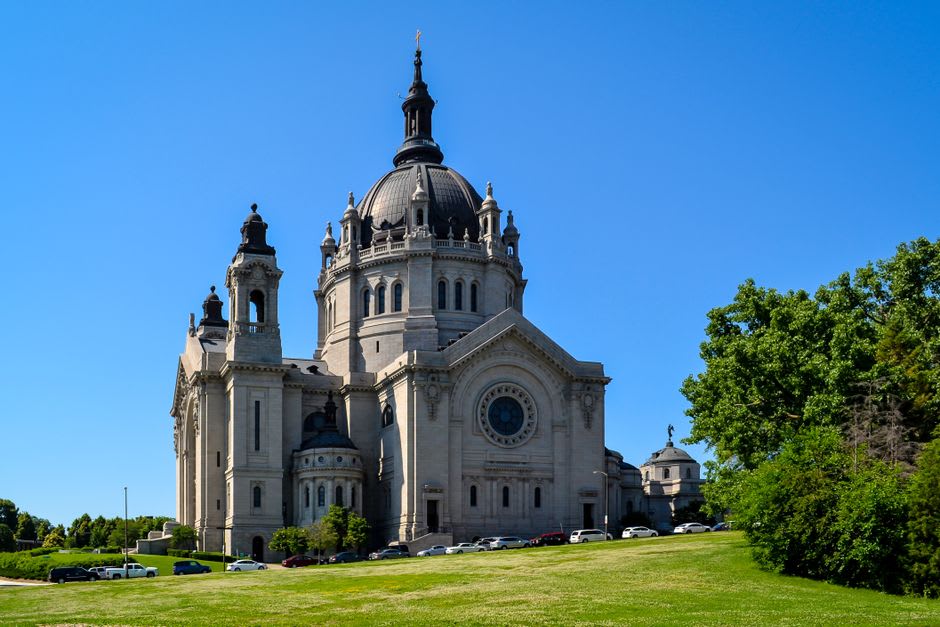
People kept telling us to skip St Paul for its flashier twin, and I am glad we ignored them. There is a moment coming up Summit Avenue when the Cathedral of Saint Paul rises above the trees, an enormous domed thing modeled on the great churches of Europe, and Lia actually stopped walking. It looks transplanted, too grand for a Midwestern hill, until you learn how much money and ambition flowed through this river town in its heyday. St Paul wears its history openly, in stone and elm and mansion, and it rewards the traveler willing to simply walk and look up.
The Cathedral and the Capitol on their hills
The Cathedral of Saint Paul and the Minnesota State Capitol face each other across a shallow valley, two domes staring one another down, church and state made literal. We climbed to the cathedral first, where the interior opens into a vast cool hush beneath the dome, then walked over to the Capitol, a gleaming white building topped by a gilded quadriga, four golden horses catching the sun. The walk between them is short and deliberate, laid out by city planners who wanted you to feel the weight of both. On a clear morning it is genuinely moving, all that ambition rendered in marble.
Summit Avenue and the Gilded Age
Summit Avenue runs for miles as one of the longest stretches of intact Victorian mansions in the country, a boulevard of stone and turret and wraparound porch shaded by old elms. F. Scott Fitzgerald grew up on a row house here, and you can still find it, plaque and all. Lia and I walked a long section in the late afternoon, reading the architecture like a novel, imagining the lumber and railroad fortunes that raised these houses. It is a strange, lovely thing, a residential street you visit as a monument, and it stays quiet enough that walking it feels almost private.
The riverfront and Mears Park
Down the hill, St Paul meets the Mississippi that made it, and the riverfront has been slowly reclaimed for walking, with paths along the bluffs and views across the wide brown water. We wandered into the Lowertown district, an old warehouse quarter now full of artists’ studios and cafes, and found Mears Park, a small green square with a stream running through it where office workers ate lunch on the grass. It is the human-scaled counterpoint to all those grand domes and avenues, the everyday city, and after a day of monuments we were glad of a bench and a coffee among ordinary people.
Getting There
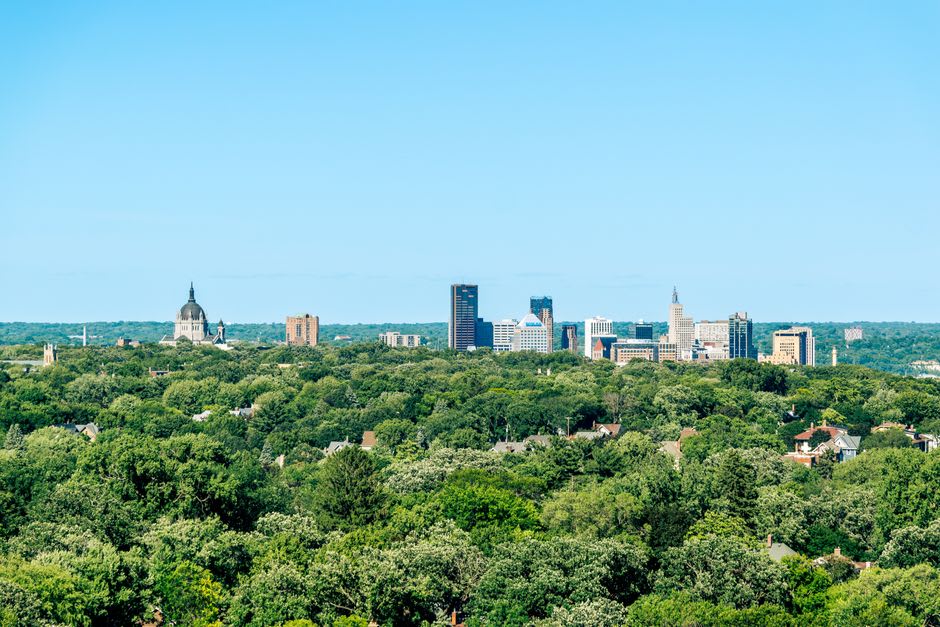
St Paul shares the Minneapolis-Saint Paul International Airport with its twin, a fifteen-minute drive southwest of downtown and one of the better-connected hubs in the country. The two cities are joined by the Metro Green Line light rail, which runs directly between their downtowns, so you can base in either and reach the other without a car. St Paul’s core, from cathedral to riverfront, is walkable if hilly, though a car helps for the length of Summit Avenue. We gave it two days and found the quieter twin the one we kept thinking about afterward.