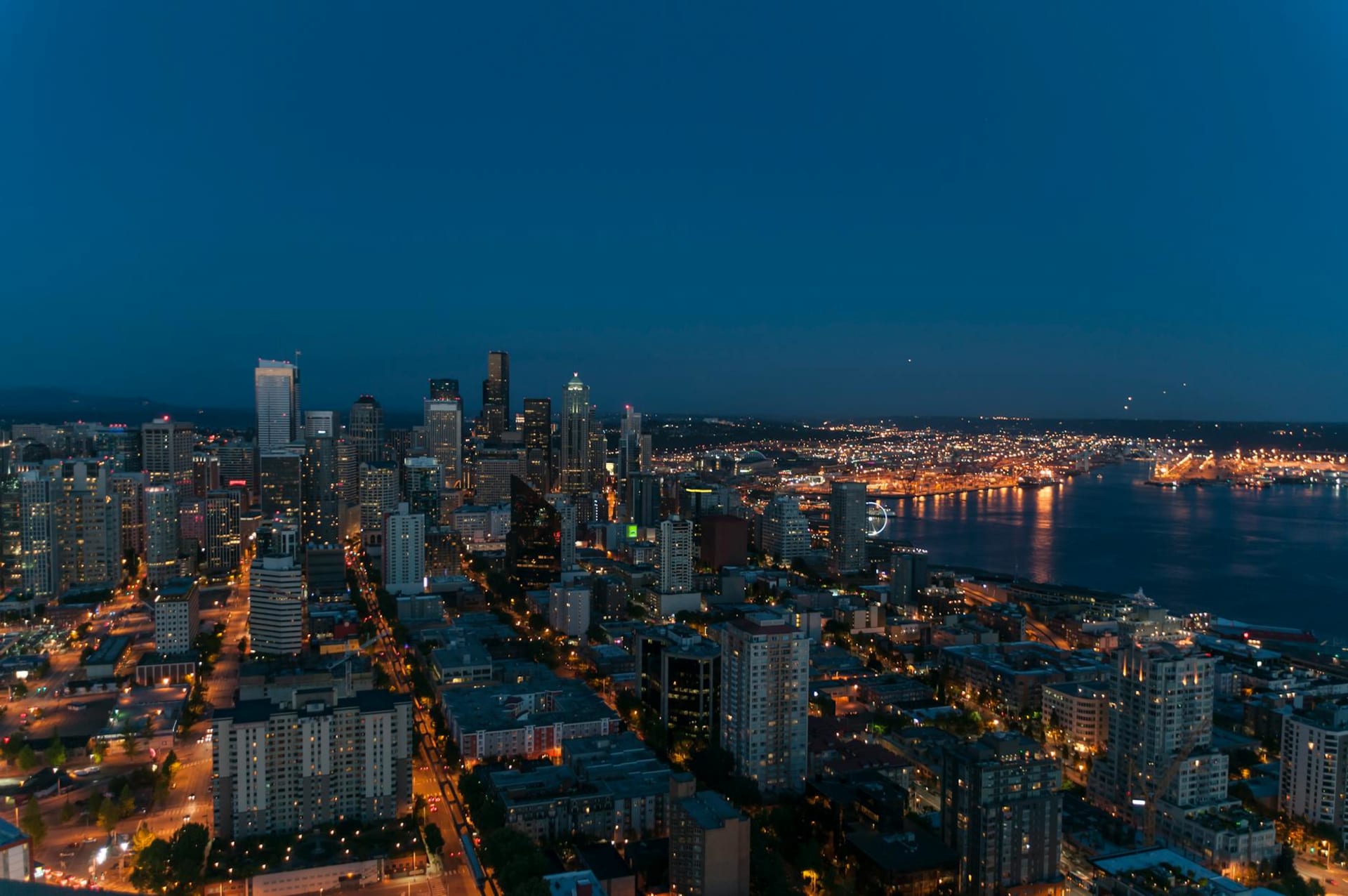
Seattle
"Seattle thrives under a sky that other cities would call an excuse to stay inside."
I arrived in Seattle on a Tuesday in November, which is to say I arrived in Seattle at its most itself. The rain was not dramatic — no thunder, no sheets — just a fine persistent mist that settled on my jacket and turned the streets of Capitol Hill into something lacquered and dark. I walked up Pike Street with my hands in my pockets and felt, strangely, welcome.
Pike Place and the Smell of Everything
Pike Place Market doesn’t smell like flowers, though there are flowers everywhere — dahlias piled six bunches high at the corner stalls, tulips in buckets, ranunculus spilling onto the wet brick. It smells like brine and fish guts and roasting coffee and the yeast coming off the Bavarian Meats stall. It smells honest. I got there early, before the tour groups, when the fishmongers were still arranging their halibut and the produce vendors were unboxing blood oranges from California. I bought a paper cup of Dungeness crab bisque from a counter near the north arcade and stood outside in the drizzle eating it with a plastic spoon, watching the ferries move across Elliott Bay.
Lia found me there twenty minutes later, holding a paper bag of warm Piroshky Piroshky pastries — potato and cheese, still steaming — and we sat on the edge of the market overlooking the water and ate without talking, which is its own kind of conversation.
Capitol Hill and the Coffee Ritual
Seattle’s relationship with coffee is not a trend. It’s structural. On Melrose Avenue, I walked past four independent cafés in two blocks and stopped at Analog Coffee, where the barista was reading Ursula K. Le Guin between orders. I drank a pour-over of a Kenyan washed natural that tasted like bergamot and red plum, and I understood for the first time why people in this city seem unbothered by the grey. They’ve built an indoor life of extraordinary warmth.
What surprised me was how quiet Capitol Hill gets by mid-morning on a weekday — the bars shuttered, the restaurants set up but empty, the hill almost sleepy. I’d expected noise. Instead I found bookshops and record stores and an easy, unhurried pace that had nothing to prove.
When the Mountains Appear
On my third day, the clouds broke. I was on the waterfront near the Olympic Sculpture Park when Mount Rainier appeared in the southeast — enormous, white, completely improbable above the roofline. It doesn’t look real. Locals call it “The Mountain” without needing to say which one, and the day it shows itself, everyone in the city seems to tilt their face toward it like a collective exhale.
When to go: Late spring through early September brings the clearest skies and the longest light, with golden evenings that stretch past nine o’clock. Come in autumn or winter if you want the city undiluted — fewer crowds, cheaper rooms, and a sky that teaches you to look closer at everything beneath it.