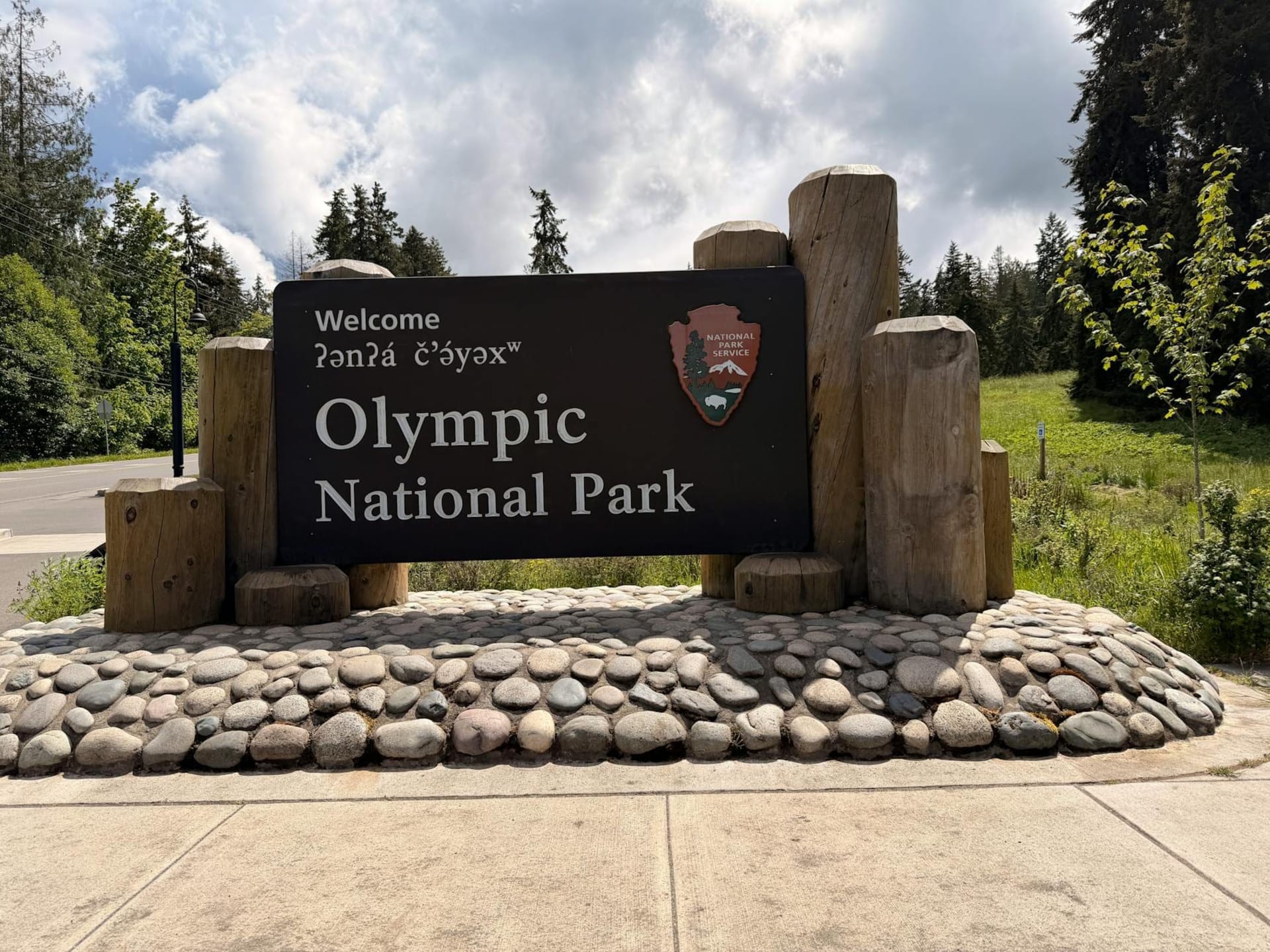
Olympic National Park
"Three worlds — forest, mountain, and sea — sharing one remarkable peninsula."
I’ve been inside many forests. I thought I understood what a forest was. Then I walked into the Hoh Rain Forest on a grey November morning and had to revise every assumption I’d built up over thirty-four years.
The Forest That Rewrites You
The Hoh receives nearly four meters of rain a year. The result is not simply dense vegetation — it is an entire atmospheric condition. Bigleaf maples along the Hall of Mosses Trail carry more moss than leaf, their branches draped in curtains of club moss that hang like slow green exhales. The light that reaches the forest floor has passed through so many layers of canopy that it arrives diffuse and olive-tinted, the kind of light that seems to come from nowhere. I walked with Lia in near silence for an hour. Not because we agreed to — there was just nothing to say that felt equal to it.
The Hoh River Trail continues inland toward Mount Olympus for nearly 30 kilometers. We went only as far as the first river crossing before turning back, but the quality of the silence deepened with every mile. Roosevelt elk move through this forest like rumors — you smell them before you see them, that specific musk of large animal and wet bark.
The Mountains Above the Clouds
Hurricane Ridge is accessible from Port Angeles in under an hour, and the elevation gain is so abrupt it reads as a small violence. The parking lot sits at 1,600 meters. On clear days the Olympic Mountains lay out their full argument: glaciated summits, snowfields that hold their blue tint even in afternoon sun, meadows of subalpine wildflowers that bloom precisely because the season for it is so compressed. Mount Olympus at 2,432 meters is technically climbable but demands serious glacier travel — I watched its icefield from the ridge trail and felt satisfied just knowing it was there.
What I didn’t expect: the marmots. Fat, indifferent, perched on boulders like small philosophers, they watched me pick my way along the Sunrise Ridge Trail without any visible concern. Something about being regarded so calmly by a wild animal shifts the power dynamic in your favor.
The Coast That Belongs to No One
The Olympic coast is federal wilderness — no roads parallel it, almost no development touches it. At Ruby Beach, Route 101 finally descends to sea level and you walk out onto a shore of sea stacks and driftwood piles the size of small buildings. The Pacific here is not the warm, invitation-issuing Pacific of southern California. It is cold, grey-green, and completely serious. Tidal pools at the base of the stacks hold purple urchins, ochre sea stars, hermit crabs navigating their slow dramas. The sound is continuous — surf and wind and the occasional raven.
We drove the coast road south at dusk, the light going pink over the water, fog beginning to collect in the river mouths. The Olympic Peninsula does not try to impress. It simply remains itself, in three distinct versions, all within a single afternoon’s drive.
When to go: Late June through September offers the driest weather and full access to Hurricane Ridge. The rainforest is worth visiting any time — rain is not a reason to stay away, it is the reason to come.