
Ohio's easygoing capital, where a huge university keeps the energy young, the food scene punches far above the city's reputation, and revived neighborhoods of brick and murals invite long unhurried afternoons. It is the kind of place nobody puts on a bucket list and everybody enjoys once they land.
We landed in Columbus with no plan beyond a night’s sleep and a friend’s insistence that we eat well. What we found was a city so relaxed it almost dares you to slow down. No crush of tourists, no monument fatigue, just wide leafy streets, a river running through the middle, and a population that seemed genuinely unhurried. Lia summed it up over breakfast on our first morning: this feels like a place people actually live, rather than a place people photograph.
German Village
We started in German Village, and I did not want to leave. Just south of downtown, it is a district of tidy brick houses and cobblestone streets laid by German immigrants in the 1800s, painstakingly preserved so that every wrought-iron fence and gas lamp feels considered. At its heart sits The Book Loft, a bookshop sprawling across thirty-two rooms in a warren of a building, each room playing its own music, each turn revealing another cramped shelf-lined chamber. Lia and I lost each other in it for half an hour and reunited by accident three rooms apart, both carrying books we hadn’t meant to buy. We ate cream puffs afterward at Schmidt’s, a boisterous sausage haus that has been feeding the neighborhood for over a century, and rolled out into the afternoon happily overfed.
The Short North and Its Arches
By late afternoon we drifted up High Street into the Short North, the arts district that stretches between downtown and the university, its length marked by lit metal arches arcing over the road — a nod to the arches that spanned the street a century ago. This is where Columbus shows off. Galleries, muralled walls, independent boutiques, and more good restaurants per block than seems fair for a Midwestern capital. We happened onto the neighborhood during one of its monthly Gallery Hops, when the street fills with people spilling between openings, and we wandered with the crowd, peering into studios, buying nothing, absorbing the easy sociability of it all. A local muralist told us the whole district had been rough not so long ago. You would never guess it now.
Campus Energy and the Scioto Mile
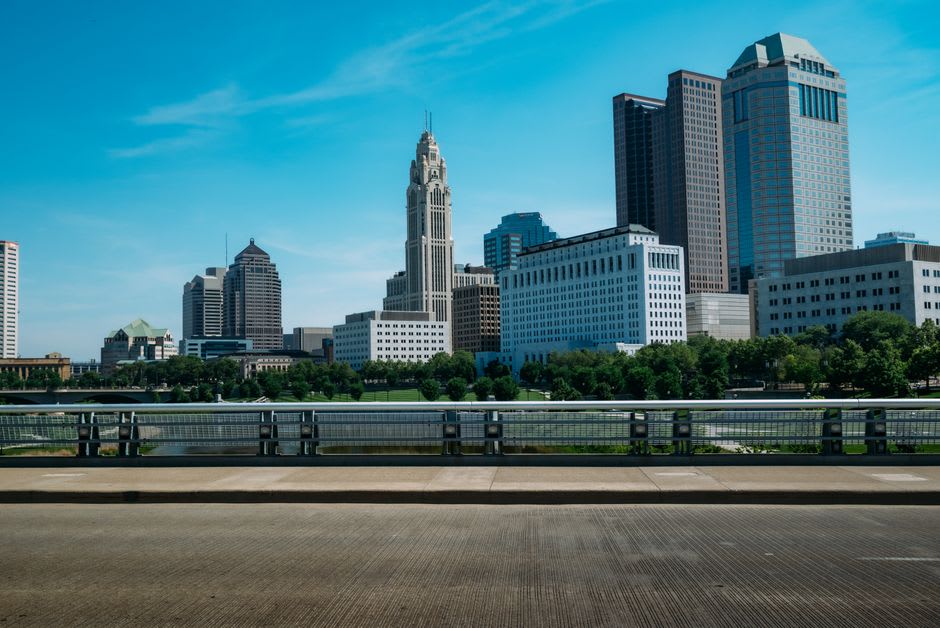
The next day we walked the Ohio State campus, one of the largest universities in the country, and its sheer scale is its own spectacle — the vast horseshoe of the football stadium, the ceaseless flow of students on bikes, an oval green crossed by a hundred casual paths. That youthful churn is the engine under Columbus’s whole mood. Later we followed the river back into the center along the Scioto Mile, a ribbon of riverfront parks and fountains where the city has turned its back-lot waterway into a place to actually be. Kids ran shrieking through the interactive fountain jets while we sat on the grass watching the skyline light up in the reflection. It was, again, deeply ordinary and quietly lovely, which is the thing I keep wanting to tell people about Columbus.
Getting There
John Glenn Columbus International Airport sits about twenty minutes east of downtown and connects to most major US cities; a taxi or rideshare is the simplest way in, as transit links are limited. Columbus lies at the crossroads of I-70 and I-71, making it an easy driving stop between Cincinnati, Cleveland, and Pittsburgh. A car helps for hopping between neighborhoods, though German Village, downtown, and the Short North string along walkable High Street. Come in autumn for football-season energy and mild weather, or late spring when the patios open and the riverfront parks fill up.
Keep exploring
More of Ohio