
Lower Manhattan
"New York does not welcome you. It simply begins, and you either keep up or you don't."
The original New York — where graffiti alleys open onto hidden restaurants, cast-iron facades glow at blue hour, and the city keeps going long after you've decided to stop.
We landed at JFK on a Wednesday afternoon in May, which is the correct way to arrive in New York — on a day that nobody treats as special, in weather that cannot make up its mind, with a suitcase and the specific optimism of someone who has been told, many times, that this city will change you. I had been told this about Paris too. Paris did not change me. It confirmed things I already suspected. New York operates differently.
The hotel — Untitled at 3 Freeman — sat at the entrance to Freeman Alley itself, on a block that had been a garment district tenement, then a nightlife corridor, and now existed somewhere between those two identities, the old signs still visible through the new paint. The name was the first thing New York gave us: unlabelled, address-as-identity, an invitation to fill in the rest ourselves. We dropped our bags and went immediately to the roof.
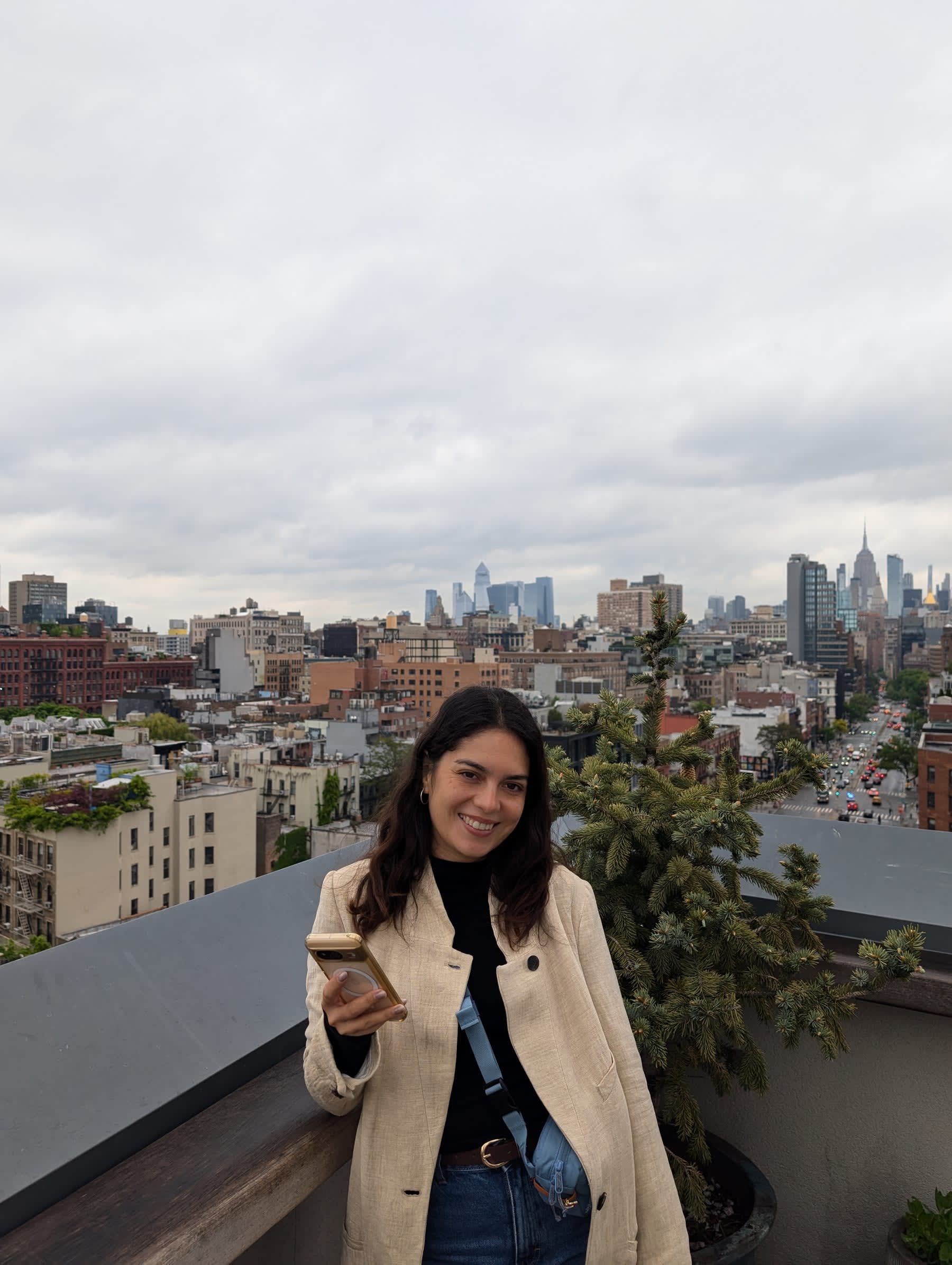
From twenty floors up, the city presented itself without introduction. The Empire State Building in the middle distance. Water towers on every rooftop. The grid of streets below, already filling with evening traffic. As a Frenchman, I have stood on rooftops in Paris and felt that the city was arranged for viewing — the Haussmann boulevards, the measured limestone facades, the deliberate beauty of a capital that knows it is being looked at. New York from above does not feel arranged. It feels accumulated. Centuries of building stacked onto each other without apology, and the result — this improbable skyline, this particular density — is not beautiful in the French sense. It is something else. Something that requires a different word.
We went downstairs and walked south.
Freeman Alley
You could walk past Freeman Alley a hundred times and miss it. The entrance is a gap between buildings on Rivington Street — unmarked except for a small sign, barely wider than a delivery van, the kind of passage that in most cities leads to a loading dock or a fire escape or nothing at all. In New York, it leads to dinner.
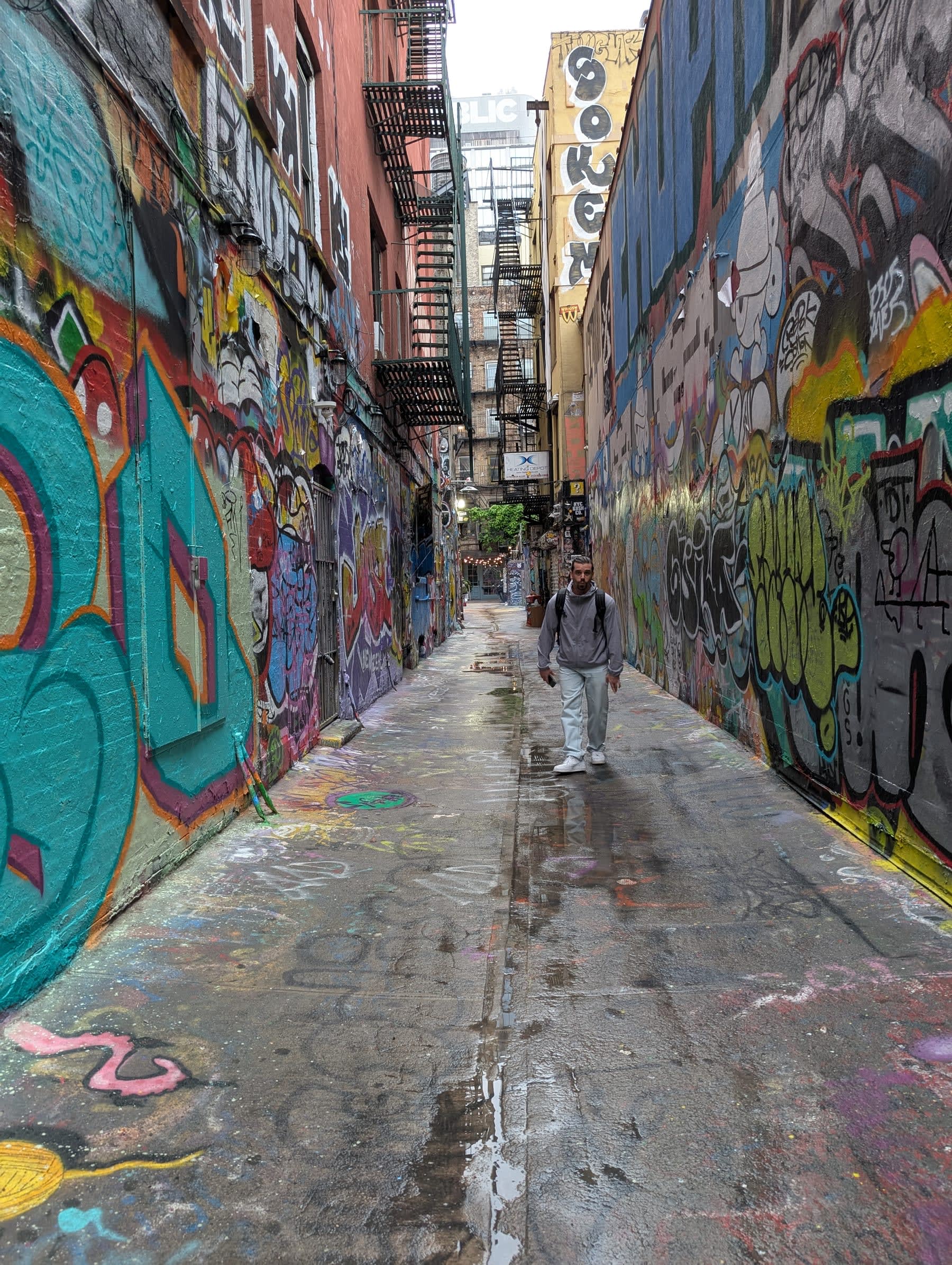
The walls on both sides are covered floor to ceiling in graffiti — not tags, not vandalism, but considered work: murals built over years of accumulated painting, one layer over another, so dense and interlocked that the alley functions as an outdoor gallery that nobody curated and everybody made. The fire escapes overhead are rusted in the specific way that suggests they have been there since the building went up and will outlast everyone currently walking beneath them. The cobblestones underfoot are damp. The whole corridor smells of spray paint and city and something cooking from somewhere inside.
At the end of the alley, where the passage opens into a small courtyard, there is a door. A blue door, flanked by rough wooden panels and strung with Edison bulbs. A chalkboard announces the hours. A small iron dog guards the entrance. This is Freemans, and it has been here since 2004, and it has the quality of a place that intends to remain long after every restaurant around it has been replaced by something with a QR code menu and an Instagram-optimised interior.
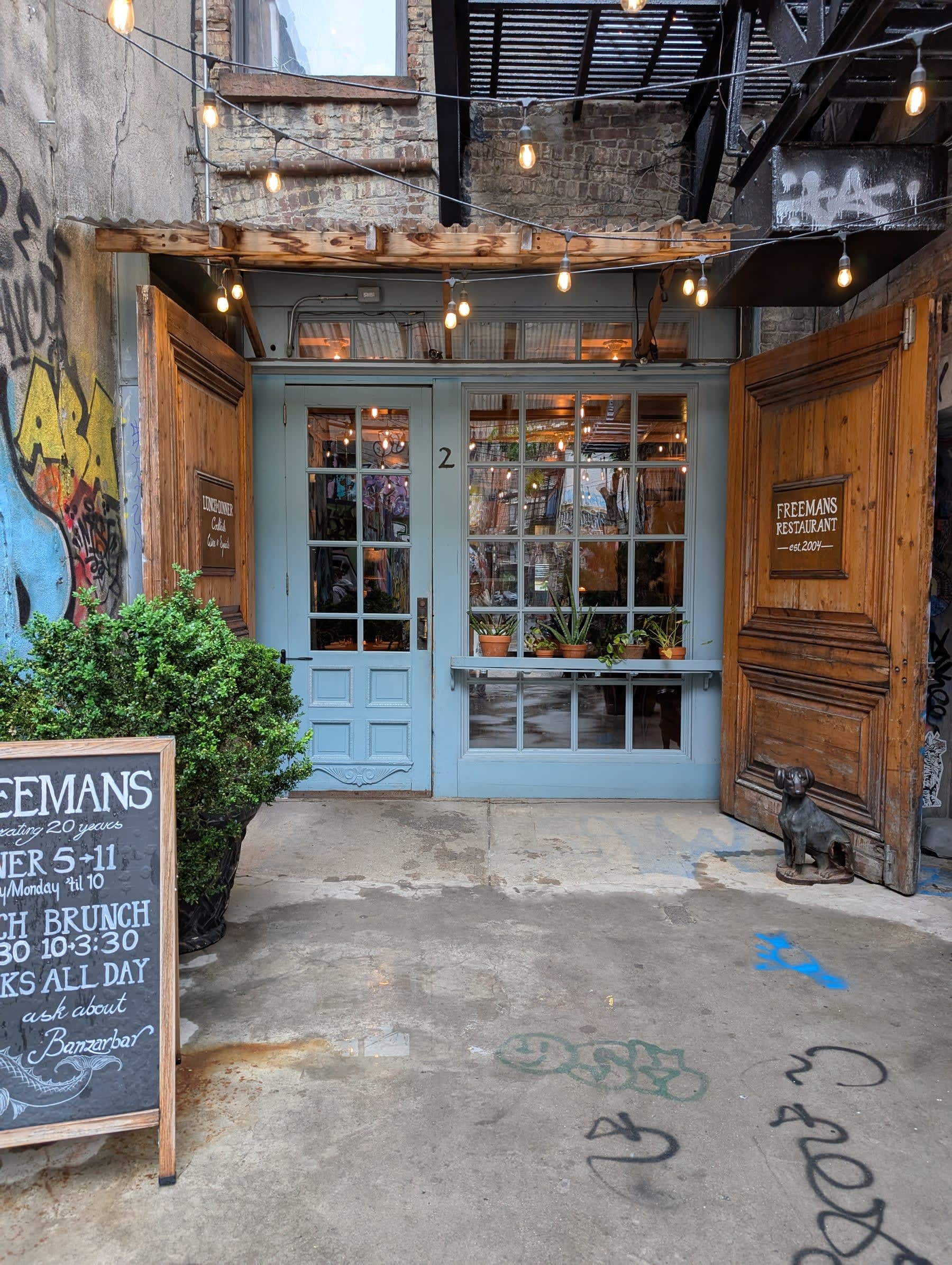
We did not eat there that first night — the wait was over an hour and we were not yet adjusted to New York time — but I stood at the entrance long enough to understand why people wait. The warm light through the glass, the mounted antlers visible on the walls inside, the sound of a full room doing what rooms are meant to do. We noted the hours on the chalkboard and kept walking.
Murals and the City at Night
The Lower East Side at ten in the evening is a different city from the one that exists at noon. The light changes — the shop signs come on, the bars fill, and the streets take on the particular quality of a place that is genuinely nocturnal rather than performing nocturnality. We walked north without a specific destination, which is the correct approach to this neighbourhood.
On a corner somewhere near Houston, Lia stopped.

The Monopoly Man. Six storeys tall. Full regalia — top hat, monocle, tailcoat, the prosperous flush of a man who owns everything on the board. Behind him, miniaturised: a taxi, a skyscraper, a bridge. The mural is so absurd and so precisely placed on a corner in the most commercially contested real estate in the world that it reads less like street art and more like editorial comment. Lia looked at it the way she looks at things that deserve to be looked at — without irony, without performance, just attention. I took the photograph before she noticed I was photographing her and not the mural.
A few blocks further, we passed Mighty Lucky.
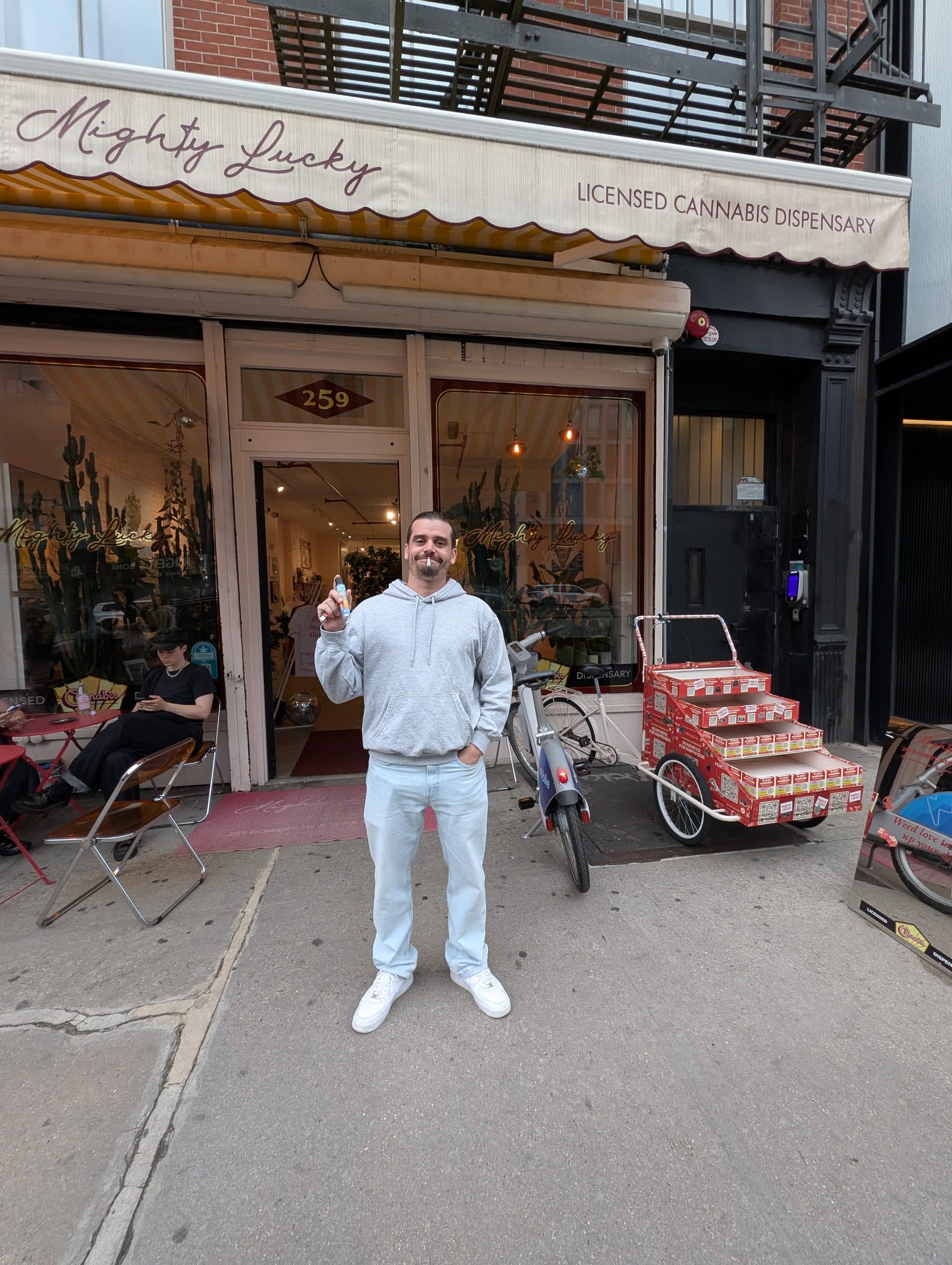
I am from France. Cannabis is not legal in France. The concept of a licensed dispensary — with a proper storefront, a handwritten sign, and the calm atmosphere of a boutique selling olive oil — remains genuinely strange to me no matter how many American cities I visit. The name delights me. Mighty Lucky. The thumbs up felt appropriate.
Two minutes south, on an improbably pink facade, Spicy Moon announced itself.
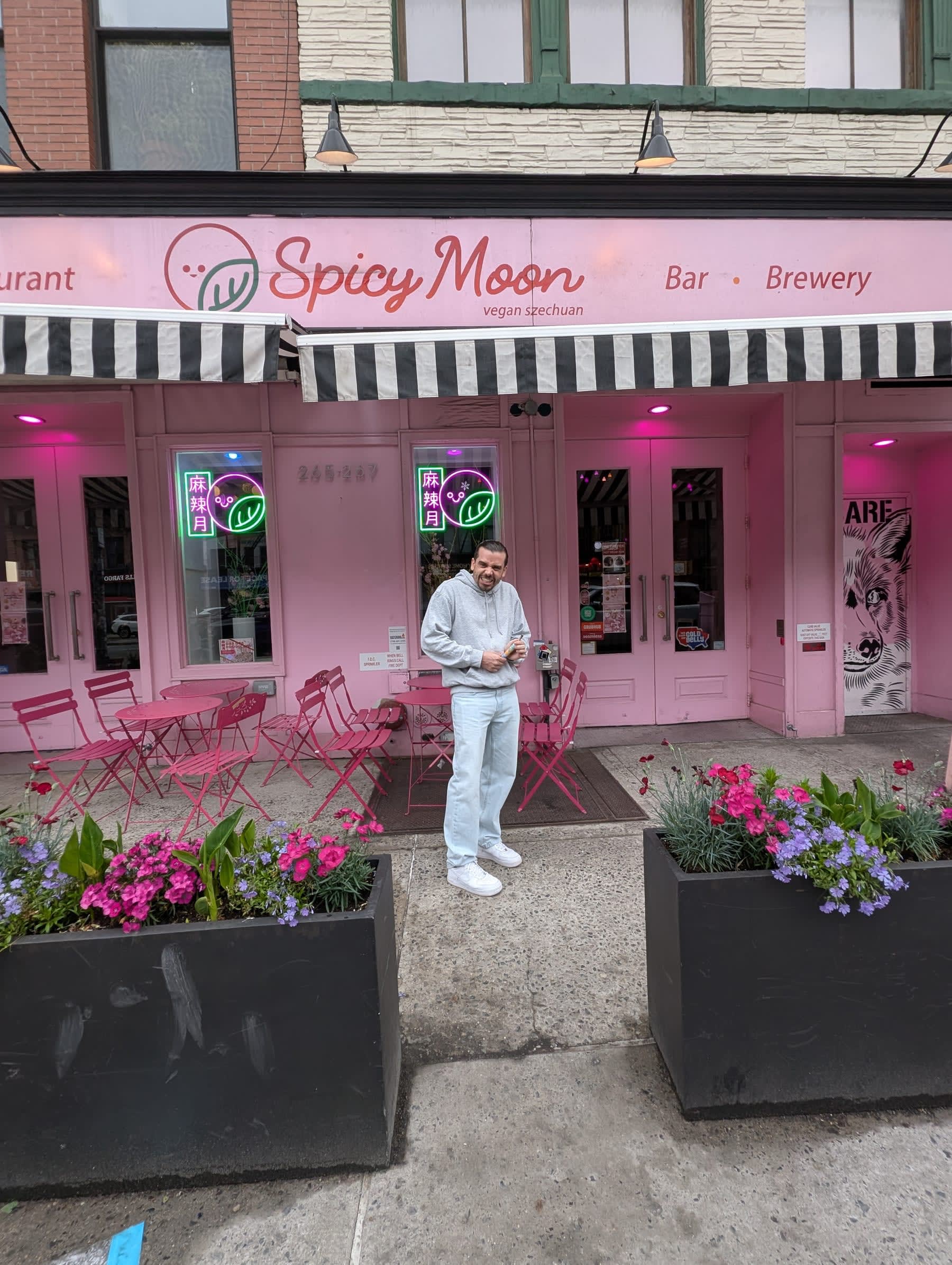
Vegan Sichuan. The words should not work together, but in New York they do, and Spicy Moon has lines on weekends that suggest the neighbourhood has accepted this premise without reservation. The pink is the precise shade that the internet would call “aesthetic” — which in this case I mean without mockery, because the restaurant understands its audience and has chosen its visual identity with the same care it presumably applies to its mapo tofu. We noted this one too, filed under reasons to return.
After Midnight
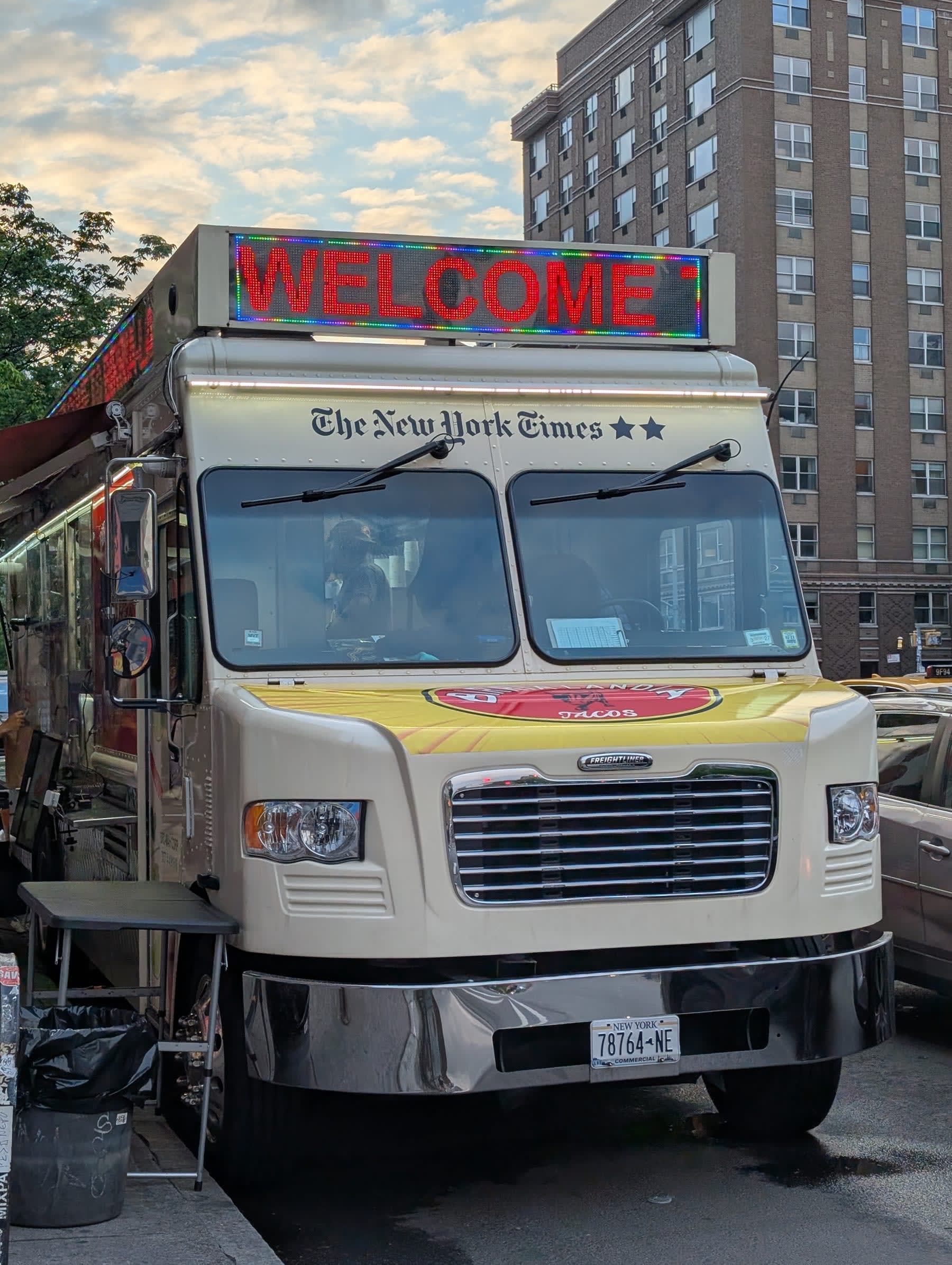
Somewhere near eleven-thirty, parked on a side street in the kind of quiet that Lower Manhattan achieves when it is briefly between things, the New York Times food truck. Its LED marquee read WELCOME in red. I do not know what the New York Times is doing with a food truck at eleven-thirty on a Wednesday evening. I photographed it because it was there, and because being there at the right moment — in New York, at the right moment — is its own form of news.
We found a bar with outdoor seating on a corner — Half Pint, the coasters announced — which turned out to describe both the establishment’s personality and its effect on the evening. I had a beer. Something local, on tap, served in a tall glass without ceremony. Lia had wine. The intersection around us was doing what New York intersections do at midnight: delivering things, feeding people, keeping the city metabolically alive in ways that have nothing to do with us and everything to do with the fact that it is always, somewhere, somebody’s first night here.

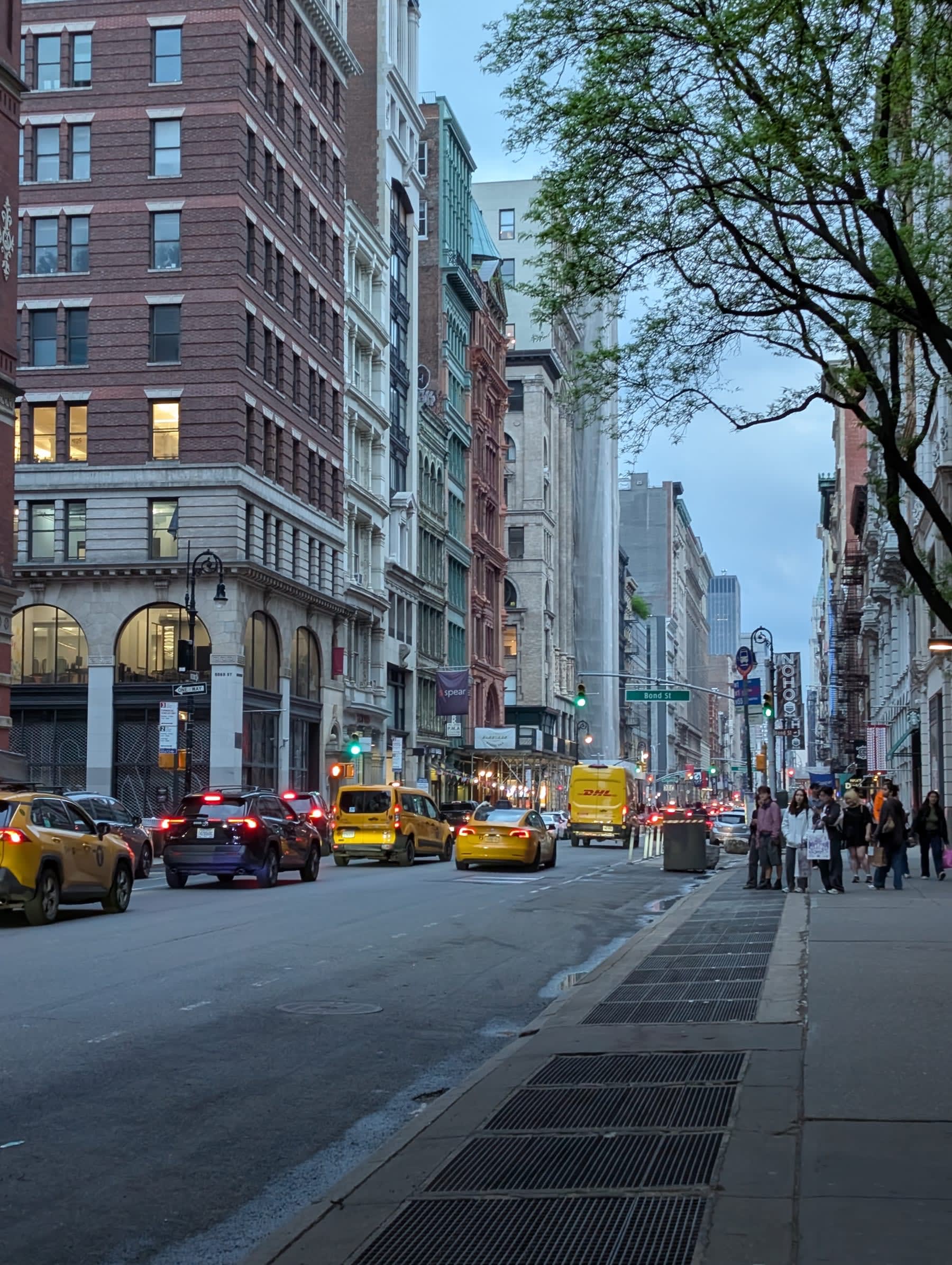
On the walk back we crossed a long straight block — the kind of New York block that ends up in films because the real thing looks more cinematic than any set designer would dare to build. Yellow cabs moving through the intersection. The cast-iron facades of SoHo lit from below in the blue hour after midnight. A traffic signal going green and everyone moving at once as if the city had been holding its breath and had just decided to exhale.
Freemans, Finally
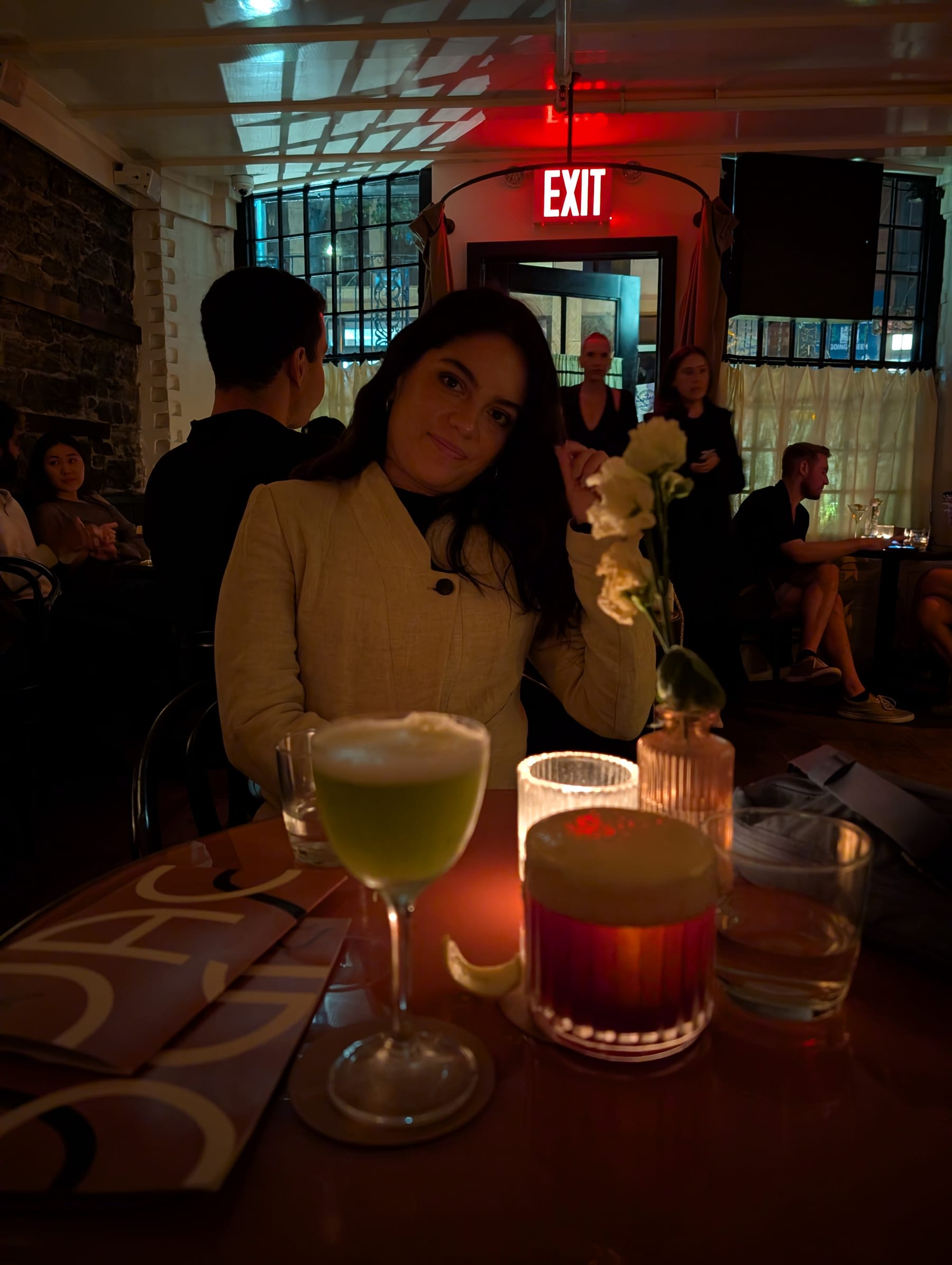
We went back to Freemans after midnight. No wait. We were seated immediately in the back room, which is dark and low-ceilinged and lit by candles that appear to have been burning in the same spots for decades. A white flower in a small vase on the table. The sound of a room talking quietly at the end of its evening.
Lia ordered cocktails. The menu here is serious in the way that American restaurants can be when they decide to take themselves seriously without announcing it — game dishes, a wine list that reflects actual thought, cocktails that involve ingredients I cannot pronounce but that taste like they were invented by someone who cared deeply about what they were doing. The dark panelling absorbed the candlelight. Nobody was in a hurry. The EXIT sign above the door glowed red in a way that felt less like an instruction and more like a suggestion.
Somewhere near two in the morning — I have lost the precise timeline, which is the correct relationship to time to have on a first night in New York — we ended up at a bar with a copper counter. I do not remember the name. I remember the counter, the way the warm light caught it, the bowl of marinated olives that arrived without being ordered, the pink cocktail that came with a garnish requiring more effort than garnishes usually receive. A wine glass with cold white wine stood beside it. Someone had made this bar beautiful on purpose, and it showed.
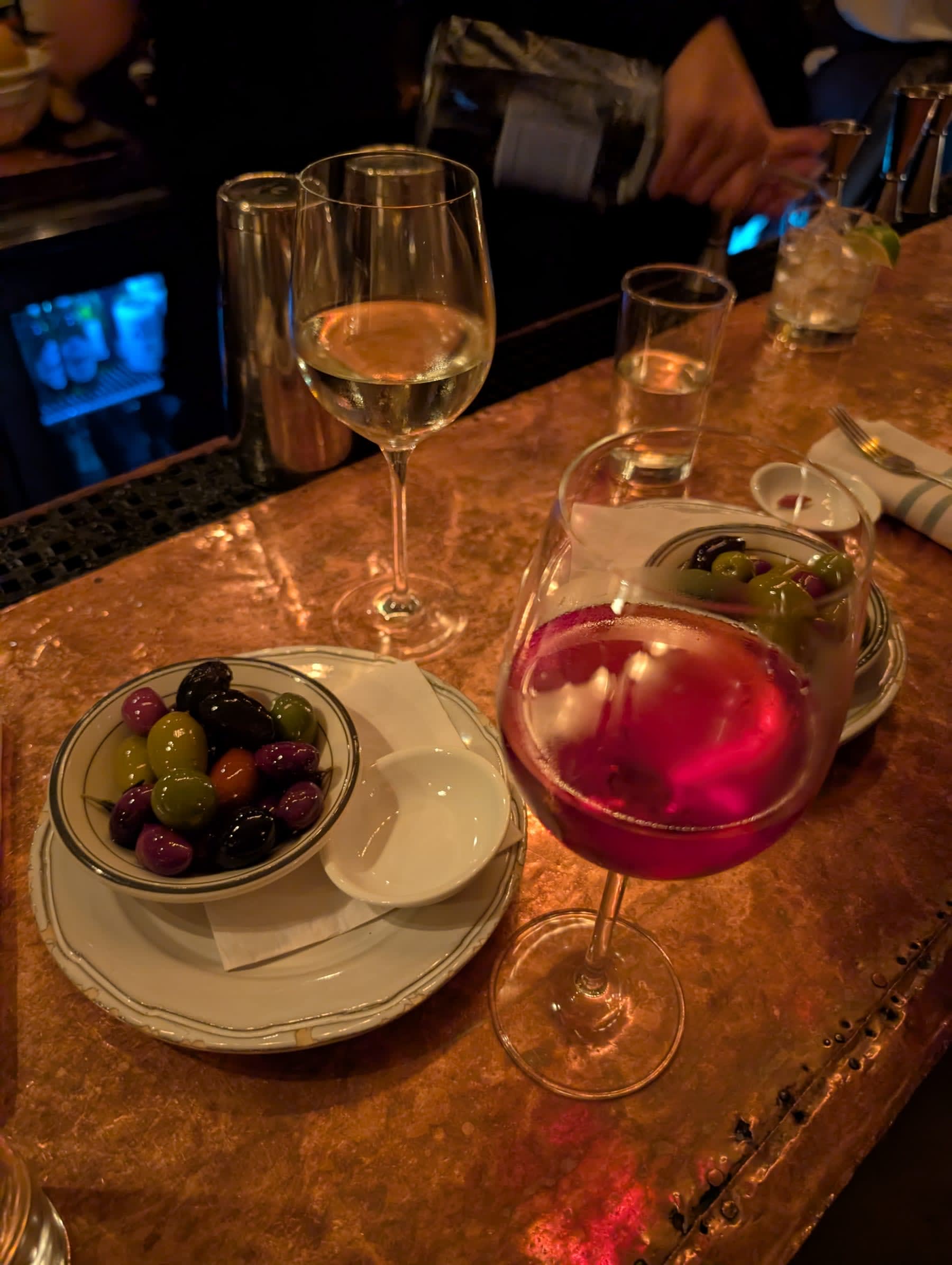
This is what the first night in New York does. It simply keeps going. Not because you lack discipline, but because the city has not yet given you permission to stop, and the city is correct.
The Morning After
At noon the next day — which in the calculus of the previous evening counted as morning — we found a café near the hotel with marble counters and coffee. The barista wrote “Lia” on the cup in marker with the fluency of someone who has written ten thousand names and has not lost interest in any of them. My cup said something beginning with O. I did not correct it.

The croissant was good. Not French — nothing outside France is French in the way that the French mean it — but good in the American sense: direct, unpretentious, making no apologies for not being something else. The coffee was better than I expected. The light through the café window was the particular May light that makes even ordinary streets look like they are worth paying attention to.
We sat at the marble counter and did not speak for a while. The city had begun, as promised. We had simply kept up.
When to go: May and September are the sweet spots — warm enough to walk all evening, cool enough to keep moving. Avoid July and August if you prefer not to arrive at your destination already defeated by the heat. Freeman Alley at dusk, when the light reaches the end of the corridor. The SoHo cast-iron facades in the blue hour after sunset. Freemans after midnight when the wait disappears. None of this requires a reservation. Only the willingness to walk without a fixed destination and see what the city decides to show you.
Day Two — The Walk South
The hotel is called Untitled, and it sits at 3 Freeman Alley — which is to say, it sits at the entrance to the alley itself, which means that every time you leave or return, you pass through the graffiti corridor like a recurring character in your own story. The name is appropriate. New York does not always offer you a title. It offers you an address, and you figure out the rest.
We had slept properly for the first time since landing, which is a different thing from the approximate sleep of jet lag. We left the hotel around two in the afternoon — late, by any reasonable measure, but the city had kept us until nearly three in the morning, and New York does not accept excuses in either direction.
The plan, if it could be called one, was to walk south. The Financial District, the waterfront, the helicopter. Two kilometres on a map. Considerably longer on foot, because the city insists on showing you things along the way that were not in the plan.
The first thing it showed us was this.
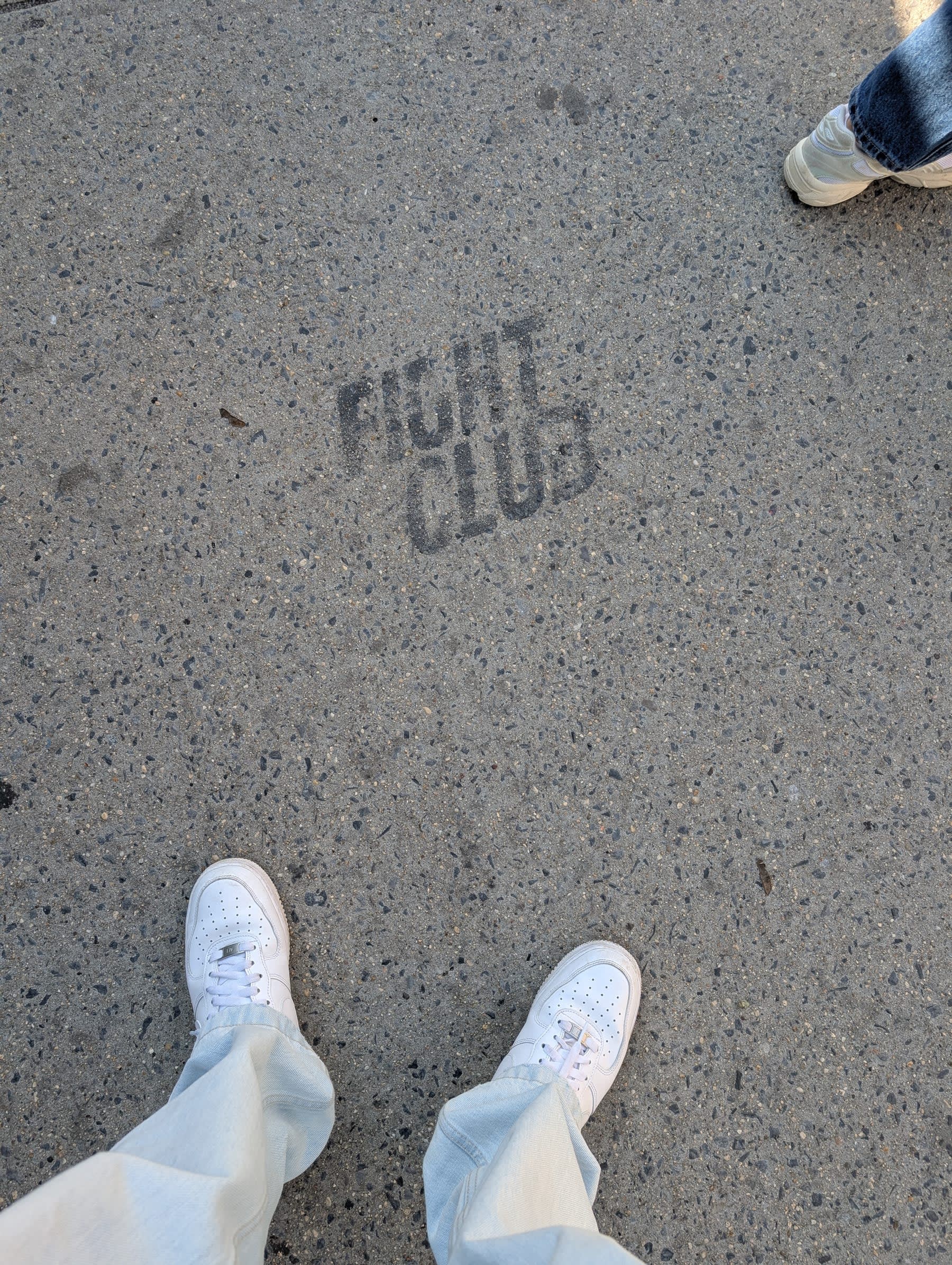
I stood on it before I noticed it. The first rule of Fight Club, apparently, is that it is stencilled onto the pavement of the Lower East Side. I do not know what is being advertised. I am not certain anything is being advertised. New York is full of declarations that exist purely as declarations, statements addressed to no one in particular and therefore to everyone.
A few steps further, another one.
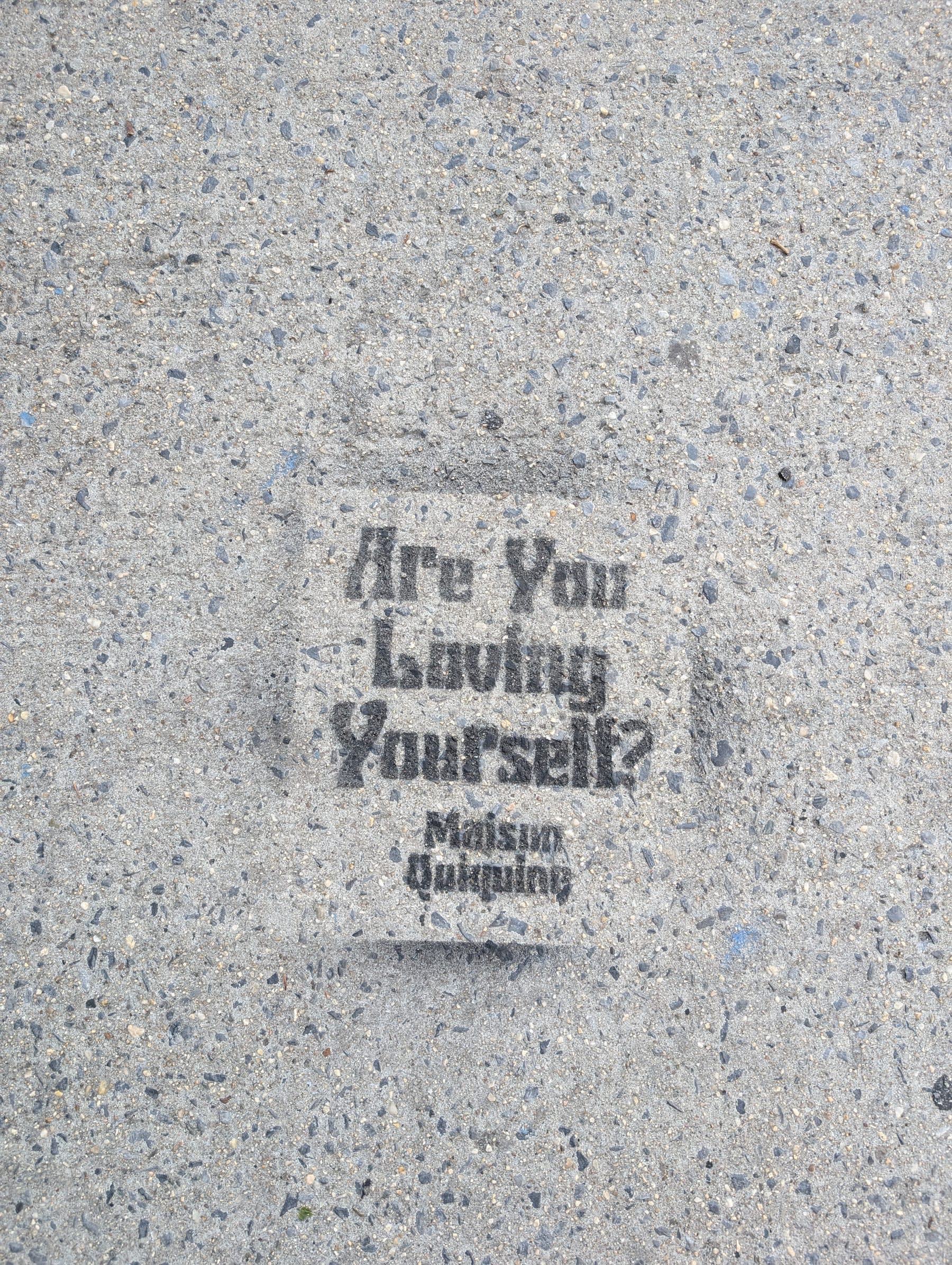
Are You Loving Yourself? Maison Quinqine. A brand. Or a question. Or, in this neighbourhood at this hour, both simultaneously. In France, the walls speak. In New York, so does the ground.
The Manhattan Bridge
We cut east toward the Manhattan Bridge, which has a pedestrian walkway that most visitors ignore in favour of the Brooklyn Bridge. This is a mistake. The Manhattan Bridge walkway is utilitarian in the best sense — chain-link fencing, exposed steel, the industrial skeleton of the thing rather than its dressed-up face — and it places you at exactly the right height to understand what you are walking across and what the city looks like when someone is not trying to make it picturesque for you.
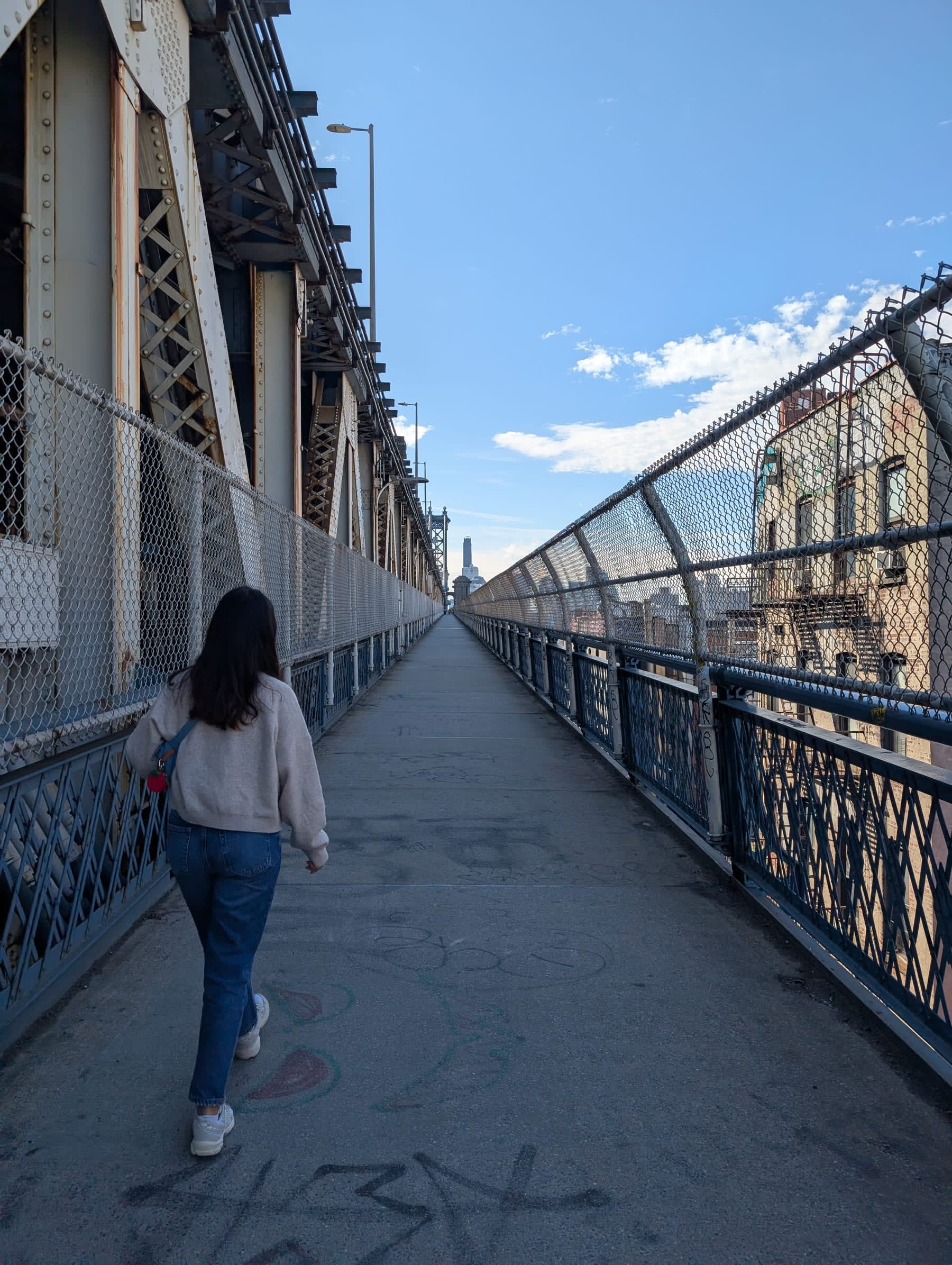
From the walkway, looking back toward Manhattan, the view reorganises everything. The city compresses. The rooftops of the Lower East Side pile up in layers — the tenements, the water towers, the graffiti visible from above — and behind them, already, the towers of the Financial District begin to appear. One World Trade Centre rising above the brick. The Municipal Building’s copper crown. Downtown Manhattan from a height that removes the noise and leaves only the structure.
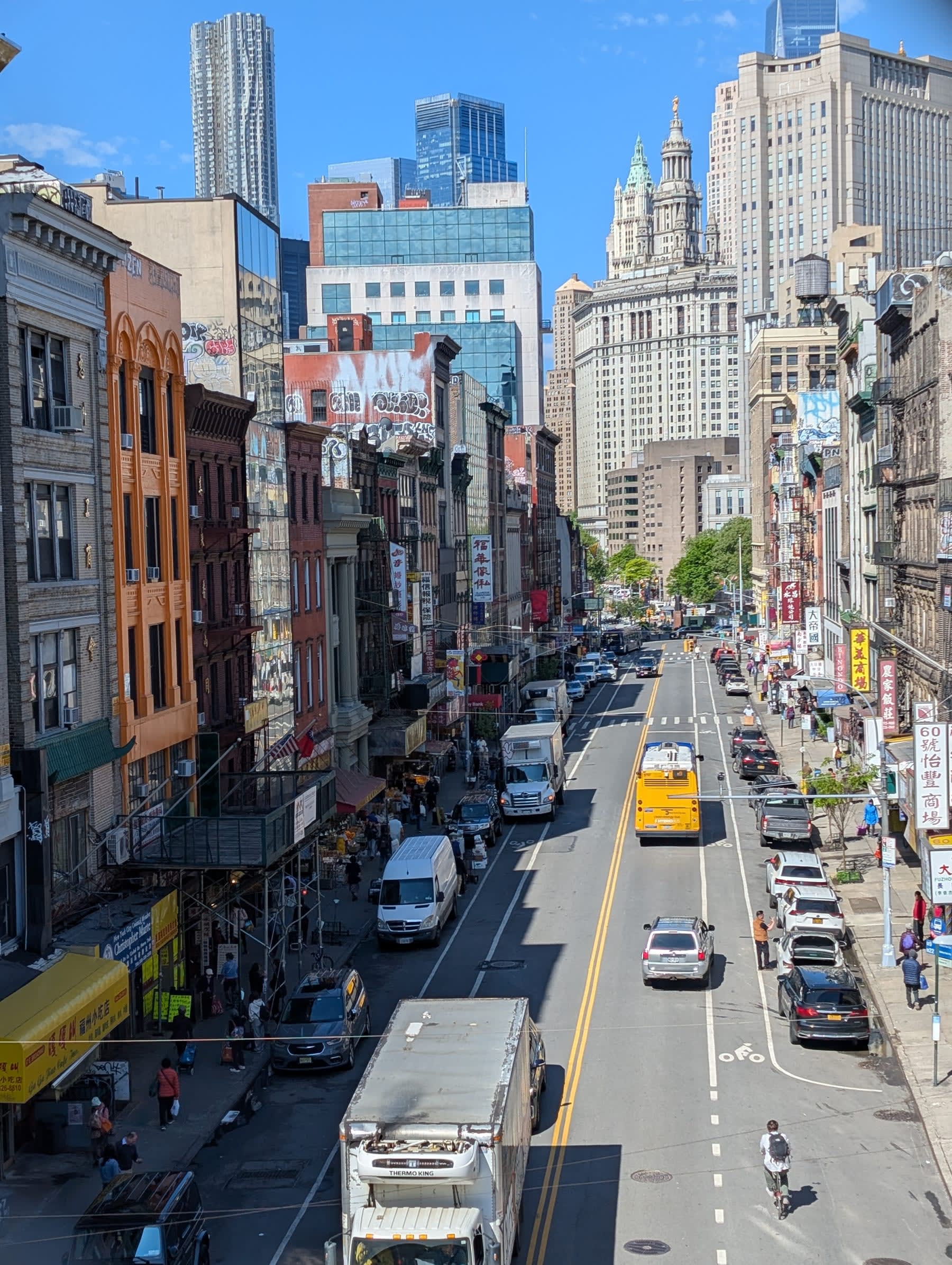
We did not cross to Brooklyn. We turned back, descended, and walked south into Chinatown.
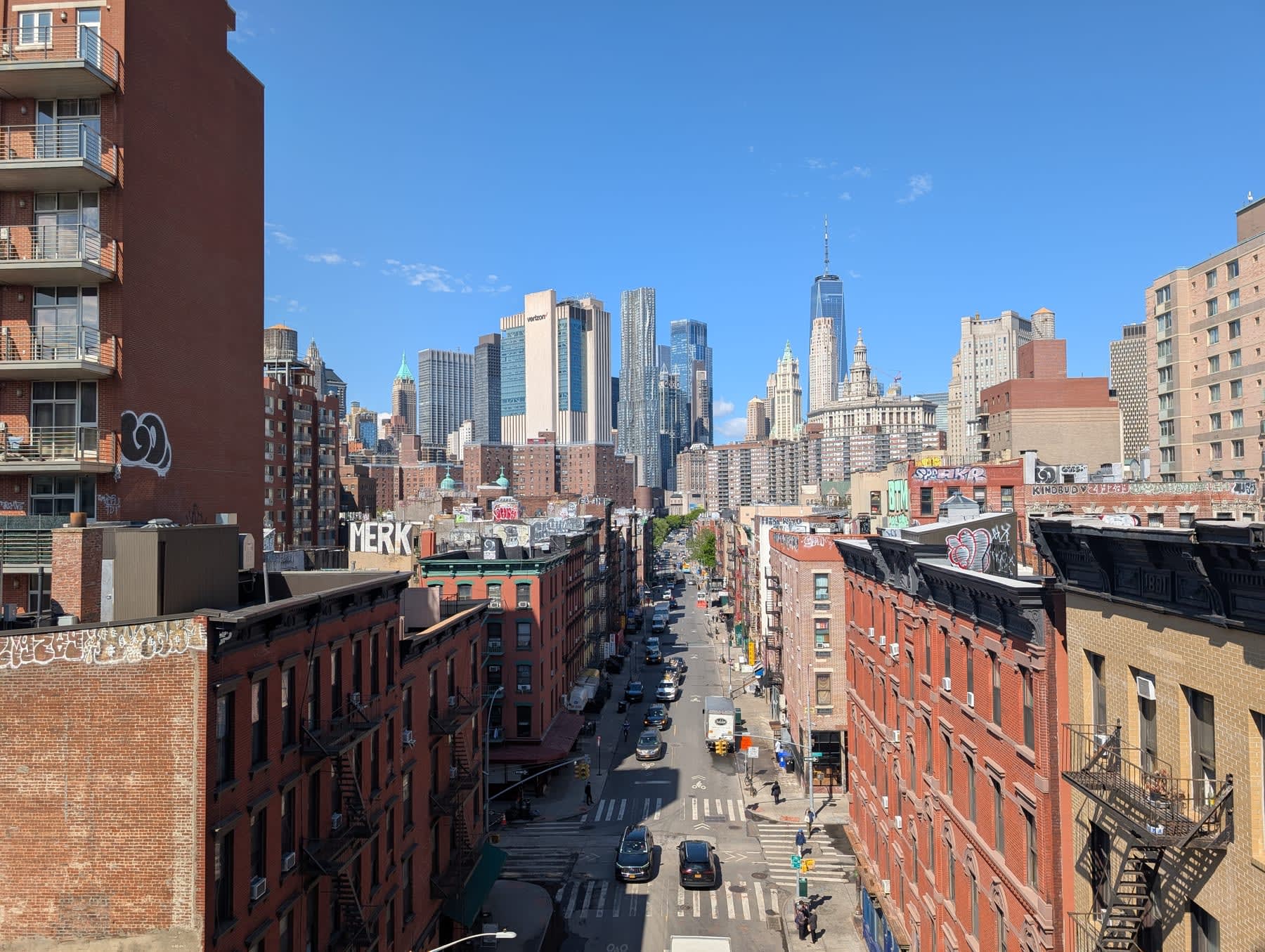
Chinatown
The transition happens without announcement. One block you are on Delancey, the next you are somewhere that the street signs have Chinese characters alongside the English and the fish are displayed in open crates on the pavement and the restaurants have laminated photographs instead of menus and everything smells of orange peel and char siu and the particular cold of refrigeration units venting onto the sidewalk.
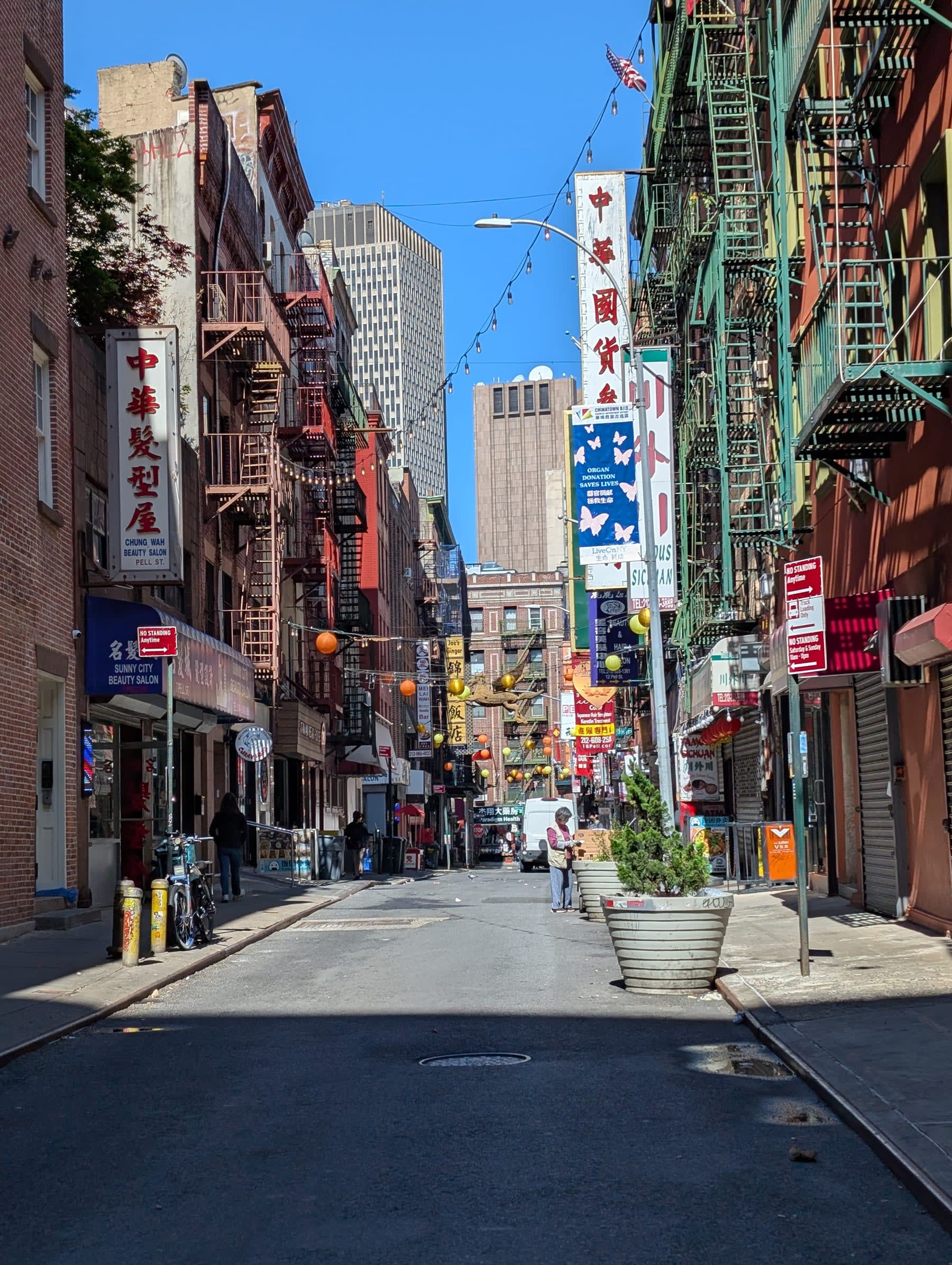
We had eaten in Chinatowns in many cities. San Francisco’s, which is performative. Montreal’s, which is genuine but small. Mexico City has no Chinatown, which is one of its few absences. New York’s is different because it is not a district that Chinese immigrants moved into — it is a district that Chinese immigrants built and have maintained for a hundred and fifty years, and the accumulated density of that presence has produced something that functions less like an ethnic neighbourhood and more like a city within a city, with its own logic and its own pace and its own relationship to the grid that surrounds it.
We walked through without stopping. The helicopter was at two-thirty.
The Brooklyn Bridge and the Waterfront
The Brooklyn Bridge appeared above the roofline on Centre Street — the towers, the cables, the unmistakable silhouette that exists on approximately forty million photographs and has not been diminished by any of them.

There are bridges that exist as infrastructure and bridges that exist as monuments. The Brooklyn Bridge is both, and the remarkable thing is that neither function diminishes the other. It carries traffic and it is beautiful. It was finished in 1883 and it looks like it was finished last year. The cables catch the light in a way that suggests they were designed by someone who understood that a bridge is also a piece of public art, which in 1883 was not a common engineering brief.
We did not cross it. We turned west along the waterfront.
South Street Seaport arrives like a surprise gift at the end of a long sentence. The wooden boardwalk, the tall ships, the sudden openness after the compressed streets of Chinatown and the Civic Center. I stood on the pier with a red-hulled tall ship behind me and the Financial District skyline ahead — the same skyline we had seen from the hotel rooftop two nights before, but from water level now, rearranged by the change in angle into something different.

From the gardens at the edge of the pier, the view opened further still — the East River wide and moving, Brooklyn’s skyline on the far bank, the tall ship’s masts cutting the sky, everything green and loud with May light. The kind of view that makes you understand why people have been standing in this exact spot, looking at this exact thing, for three hundred years.

The helicopter was waiting somewhere north of here, above the Hudson. We left the seaport and walked toward it — which is a story for another page, and a different kind of view entirely.
When to go: May and September, and specifically on foot, from the hotel to the water. The Manhattan Bridge walkway before noon when it is quiet. Chinatown on a weekday morning before the lunch crowds. The South Street Seaport gardens in the late morning before the tourist boats arrive. The walk from Freeman Alley to the seaport is roughly forty minutes at a reasonable pace and considerably longer if you stop for everything worth stopping for, which you should.
Keep exploring
More of New York