Financial District
"From the ground, New York is too large to see. From the air, it becomes, briefly, legible."
The oldest corner of Manhattan — where helicopter tours reveal a city too vast to comprehend on foot, Wall Street's canyon closes around you like a canyon, and dinner at sixty floors means eating above the clouds.
There is a limit to what walking can tell you about a city. After two days in New York — two days of walking from Freeman Alley to Chinatown to the seaport, of reading the city block by block and street by street — I understood approximately one neighbourhood and had no meaningful sense of the whole. The helicopter changed that. Not permanently, and not completely, but for twelve minutes above the Hudson it reorganised everything I thought I knew into something I could actually see.
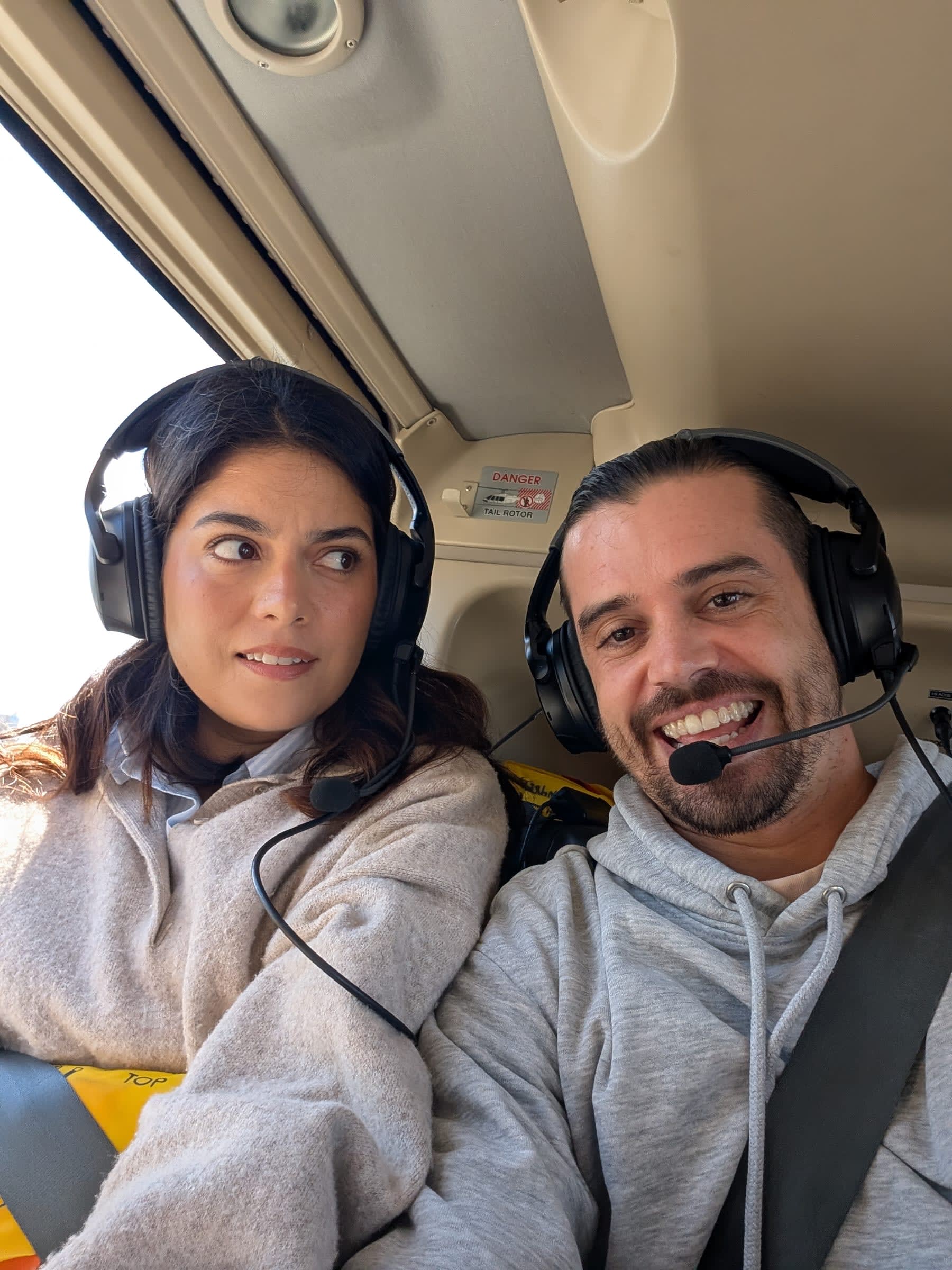
HeliNY operates from the Downtown Manhattan Heliport at Pier 6, at the bottom of Wall Street where the island comes to its southern tip and the East River meets the Upper Bay. The heliport is unremarkable from the ground — a concrete pier, a waiting area, a small yellow helicopter that looks considerably smaller up close than it did in the booking photographs. You sign a waiver. You put on a headset. You are told, matter-of-factly, where to sit and how to fasten the harness. Then the rotors begin and the ground drops away and the city opens below you like a map that someone has finally unfolded to full scale.
Above the Harbor
We banked south over the harbor almost immediately, and the Statue of Liberty appeared in the window the way landmarks appear when you are moving too fast toward them — suddenly, and larger than expected.
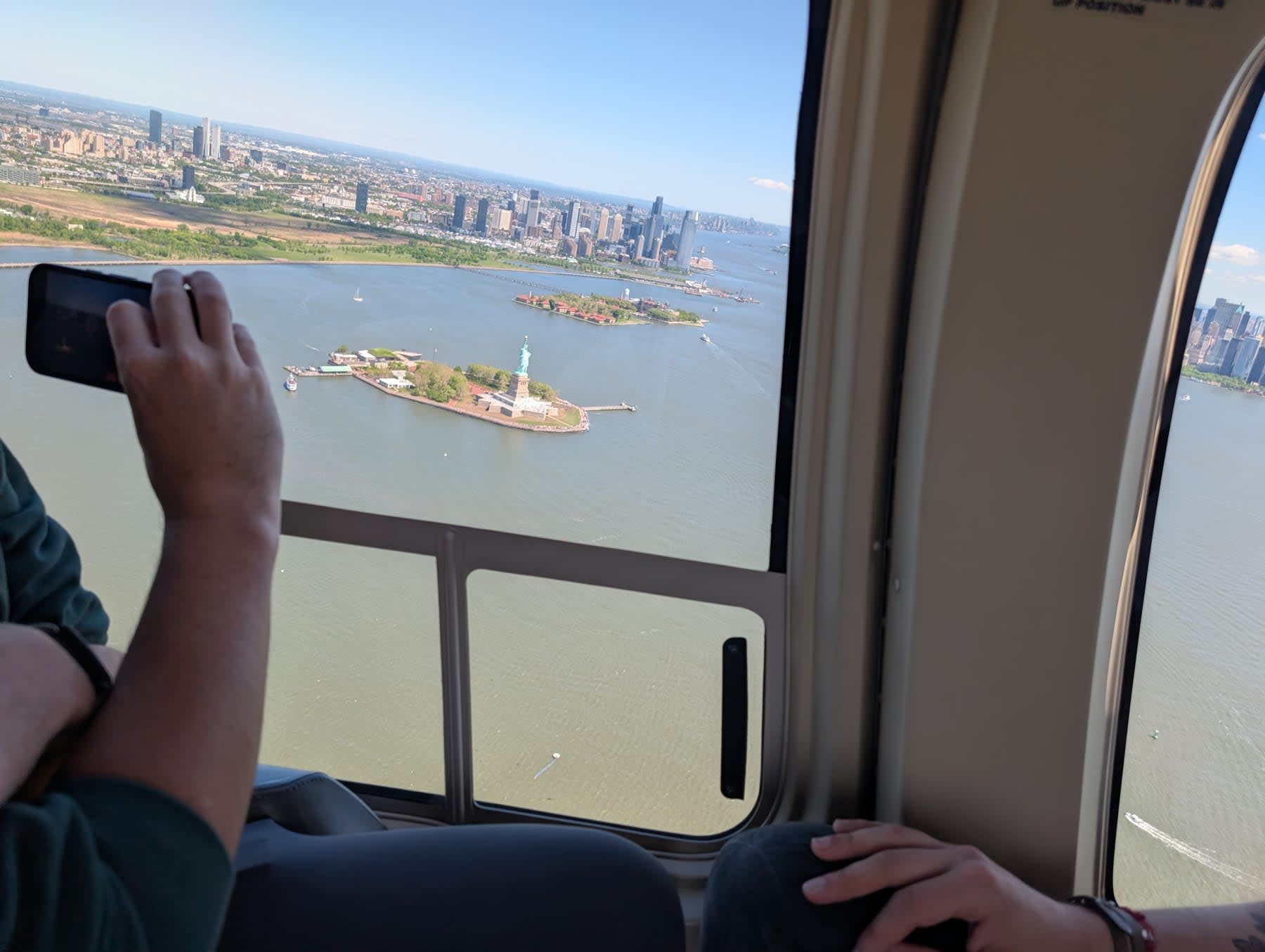
From this height, the statue is reduced to a figure standing on a star-shaped pedestal in the middle of a very large bay. The harbor is immense. New Jersey fills the western horizon. Staten Island sits to the south. A dozen container ships move slowly on the water. The scale that the ground removes — the city as a thing embedded in a vast geography of water and other places — is entirely visible from here, and the effect is disorienting in the best possible sense.
The pilot banked closer, and Liberty Island appeared directly below — the whole thing visible at once, the red-brick pathways, the ferry docks, the careful geometry of the grounds, the statue herself standing at the centre with her arm extended and her back to us as we passed to the north.
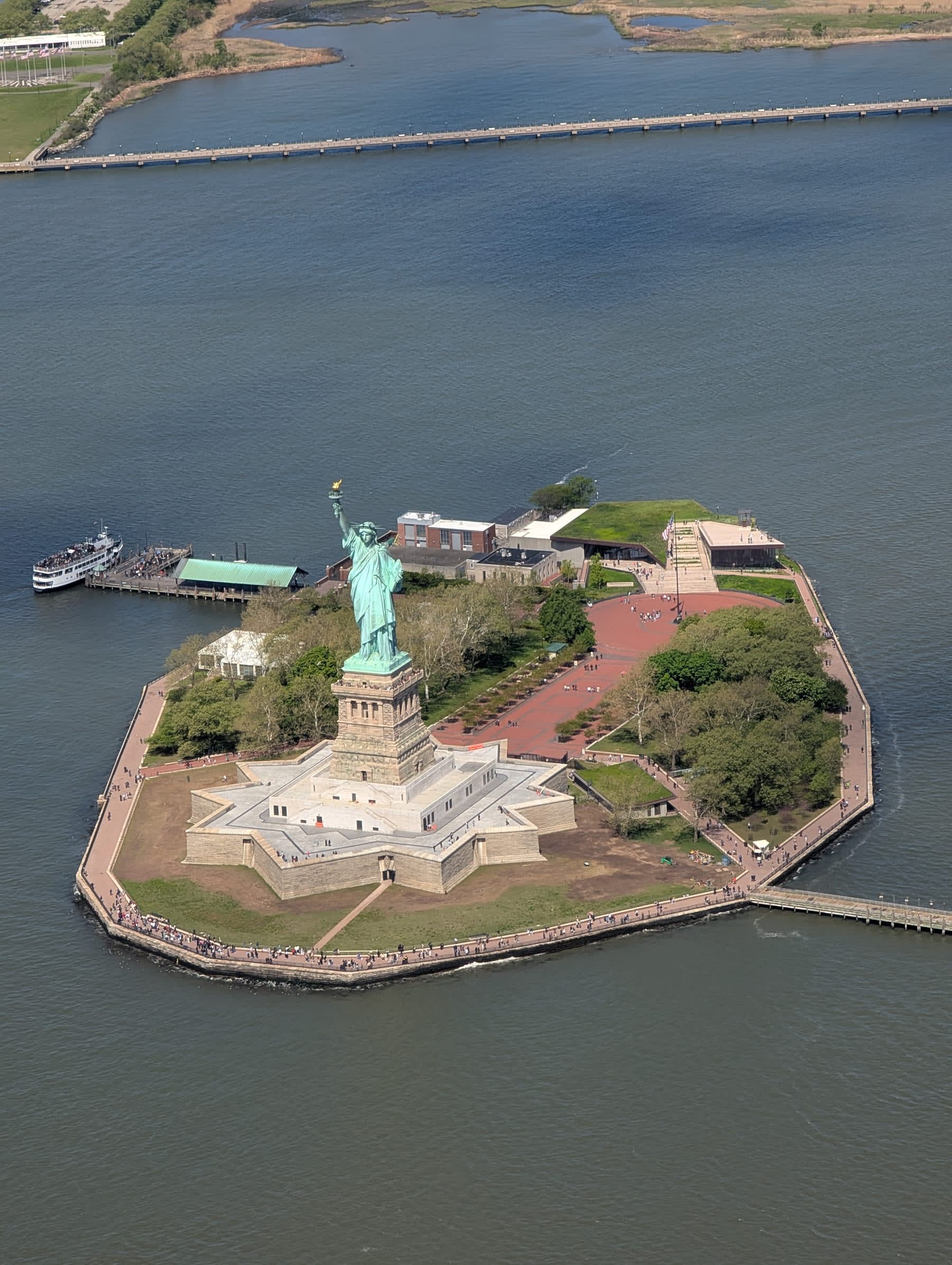
I have seen the Statue of Liberty from the ferry, from the Brooklyn promenade, from other tall buildings, from photographs taken at every possible angle for a hundred and forty years. I had not seen her from directly above, looking down at the torch she holds above her head, the city she was always facing. It is not a better view than the others. It is a different kind of knowledge.
The City from Above
We turned north and flew up the Hudson, and Manhattan laid itself out on our right side.
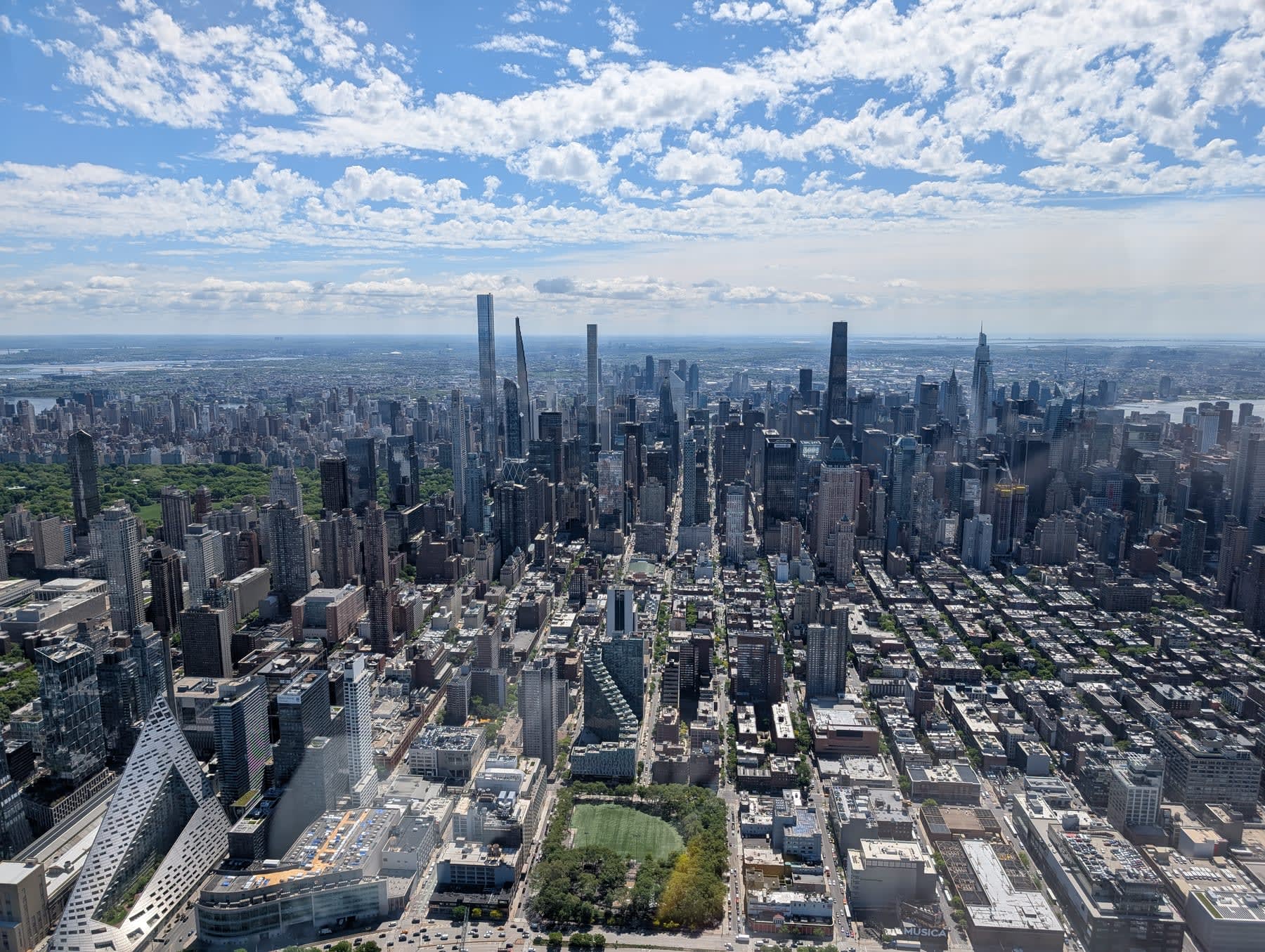
From the air, Manhattan is an island, which sounds obvious but is something you stop understanding on the ground. The Hudson to the west and the East River to the east are not decorative — they are edges, hard boundaries that define the shape of the thing. The grid appears as it was designed to appear: logical, relentless, a mathematical system imposed on a piece of land that was not consulted about the decision. Central Park sits in the middle of it like a deliberate error, a green rectangle where the grid chose not to go, and it is visible from here as something the city decided to save from itself.
The new towers — 432 Park, Steinway Tower, 111 West 57th — rise above the midtown plateau like needles, absurdly thin, and from the air you understand why the criticism of them always misses the point. They are not trying to fit in. They are trying to be visible. From the helicopter, at least, they succeed.
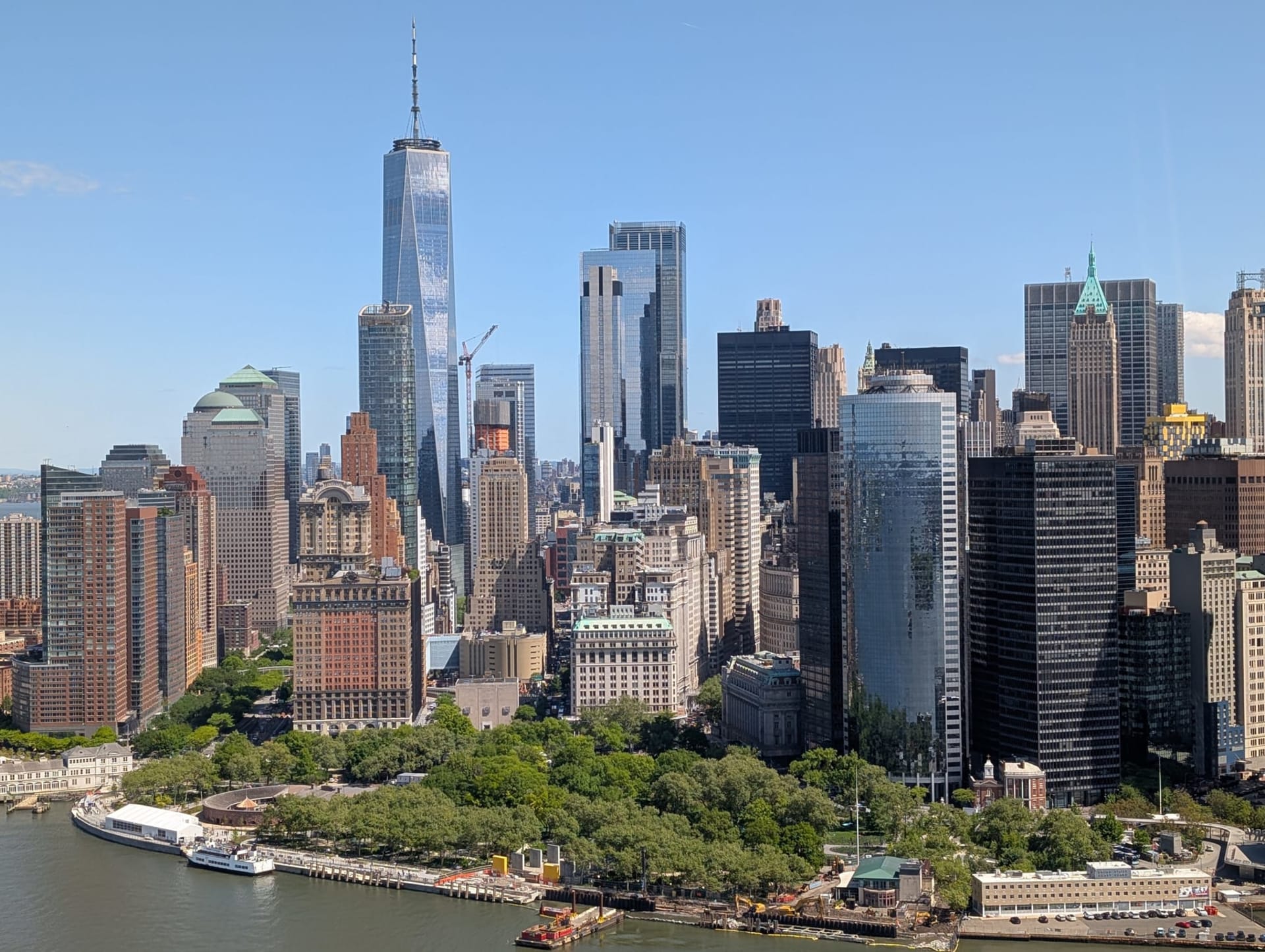
Then we came around the southern tip and the Financial District appeared from the water side.
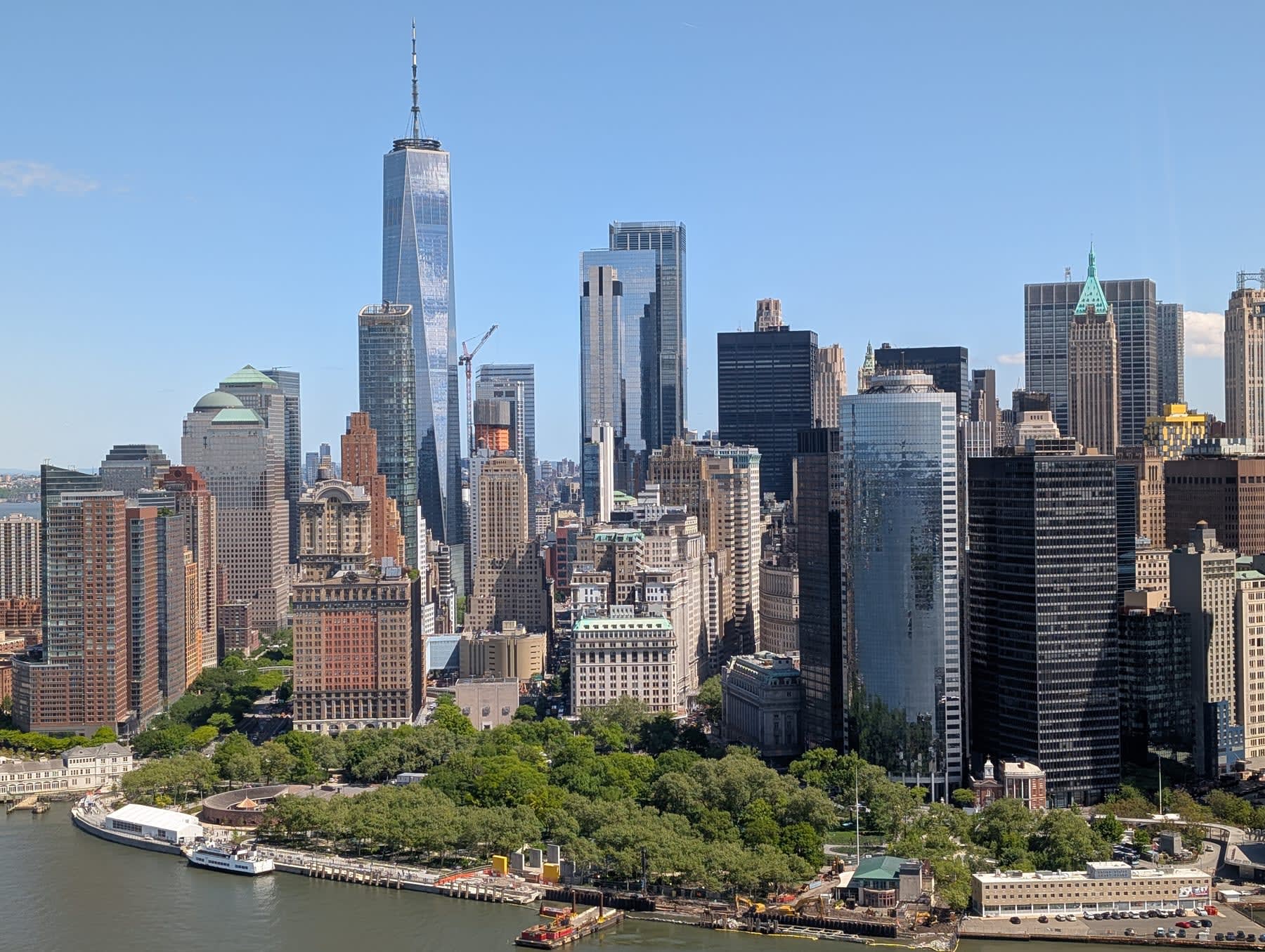
This is the famous view — the one that appears in every establishing shot of every film set in New York, the one on every postcard, the one that tourists photograph from the Staten Island Ferry. From the helicopter it is the same composition but you are inside it, moving through it, and the scale lands differently when you are not looking at it through glass from a distance. One World Trade Centre is very tall. The cluster of older towers around it — 40 Wall Street, 70 Pine Street, the dark glass of the older buildings — compresses into something that looks less like a skyline and more like a city that grew upward because it had nowhere else to go.
We landed. The concrete came back up to meet us. The city, briefly legible, closed again around street level.
Wall Street
The street is shorter than I expected. Wall Street runs for seven blocks between Broadway and the East River, and it takes less than five minutes to walk from end to end. What takes longer is the accumulation of it — the weight of the name against the reality of the stones.
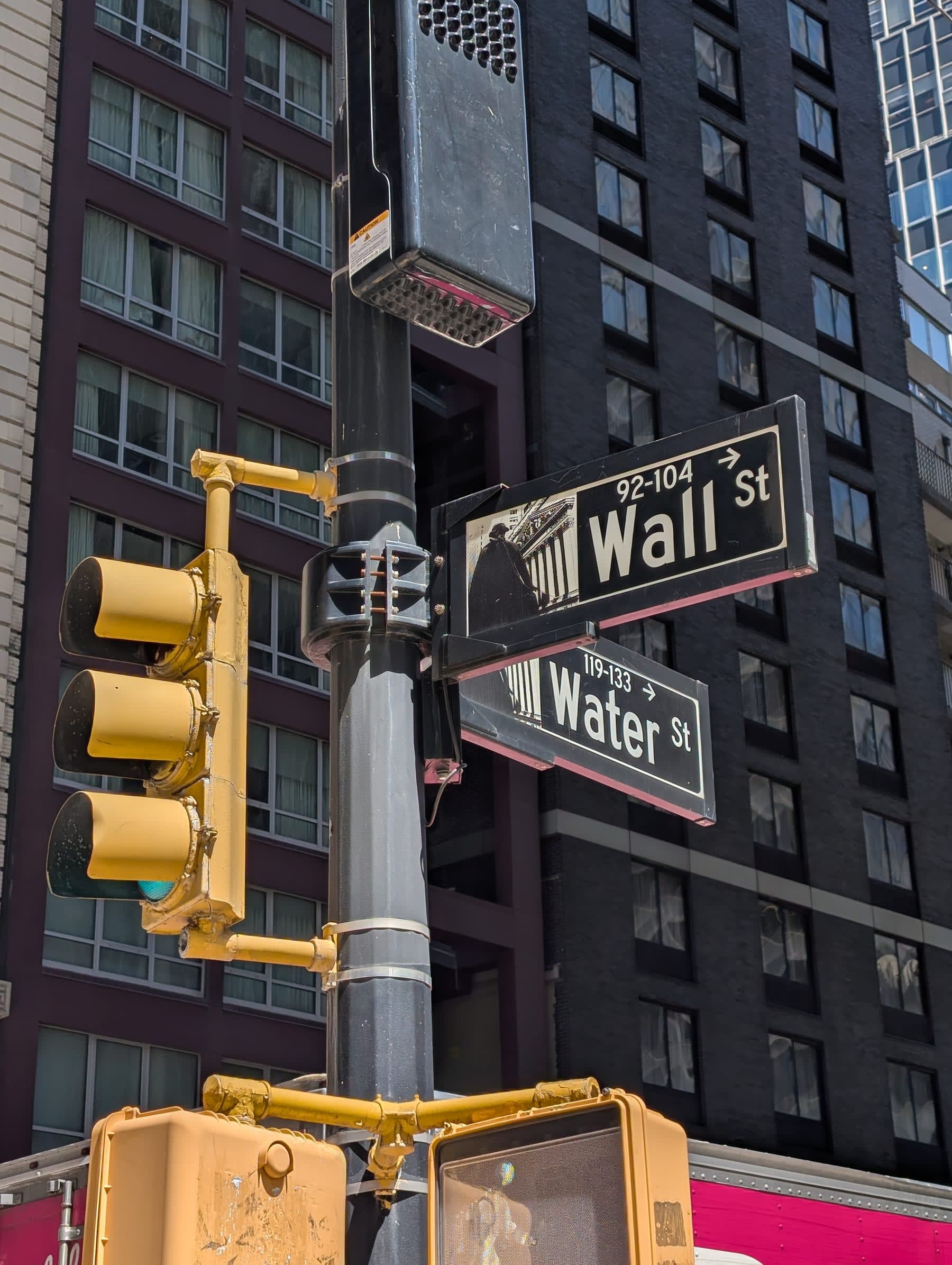
I photographed the sign because one does. It is a street sign. It has white letters on black. It says what it says. And yet it carries enough cultural mass that stopping to photograph it feels less like tourism and more like acknowledging something that exists and has consequences and is therefore worth looking at directly.
The buildings on either side are, for the most part, extraordinary. The Beaux-Arts and Neoclassical facades that line this street were built in the early twentieth century by people who believed that financial power required architectural expression, and they were not wrong. The Bank of New York building at 48 Wall Street — limestone, arched windows, the words carved into the stone above the door — is the kind of building that Europe has in quantity and America has mostly replaced with glass.

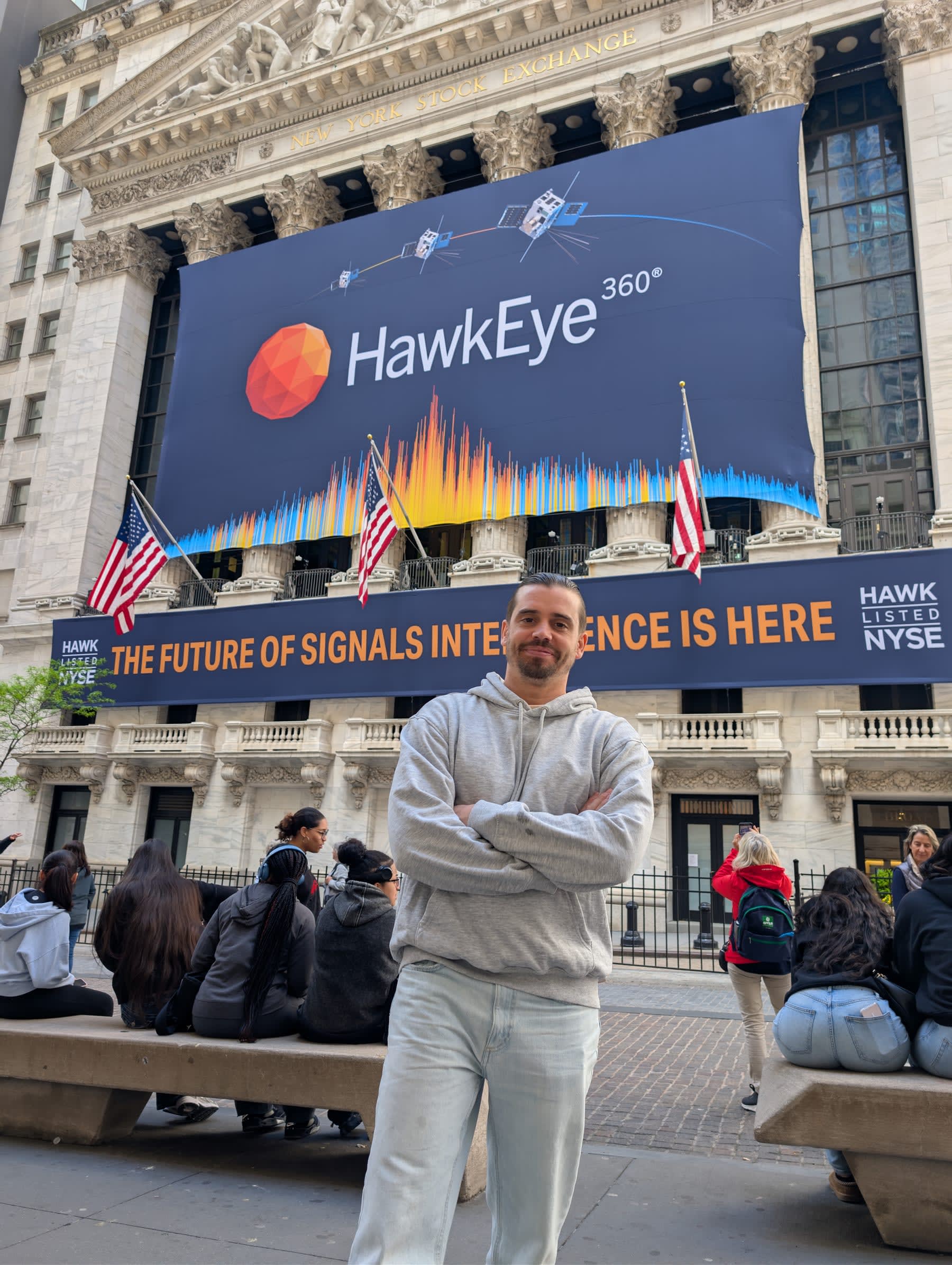
The New York Stock Exchange is at the corner of Wall and Broad. The building is Classical Revival — Corinthian columns, a pediment with allegorical figures, the American flags that have hung there since before anyone currently working there was born. On the day we visited, the facade carried a banner for a company called HawkEye 360, which had apparently just listed. The Future of Signals Intelligence Is Here, it read, across six columns of white marble. The juxtaposition — the oldest symbols of American financial authority dressed in the marketing language of a satellite intelligence startup — felt like a compressed image of where the country currently is.
Walk half a block west and look down Wall Street toward Broadway. The street is a canyon here — the stone facades rising on both sides, the pavement between them in shadow, and at the end of the corridor, visible like a precision-placed punctuation mark, the spire of Trinity Church.
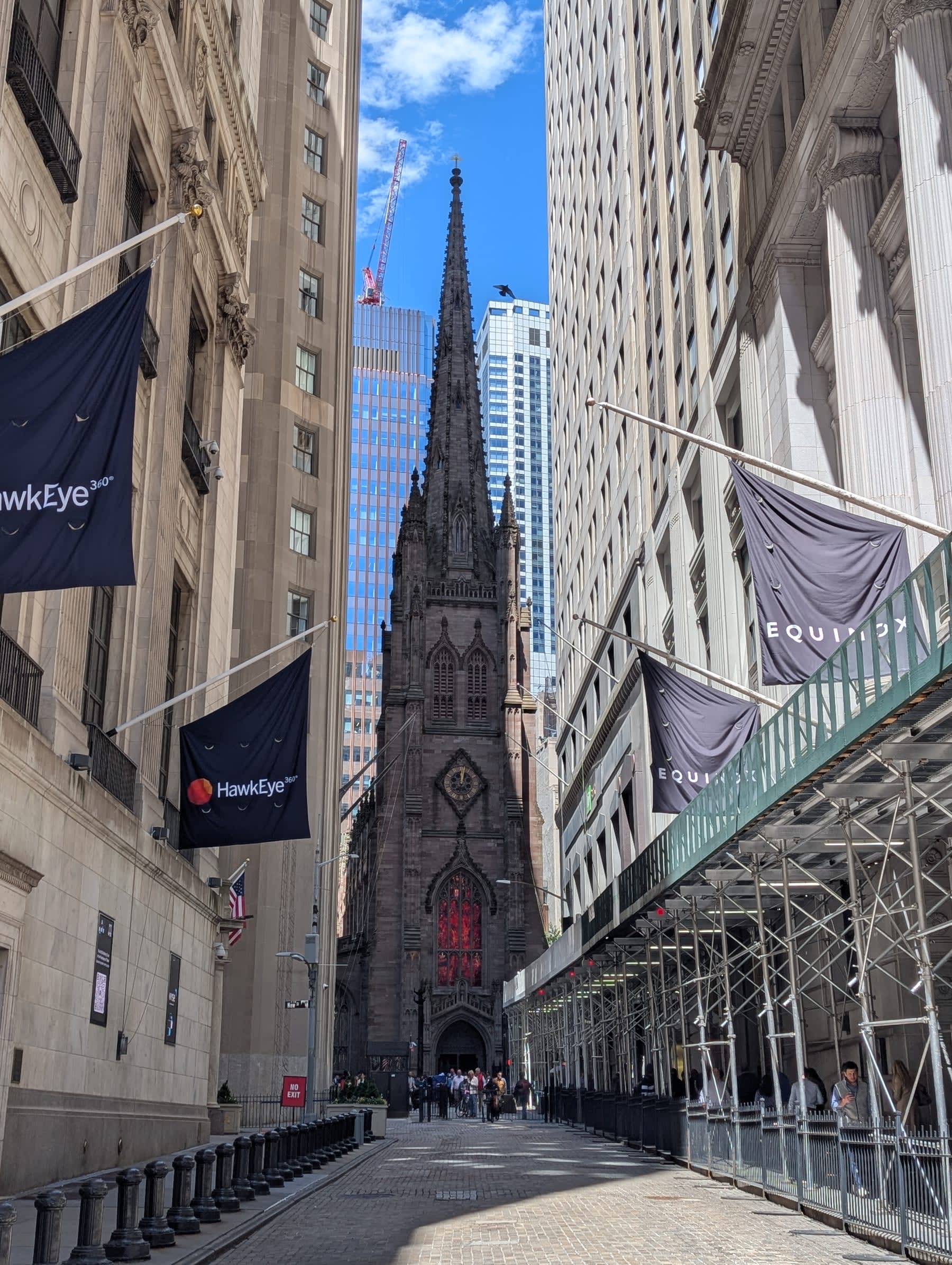
Trinity Church was finished in 1846. It sits at the head of Wall Street with the composure of something that was here before the banks and expects to be here after them. The Gothic spire rises above the surrounding towers with an ease that suggests it is not competing with them but simply occupying a different dimension of the argument. Alexander Hamilton is buried in the churchyard. So is Robert Fulton. The graves are worn smooth. The city has built up around them seven times since they were placed.
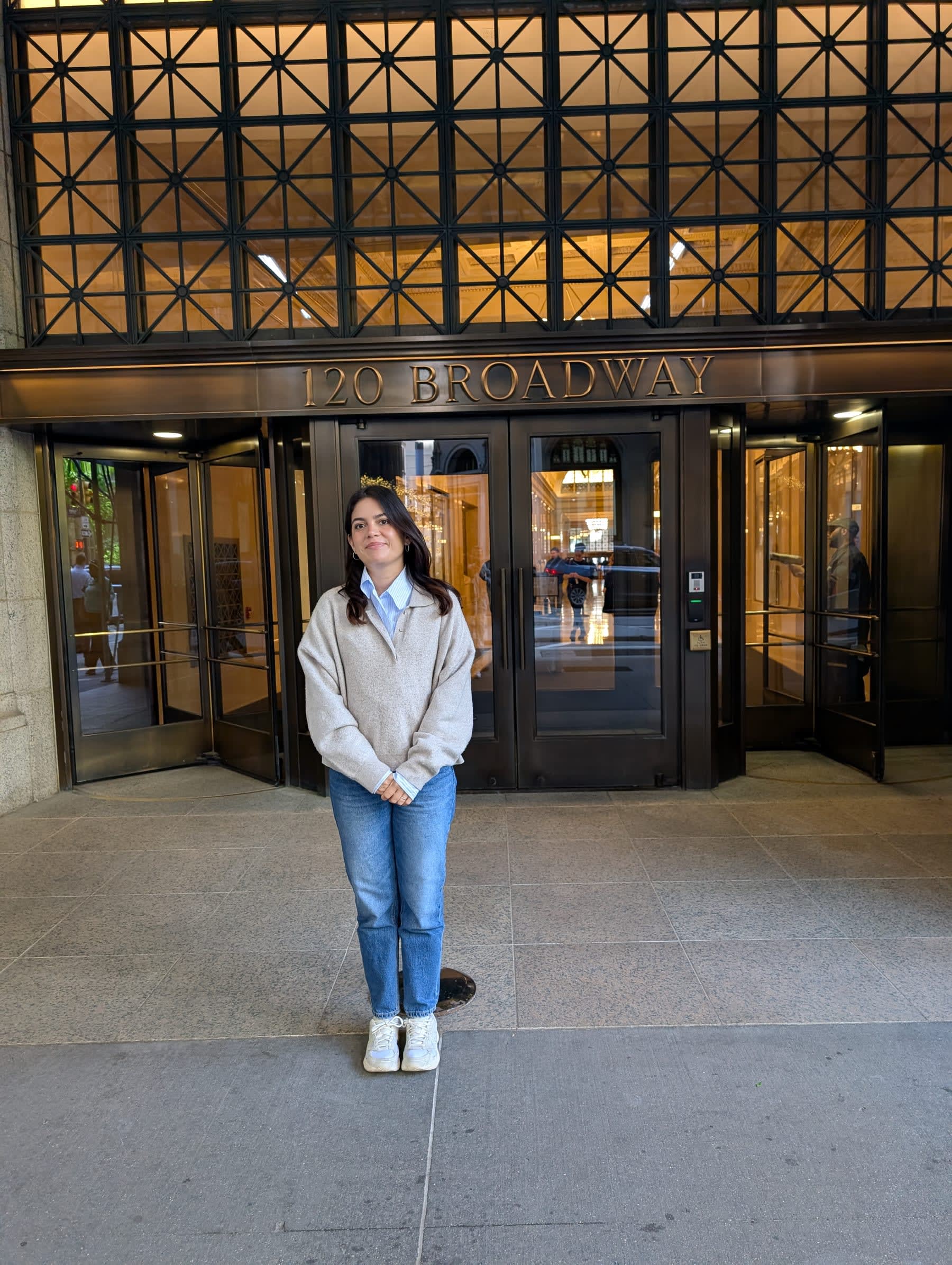
A few minutes south on Broadway, at 120 Broadway, Lia stopped to look up at the facade — an early-twentieth-century office tower, the kind that fills this part of the city, its setback roofline visible above the entrance canopy and the revolving doors. The scale of these buildings from street level is such that looking up produces the specific vertigo of standing inside something very large.
Manhatta
Manhatta is on the sixtieth floor of 28 Liberty Street, which is the building formerly known as One Chase Manhattan Plaza. The restaurant takes its name from the Walt Whitman poem — Manhatta, the island-name before the spelling settled — and the name is apt, because the view from the sixtieth floor is not a view of New York so much as a view of the poem that preceded New York and in which New York is still, somewhere, embedded.
We arrived early and sat at the bar while the table was being prepared. Behind the bar, a full wall of spirit bottles was arranged on a shelf against the floor-to-ceiling window, and through the bottles and the glass behind them, the midtown skyline floated in the afternoon haze — the Empire State, the Chrysler, the clustered towers of midtown, everything familiar from a distance and from this angle made strange by the height and the light and the peculiar effect of looking at a city through the necks of whiskey bottles.
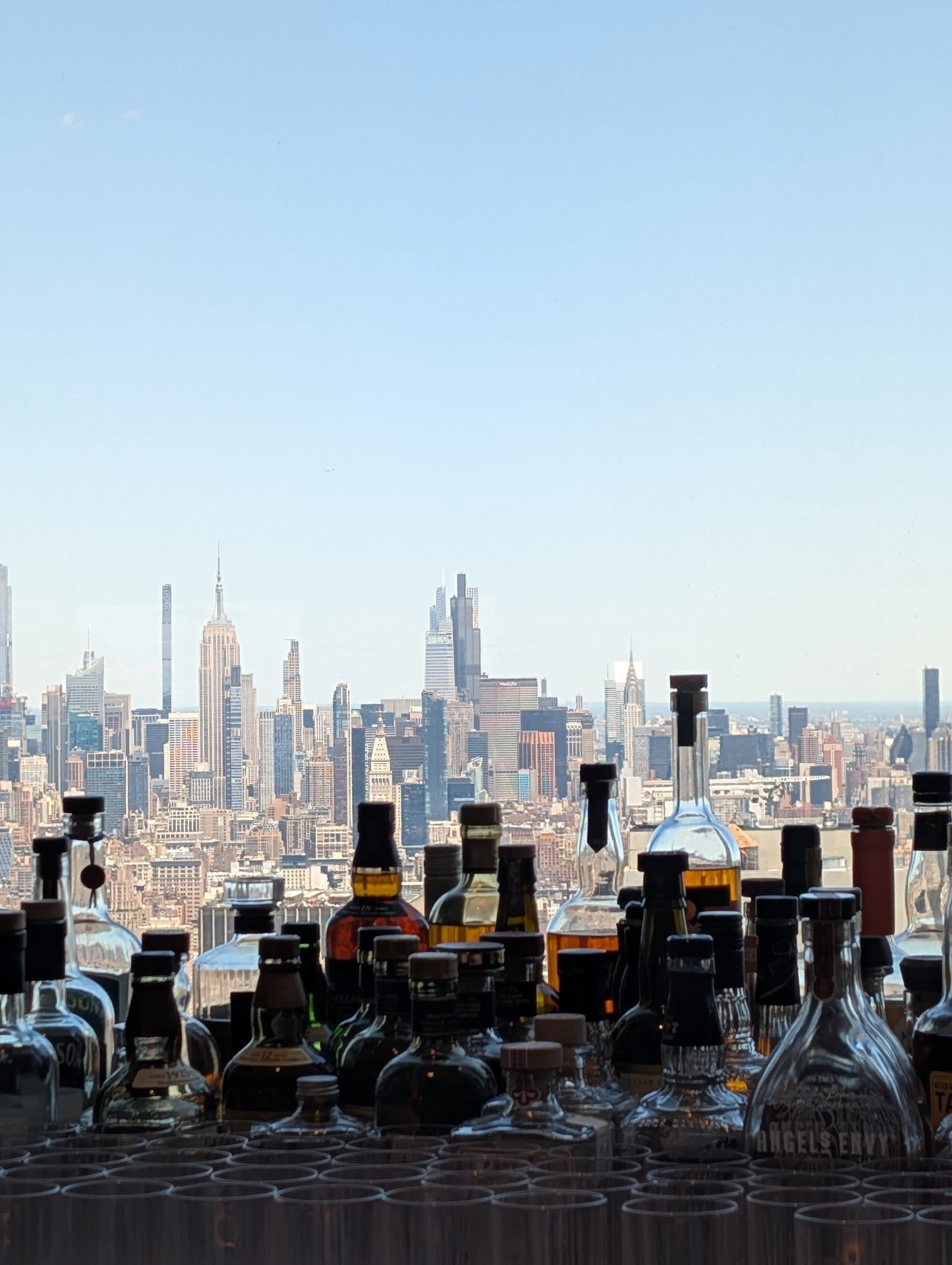
This is not a gimmick view. The bar was not designed to produce an Instagram photograph, though it inevitably produces one. The view exists because the building is tall and the window is large, and the bottles happen to be there because it is a bar, and the cumulative effect — the amber of the bourbon, the clear glass of the decanters, the steel and stone of the skyline behind — is genuinely beautiful in a way that no single element would be alone.
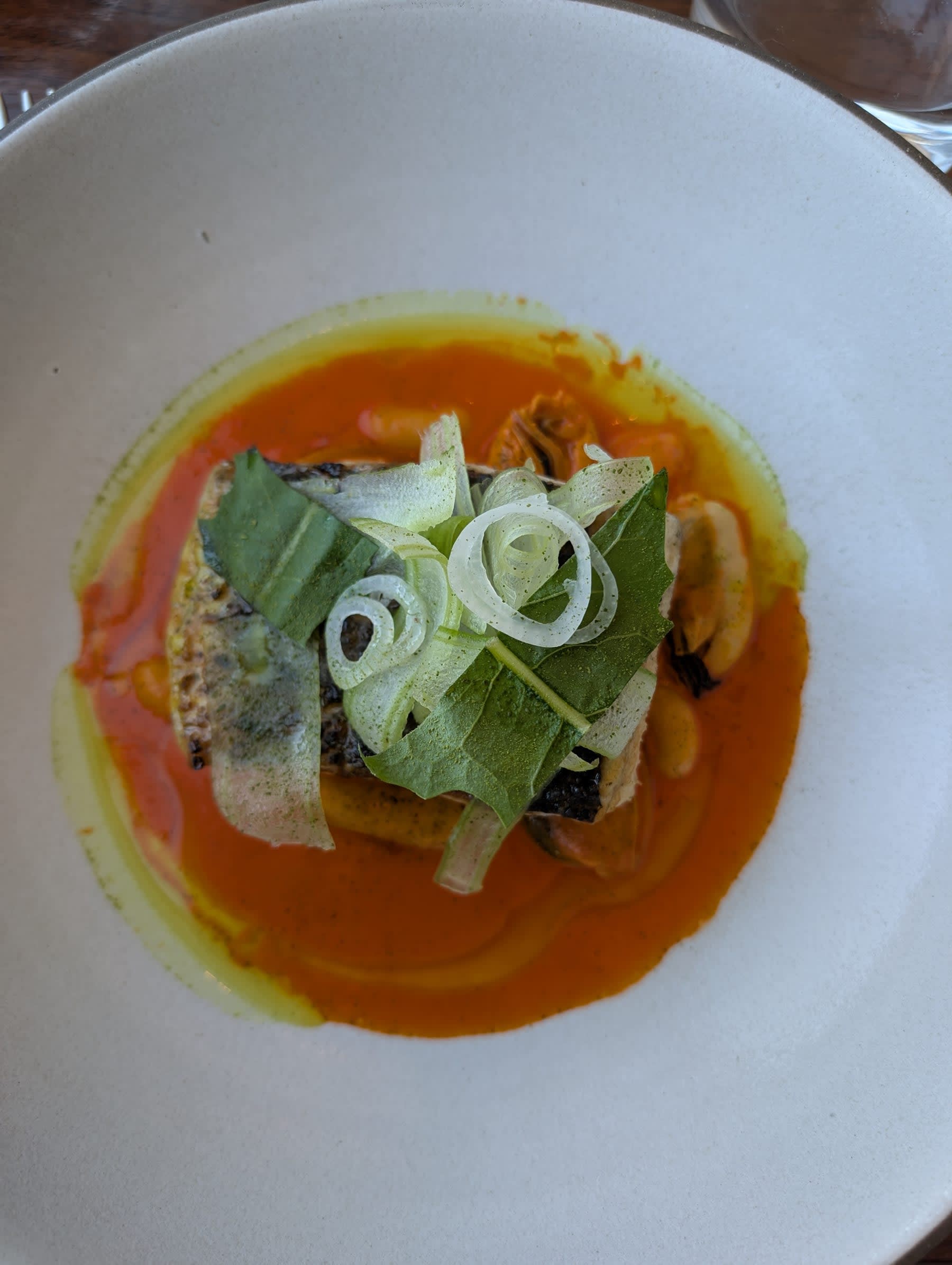
The restaurant itself is serious. The kitchen uses American ingredients with the precision that European cooking usually claims and American cooking is increasingly delivering. We ordered the fish — a piece of black bass in a tomato and saffron broth, garnished with herbs and curls of fennel, the kind of dish where every element has a reason and the reason is flavour.
And the short rib — braised to the point where a spoon would have done the work a knife was called for, served with roasted summer squash and a bone marrow sauce that was, and I say this as someone raised in a country that takes butter seriously, unnecessary in the best possible way.

By the time the main courses arrived, the afternoon had shifted toward evening and the city had rearranged itself in the changed light. Looking north from the table, the Woolworth Building — finished in 1913, the tallest in the world for seventeen years — stood in the middle distance below us, which is a sentence that requires a moment to process. Below us. A building completed in 1913 that held the height record for seventeen years was now something we looked down at from our table while eating short rib.

I sat by the window and looked at Brooklyn across the East River — the low rooftops, the housing projects, the water between. From sixty floors above the Financial District, the city is not intimidating. It is, for the duration of a meal, comprehensible. The same city that defeats you on foot resolves itself, from this height, into something with edges and proportions and a shape that you can hold in a single glance.
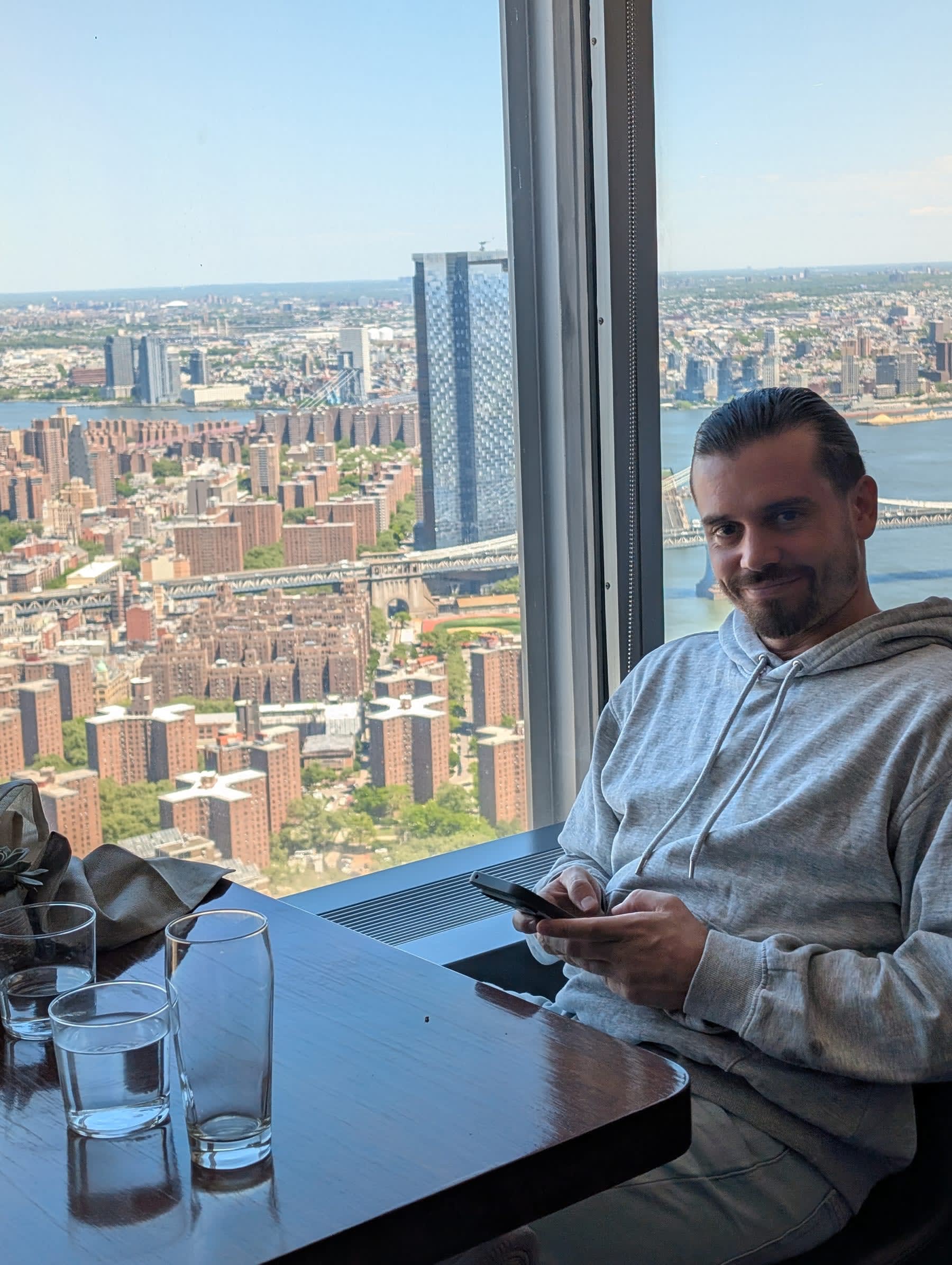
The food was excellent. The view was better. The combination — eating this well, at this height, with this particular geography below — is one of those experiences that New York occasionally produces and that are genuinely difficult to reproduce anywhere else, for the simple reason that there is no other city that is simultaneously this dense, this vertical, and this willing to put a serious restaurant at the top of a sixty-storey building above a street where the foundations of American capitalism were first poured.
We paid the bill. We took the elevator down sixty floors. The street came back up to meet us, as it always does.
When to go: The helicopter is best on a clear morning — May and September offer the most reliable visibility. Book HeliNY at least a week ahead, request window seats, and go without luggage. Walk Wall Street on a weekday when the suits are out. Manhatta takes reservations and fills up; book two weeks in advance for a window table at lunch, when the light across the midtown skyline is at its flattest and most revealing. The bar before the meal is not optional.
Keep exploring
More of New York