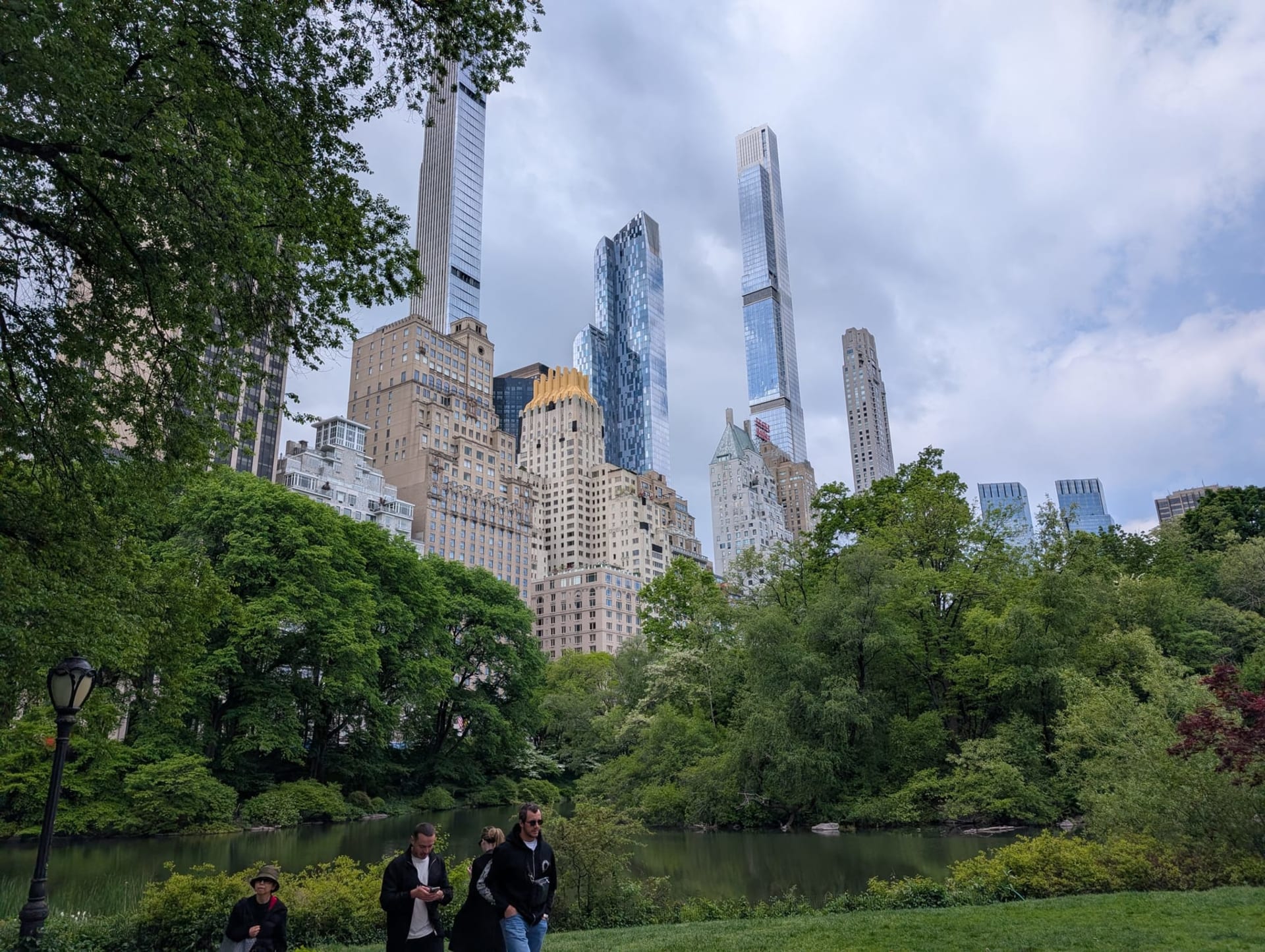
Central Park
"The park works because the city is always visible from it. The contrast is not accidental."
Four kilometres of green held inside the grid — where the city steps back and lets something older take over, and the skyline watches from the edges like it has always been there.
We walked up Fifth Avenue from the south, which is the correct direction for understanding what Central Park actually is. From below, you cannot see it. The avenue closes around you — the canyons of glass and stone, the buses, the density of the thing — and there is no indication that any of it is about to end. And then, at 59th Street, it ends. The avenue meets a wall of green and stops, and the park opens in front of you like a door that was left ajar.
Before the door, though, Fifth Avenue had things to say.
The Trunk on Fifth
At 57th Street, the Louis Vuitton maison had wrapped its building in what could only be described as an architectural act of confidence. The entire facade — several storeys of prime Fifth Avenue real estate — had been dressed to resemble a stack of oversized trunks: the monogram canvas, the brass hardware, the leather trim, all rendered at a scale that made the original trunks look modest in retrospect. The building did not look like a building wearing a costume. It looked like it had always been a trunk, and the surrounding midtown towers were the ones that seemed out of place.
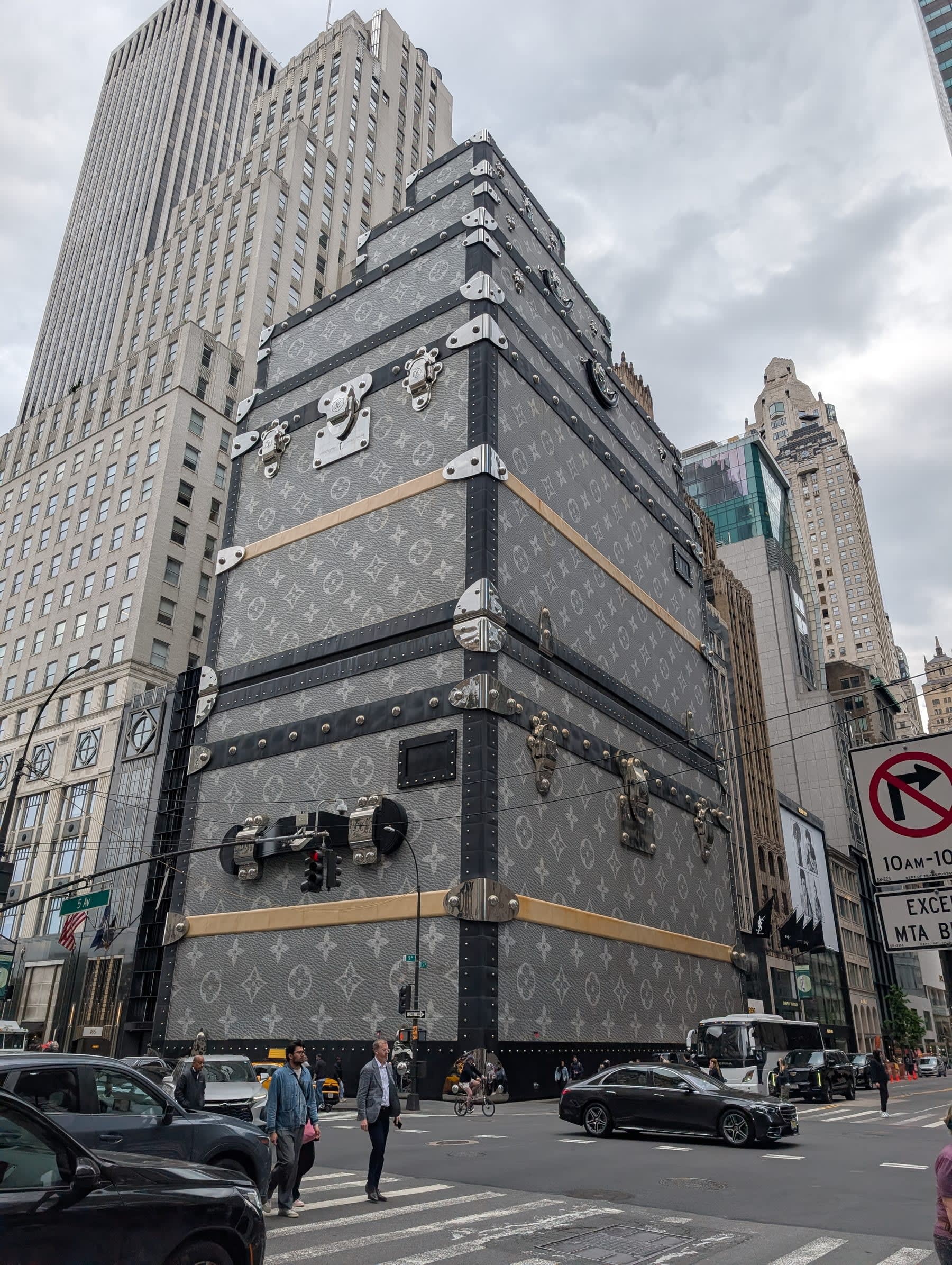
I stood on the opposite pavement for longer than was strictly necessary. The trunk-building occupied the corner with the particular composure of a very expensive object that does not need to justify itself. People walked past it the way New Yorkers walk past all singular things: without breaking stride, without looking up, as though a six-storey Louis Vuitton trunk on Fifth Avenue were simply another Tuesday.
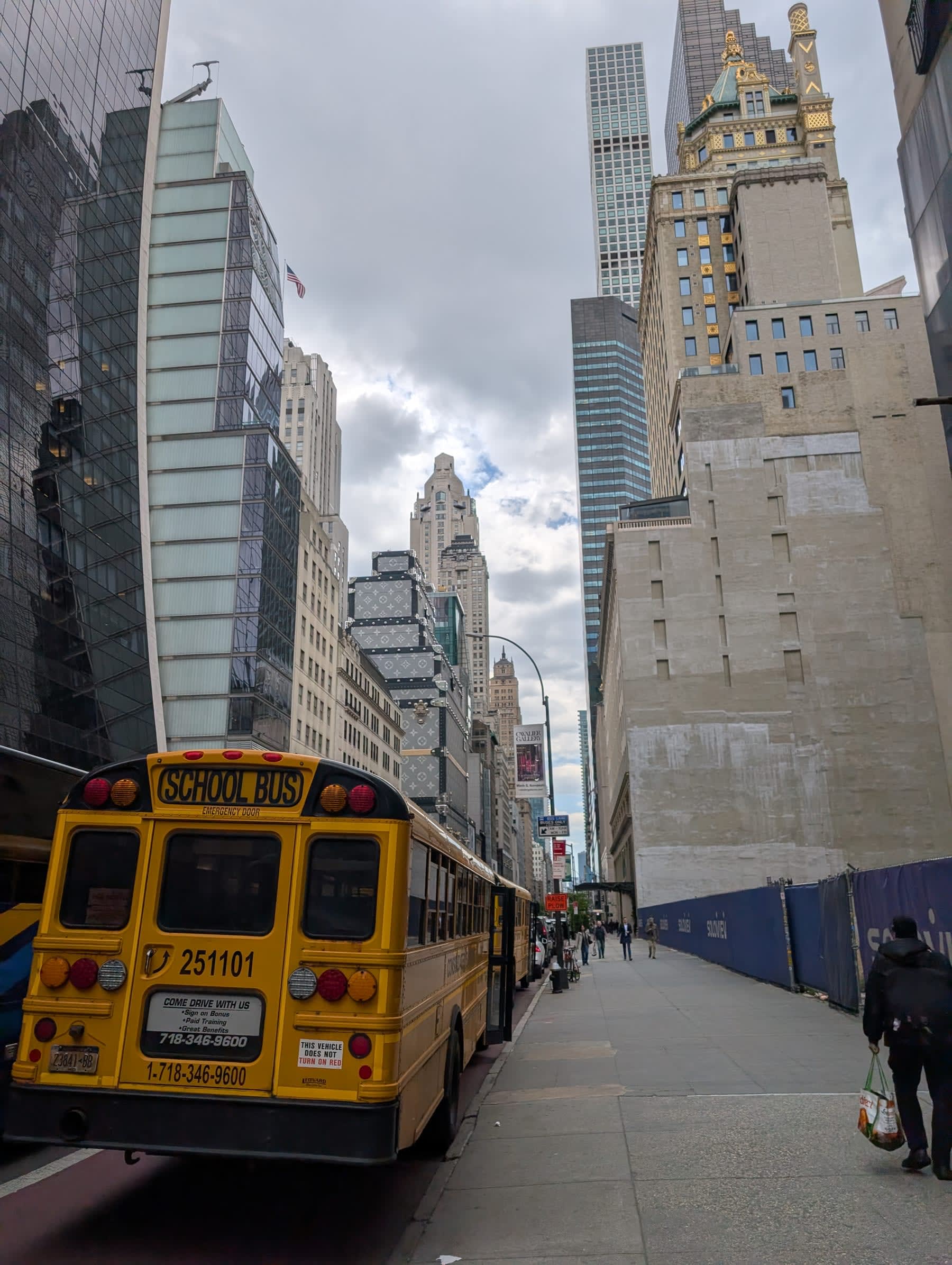
Further up the avenue, the yellow school buses lined the kerb outside some institutional building, and the towers compressed around them in the way that only midtown manages — everything too tall and too close and too certain of its own significance.
Grand Army Plaza
The park begins, really, at Grand Army Plaza — the wedge of open space where Fifth Avenue and 59th Street meet and the grid concedes, briefly, to a different geometry. At the centre of it stands the General Sherman Monument: Augustus Saint-Gaudens’ gilded group of Sherman on horseback, led by the figure of Victory, her wings extended, her arm raised, a palm frond in her hand. It is enormous and very gold.
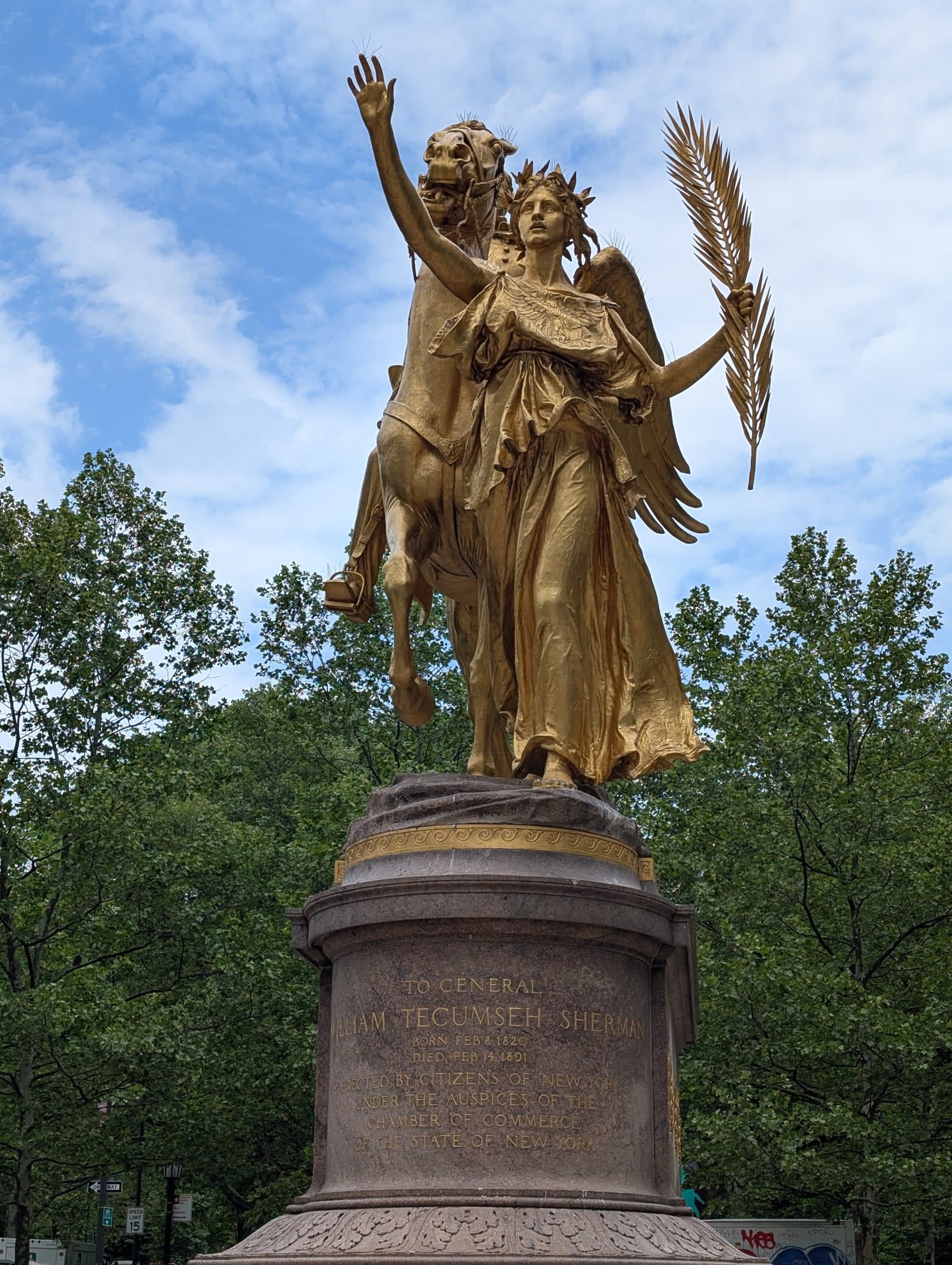
The statue was completed in 1903 and stands at the exact point where the city’s hard edge — the avenue, the hotels, the commercial concentration of the south — yields to the park. Saint-Gaudens placed Victory in the lead, which is either a comment on the nature of military triumph or simply the most compositionally satisfying arrangement, and it reads as both simultaneously. The gilt catches whatever light is available. On this day, the light was diffuse, the sky grey, and the statue still managed to glow.
The Pond
We crossed into the park via the Gapstow Bridge path at the southeast corner, and the city did not disappear so much as rearrange itself. The sound changed. The density changed. And then, twenty metres inside the treeline, the Pond appeared — a still stretch of dark water in an irregular basin, the reeds at its edges, the willows trailing, and beyond the trees, framing it from above like a backdrop that someone forgot to remove, the midtown skyline.
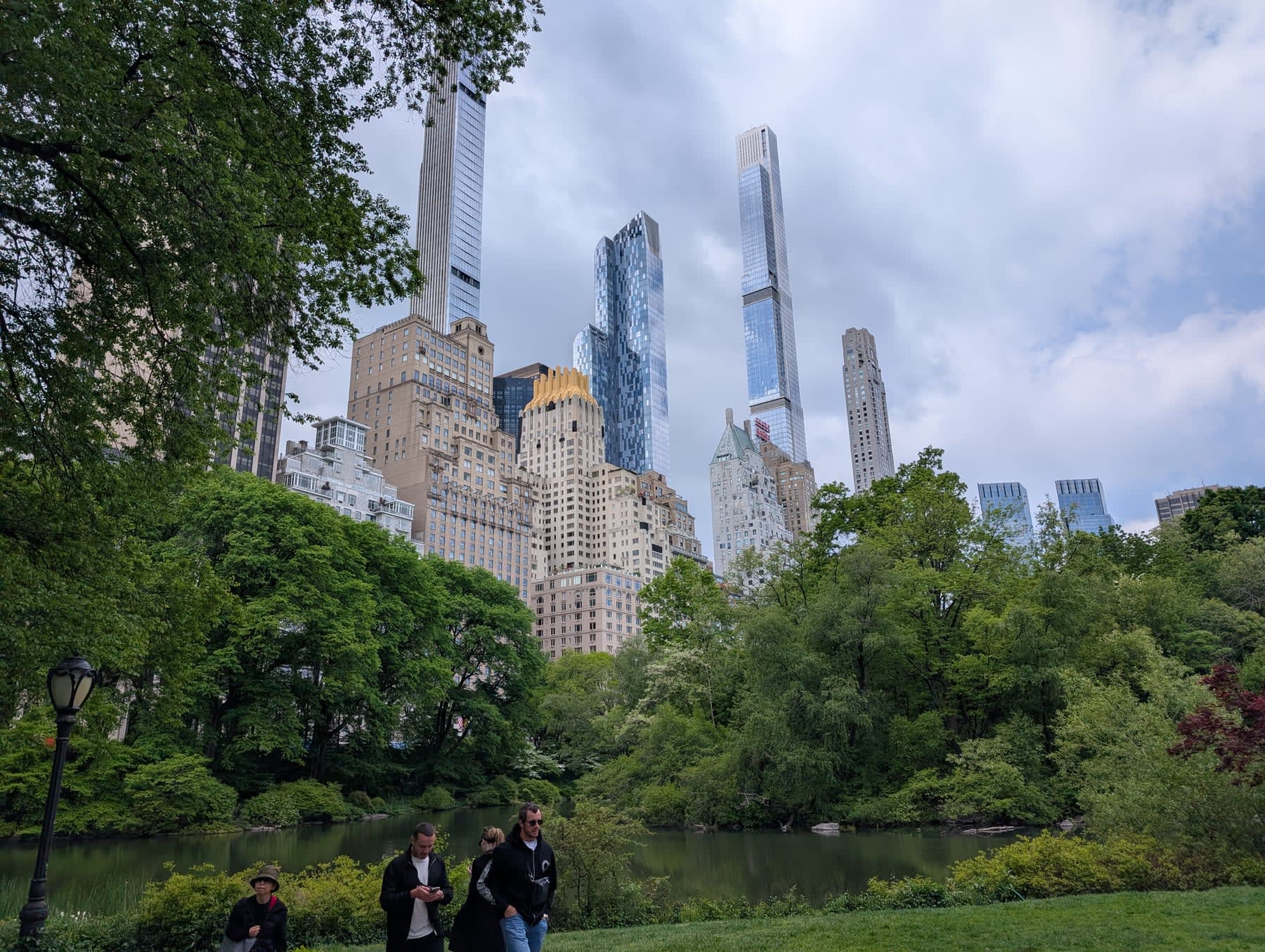
This view — the park’s foreground of water and leaf against the city’s background of glass and steel — is the central argument of Central Park. The park works because the city is always visible from it. The contrast is not accidental. Olmsted and Vaux designed the topography to foreground the natural and push the urban to the horizon, but the urban has since grown tall enough to reinsert itself, and the result is something neither of them planned: a landscape in which the two things that should cancel each other out instead become each other’s best argument.
I sat on the iron railing at the edge of the Pond with an iced coffee and looked at it for a while.
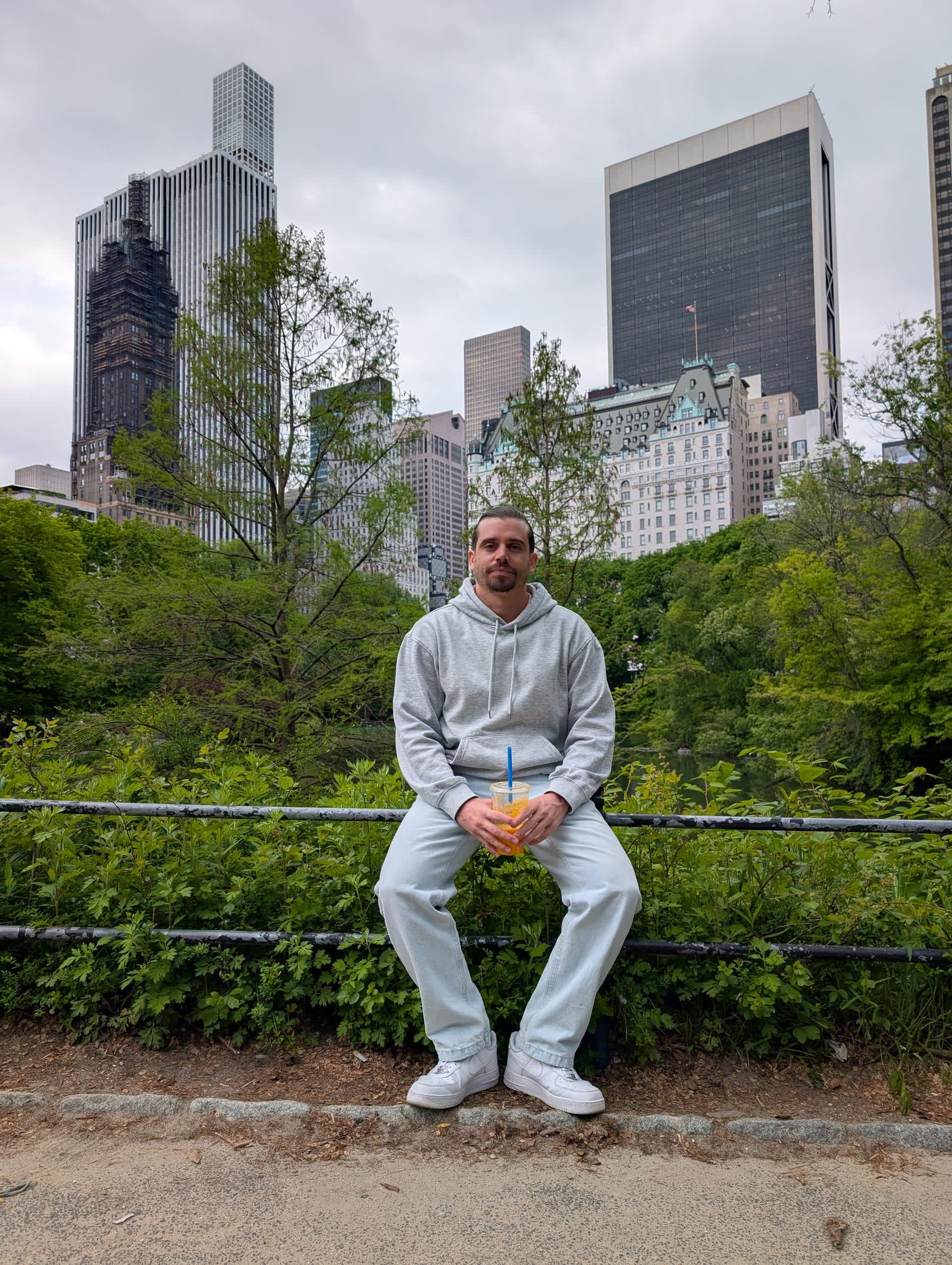
The iced coffee was from a cart near the entrance. It was acceptable. The view made it better.
Bethesda Fountain
We walked north through the Ramble path and emerged at the Bethesda Terrace, which is the park’s architectural centrepiece and the only place in the park where the design becomes explicitly monumental. The terrace descends in two levels to the fountain plaza — sandstone arcades, carved balustrades, the staircase with its Minton tile ceiling. And at the centre of the lower plaza: the Angel of the Waters.
Emma Stebbins completed the fountain in 1873. The bronze angel stands at the top of the upper basin, her wings spread, one foot stepping forward, her arm extended in a gesture of benediction over the water below. Four cherubs representing Temperance, Purity, Health, and Peace crouch at the corners of the pedestal. The whole ensemble is large enough to anchor a plaza without overwhelming it, which is a harder balance to achieve than it looks.
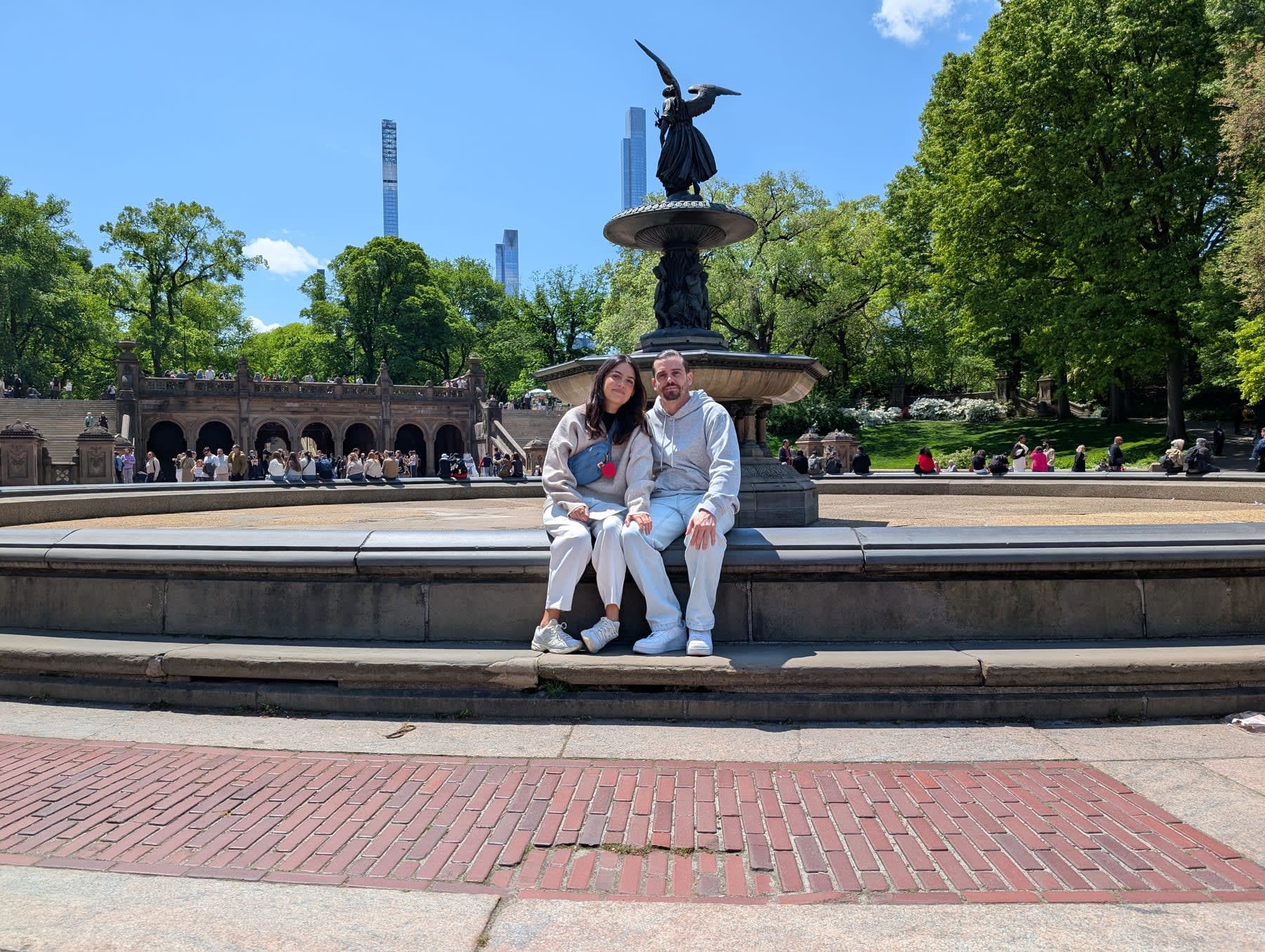
The plaza was busy in the way Central Park is busy on a clear afternoon — not unpleasant, because the scale absorbs it. People sat on the fountain’s edge, walked the terrace steps, photographed the angel from every available angle. Musicians had set up near the arcade. A family was having a picnic on the grass nearby. The general atmosphere was of a city that had, for a few hours, decided to be somewhere else.
Lia and I sat on the fountain rim and did nothing specific for twenty minutes, which is approximately nineteen minutes longer than I typically manage to do nothing specific in a city. The park is effective at this. It removes the obligation to be moving toward something, which is an obligation that New York otherwise imposes continuously.
The fountain runs. The city watches from the treeline. The afternoon holds.
When to go: May and early October are the best months — the trees are active, the light is soft, the temperature allows for walking without strategy. Arrive at the Pond at the southeast entrance before ten in the morning when the light comes from the east and the reflection is clear. Walk north through the Ramble rather than the main paths — it takes longer and costs nothing. Bethesda Fountain is at its best between eleven and two, when the sun is directly overhead and the bronze angel is fully lit. The food carts near the entrances are fine; the Loeb Boathouse restaurant is overpriced but has the correct view for a slow afternoon.
Keep exploring
More of New York