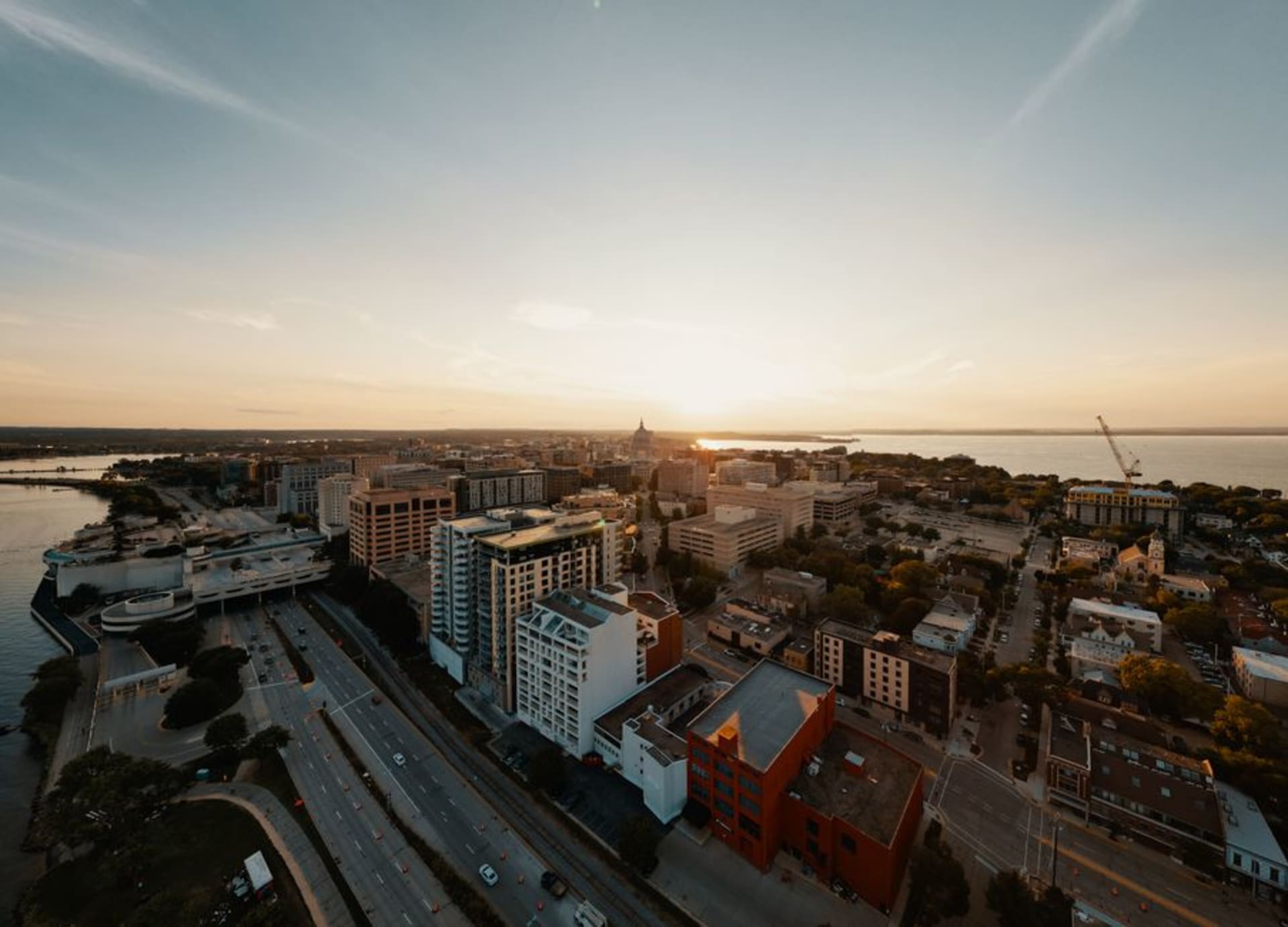
Madison sits on a sliver of land barely wide enough for a city, pinched between Lake Mendota and Lake Monona, and the geography turns out to be its whole personality. Wherever we walked, water waited at the end of the street, and the light came off it in a way that softened everything. Lia and I arrived on a Saturday morning without a plan and stumbled directly into the farmers market ringing the Capitol, which is apparently one of the largest in the country and felt like the entire city had turned out to buy cheese curds and gossip.
The Capitol and the market around it
The Wisconsin State Capitol stands dead center on the isthmus, a granite dome that is, I was proudly informed by a vendor, taller than the one in Washington. On Saturdays a market wraps the whole square in a slow-moving ring, and the etiquette is to walk it counterclockwise, which we learned by being gently corrected. We bought a paper sack of fresh cheese curds, still squeaking against our teeth the way genuinely fresh ones do, and a hunk of aged cheddar that I am not ashamed to say we finished before lunch. The dome gleamed above the stalls, and nobody was in a hurry.
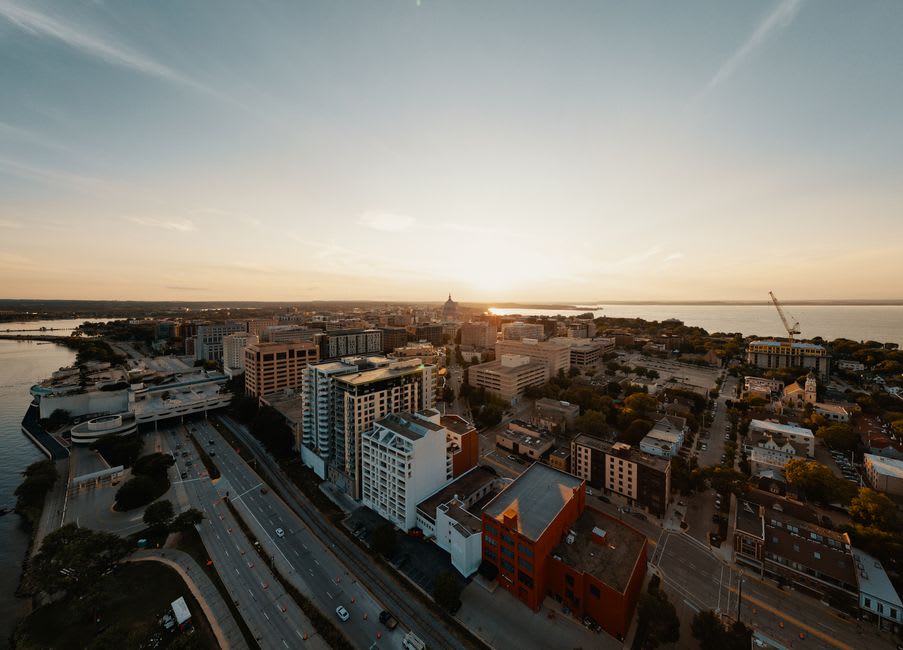
The Terrace at the water’s edge
The University of Wisconsin runs down to Lake Mendota, and there, at the Memorial Union Terrace, the city keeps its living room. It is a stretch of lakeside pavement scattered with those iconic sunburst chairs in orange, green, and yellow, where students and professors and families all sit facing the water with a beer or an ice cream. We claimed two chairs in the late afternoon and did nothing for two hours except watch sailboats lean across the lake. Lia said it was the most relaxed public space she had seen in America, and I think she was right, a place engineered entirely for sitting still.
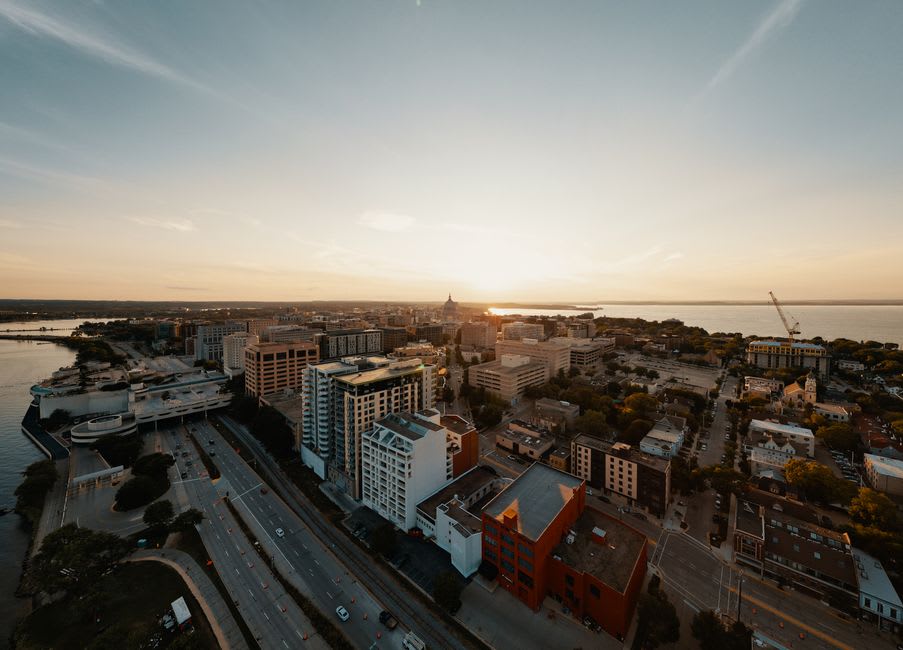
State Street and the walk between
Connecting the Capitol to the university runs State Street, a pedestrian spine of bookshops, record stores, and cheap good restaurants that carries the city’s student energy without feeling like a campus strip. We walked it slowly, ducking into a used bookstore where I lost half an hour, then eating Nepalese food at a hole-in-the-wall that a passing cyclist had shouted at us to try. Buskers played on the corners and the whole street had the loose, curious feeling of a place where people actually read the flyers stapled to the poles. It is the connective tissue of Madison, and walking it is the best way to understand the town.
Getting There
Dane County Regional Airport lies just northeast of downtown, a fifteen-minute drive, with connections through the major Midwestern hubs. Many travelers also fly into Chicago and make the two-and-a-half-hour drive north, a straight shot up through Wisconsin farmland with a bus service running the route if you would rather not drive. Once in Madison the isthmus is walkable end to end, and a rented bike is even better given the lakeside paths. We spent a weekend and left plotting a return in warmer light.