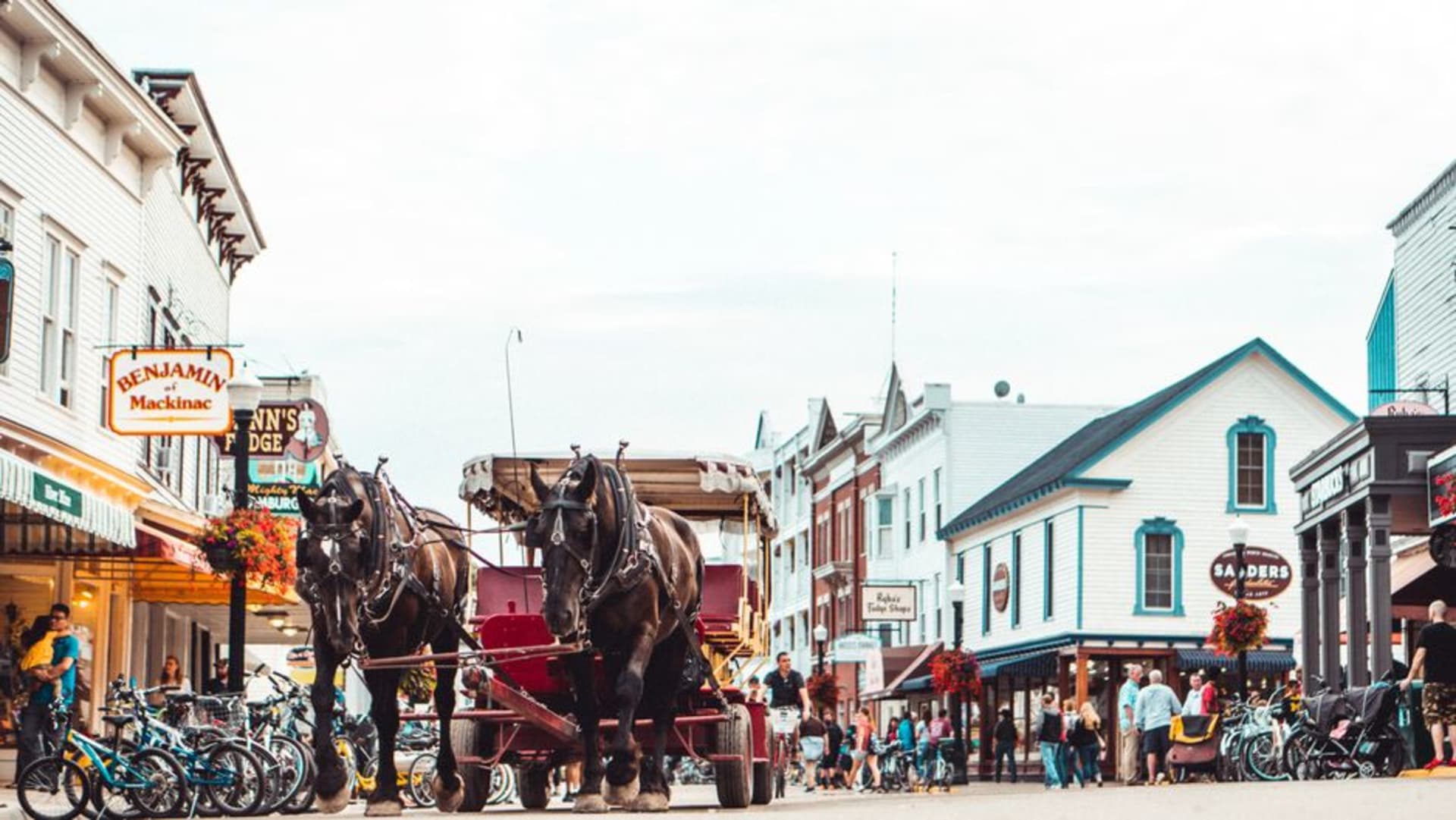
Mackinac Island
"No cars, no rush — just hooves on cobblestone and the whole island moving at the pace of a horse."
The ferry from Mackinaw City throws up a wall of spray as it rounds the point, and then suddenly the island is there — church spires, Victorian rooftops, and above it all the impossibly long white porch of the Grand Hotel. But the thing that truly announced our arrival was the sound, or rather the absence of one. No engines. As we walked off the dock, the noise that filled in was hooves: horses everywhere, pulling drays stacked with luggage and crates of the island’s famous fudge. Cars have been banned here since the 1890s, and Lia turned to me with a grin and said it was the first American place that felt genuinely, structurally unhurried. She was right, and it changed how the next two days felt.
Cycling the shoreline
The best decision we made was renting bicycles and riding M-185 — the only state highway in America where no car has ever driven. It hugs the shore for thirteen kilometres, a flat, easy loop around the whole island, and we did it slowly, stopping constantly. We passed Arch Rock, a great limestone bridge arcing over the blue water of Lake Huron, and pulled our bikes onto pebble beaches to skip stones. Away from the fudge-scented crowds of downtown, the far side of the island was empty and wild, all cedar forest and quiet coves. Lia found a piece of driftwood shaped like a bird and carried it the rest of the way, one hand on the handlebar, laughing every time we hit a bump.
Fort Mackinac and the bluffs
We climbed up to Fort Mackinac, the whitewashed British-and-American garrison perched on the bluff, and from its ramparts the view swept down over the harbor full of white sails and the long spans of the Mackinac Bridge in the distance. A costumed soldier fired the cannon, which made Lia jump and then insist we watch it again. Wandering the interior roads afterward, we passed the great Victorian “cottages” of the East and West Bluffs — vast gingerbread mansions with wraparound porches, built by wealthy Midwesterners a century ago and still summered in today. The whole hillside felt like a preserved dream of a slower, more ornate America.

Fudge, porches and lake light
You cannot come here and resist the fudge — it is practically the island’s currency. We watched it being made in the front windows of Main Street shops, workers folding great slabs of it on marble slabs with long paddles, and of course we bought too much. Late in the day we splurged on the ritual of the Grand Hotel, walking its 200-metre porch (the longest in the world, they claim) lined with red geraniums and white rocking chairs. We sat and watched the light go golden over the straits, freighters sliding past on the horizon, and I thought that few places make idleness feel so entirely earned.
Getting There
There are no bridges or roads onto Mackinac Island — you arrive by boat or, rarely, small plane. Fast passenger ferries run constantly in season from both Mackinaw City on the Lower Peninsula and St. Ignace on the Upper, taking around fifteen to twenty minutes across the straits; we left our car in a lot in Mackinaw City and never missed it. Both departure towns sit right off Interstate 75, roughly four to five hours’ drive from Detroit or Chicago. Once on the island, forget wheels entirely: everything moves by bicycle, horse-drawn carriage, or your own two feet.