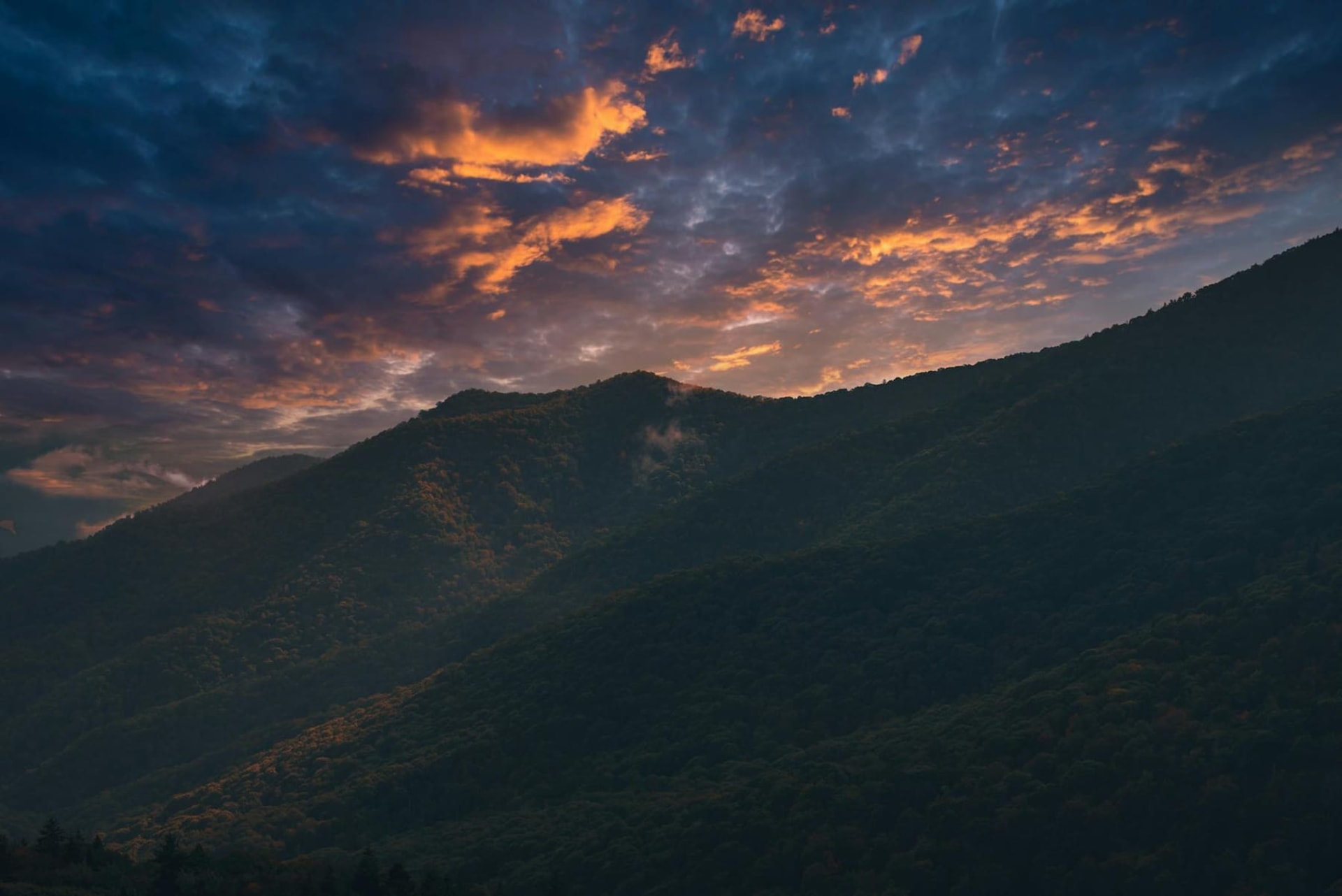
Great Smoky Mountains
"The Smokies earned their name — a soft haze that makes every ridge look painted rather than real."
I came expecting crowds. The park draws more visitors than Yellowstone and Grand Canyon combined — that statistic follows you around like a warning. What I didn’t expect was how thoroughly the mountains swallow the noise. Standing on the Alum Cave Trail at six in the morning, the fog so thick I could barely make out Lia twenty meters ahead of me, the only sound was water dripping from the bluffs and the occasional protest of a wood thrush somewhere in the canopy. The crowds were real. The solitude was realer.
The Haze Is the Point
Smokies locals will tell you the mist comes from the trees themselves — volatile organic compounds released by the dense hemlock and oak, catching moisture, building that characteristic blue veil that softens every ridge into something painterly. I believed it by the second morning. Newfound Gap Road winds across the Tennessee–North Carolina border at nearly 1,500 meters, and from the overlook there, I watched ridge after ridge disappear into gradients of grey-blue, each one paler than the last, until the farthest peak was barely a suggestion. My camera couldn’t do anything useful with it. Sometimes places resist documentation.
The smell up there is particular — damp earth, something resinous from the evergreens, a faint mineral sharpness from the wet stone. Nothing like the pine forests I know in Europe. Older, somehow. These mountains are among the oldest on earth, worn down from something once Himalayan.
Gatlinburg, and What Lies Behind It
Gatlinburg sits at the main entrance and makes no apologies for itself. Pancake houses, taffy shops, an aerial tramway that deposits you at Ober Mountain. Lia found a jar of sourwood honey at a small stall just off the main strip on East Parkway and ate half of it before we’d even left town. I had a plate of stack cakes at a diner nearby — dense spiced molasses layers, an old Appalachian recipe that predates refrigeration. Nothing I’d ever encountered in any French pastry context, but genuinely good in a way that felt earned by history.
The surprise came on our third day, driving the quiet stretch of Roaring Fork Motor Nature Trail. We stopped because a black bear was sitting in the middle of the road, utterly indifferent to the car. Not foraging, not moving — just sitting, the way a very large, very confident animal sits. We waited fifteen minutes. It looked at us once.
The Fireflies
In late spring, Elkmont Campground becomes the stage for synchronous firefly displays — Photinus carolinus, one of the few species in the world that flashes in coordinated pulses. The Park Service runs a lottery for viewing permits. We didn’t win. But standing at the edge of the meadow at dusk on a regular night, watching the ordinary unsynchronized fireflies begin their scattered signaling across the tree line, I thought: this is already enough.
When to go: Late May to mid-June for the firefly season and wildflower bloom; mid-October for peak fall color, though that window fills fast and requires planning well ahead.