Everglades National Park
"The Everglades is the only wilderness I know that whispers rather than shouts."
I came to the Everglades expecting drama — the kind of raw, aggressive wilderness that announces itself. What I found instead was something far stranger: a landscape that barely moves, barely speaks, and somehow says everything.
The River You Cannot See
The Everglades is not a swamp. That was the first correction the park made to my assumptions. It is a river — sixty miles wide and six inches deep — a slow sheet of fresh water moving imperceptibly south from Lake Okeechobee toward Florida Bay. Standing on the Anhinga Trail at Royal Palm, staring at what looks like a still, tea-colored pond, it takes a moment to notice the surface is, in fact, drifting. The whole world here is drifting.
We arrived at dawn, the air already thick and warm even in December. The sawgrass caught the first light and turned gold, then amber, and for a few minutes the entire prairie looked like it was on fire without burning. An anhinga spread its wings on a low branch to dry — that particular, cruciform pose — and did not acknowledge us at all.
The smell is its own thing: algae and wet mud and something faintly sweet underneath, like overripe fruit just out of reach. It stays in your clothes.
An Alligator and a Silence
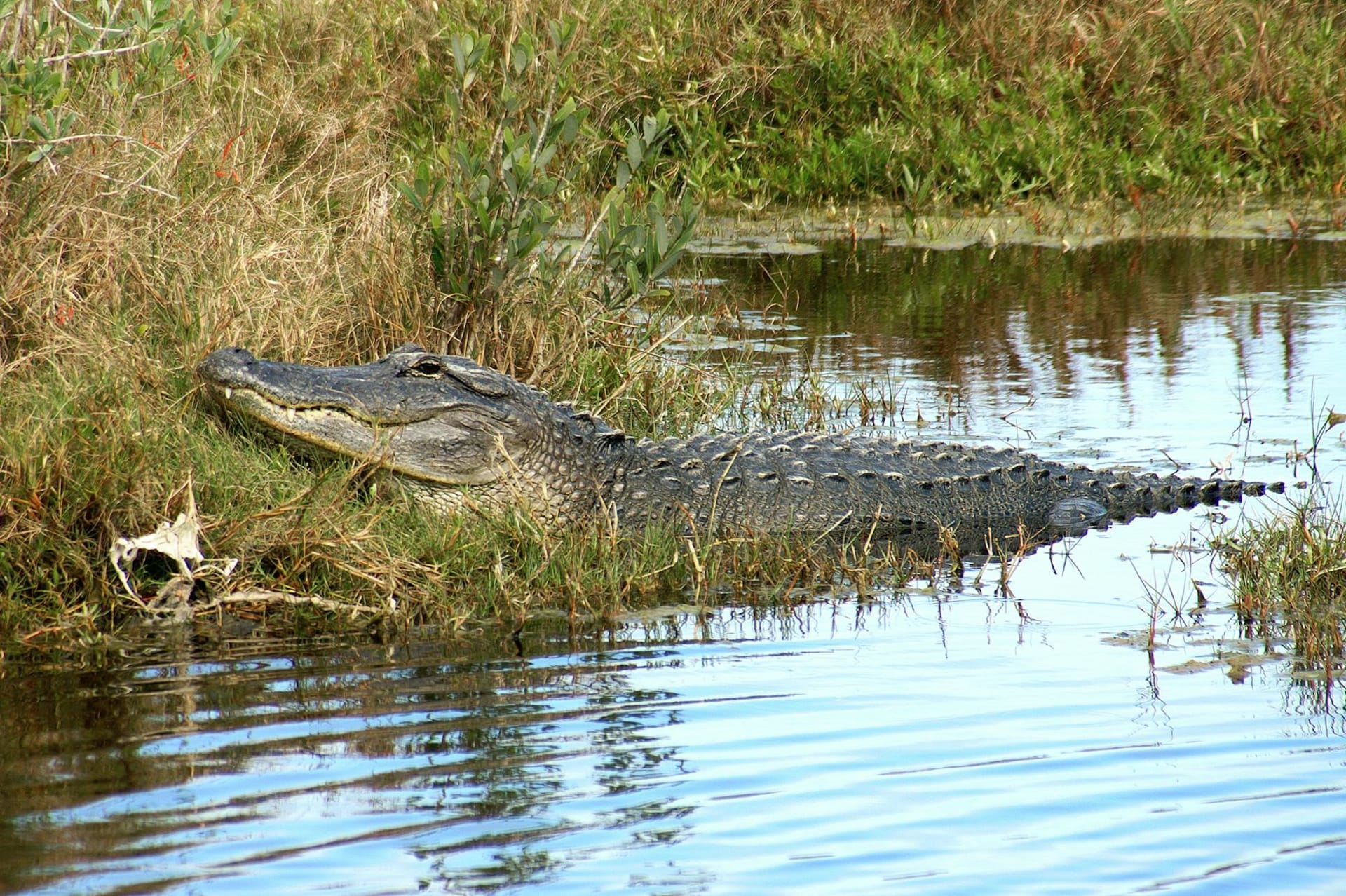
On the Gumbo Limbo Trail, Lia spotted the alligator before I did. It was lying across the path with the casual authority of something that has never once been prey, its jaw slightly open, motionless. We waited. It did not move. We stepped carefully around it, close enough to see the texture of its hide — not smooth, but almost architectural, each scute raised and precise. The unexpected thing was not the alligator itself but the silence around it. No wind. No birds in that moment. Just the soft creak of strangler fig roots and the sound of our own breathing.
Later, at Flamingo at the southern tip of the park, we watched a manatee surface near the marina — a gray, unhurried shape that rose, exhaled with a sound like a satisfied sigh, and sank again. I had not expected to feel moved by it. I was.
What the Light Does at Dusk
The sunsets at Pa-hay-okee Overlook are not the showy tropical spectacles of the Keys. They are longer, quieter — the light flattening across the sawgrass and turning everything the color of old copper. The horizon is so uninterrupted here that you feel the curvature of the earth as a physical fact.
It is a wilderness that asks for patience rather than pursuit. I was glad we gave it some.
When to go: November through April is the dry season — cooler temperatures, far fewer mosquitoes, and wildlife concentrated around remaining water sources. Summer brings rain, heat, and biting insects in quantities that are genuinely difficult to overstate.