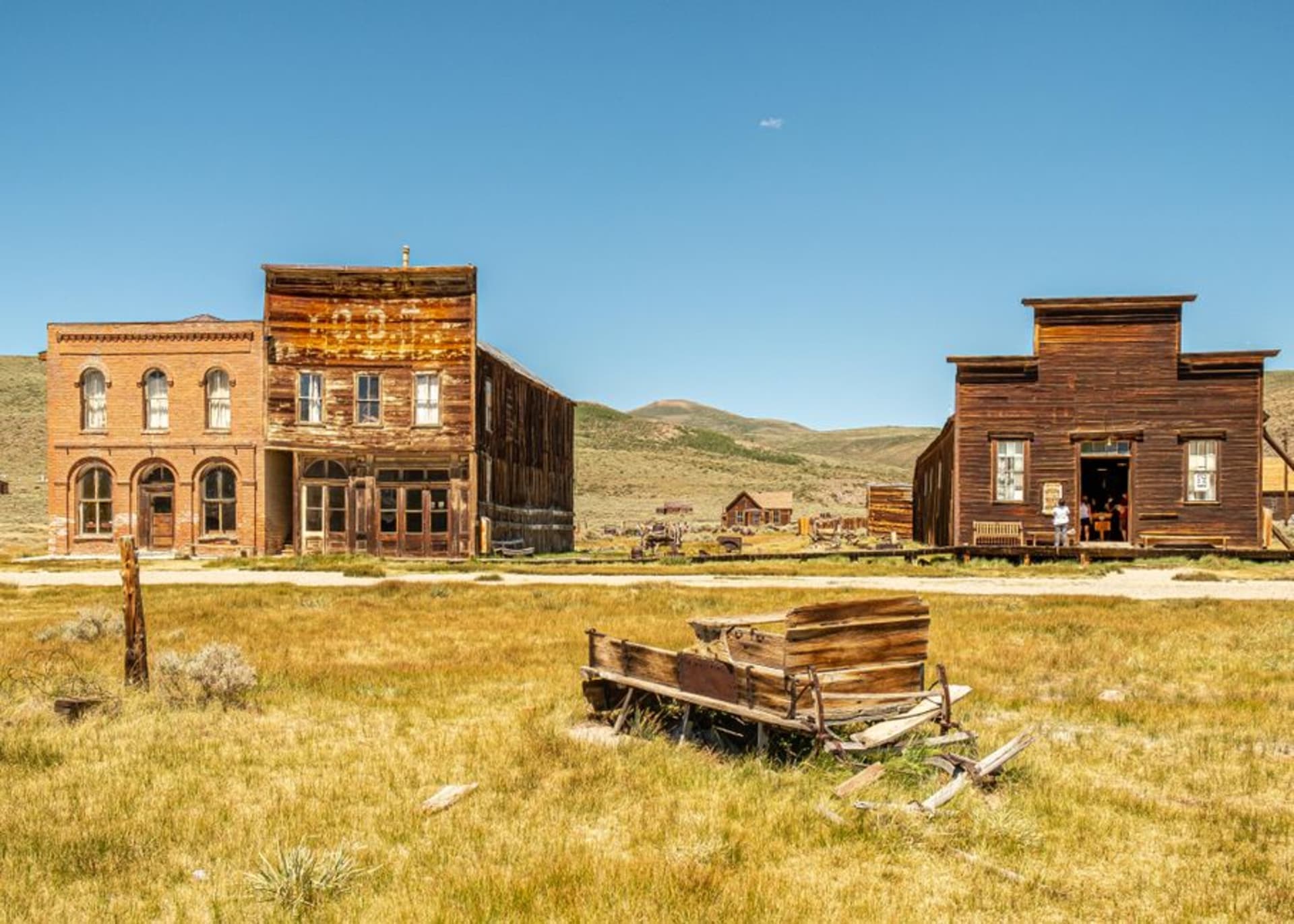
Deadwood
"The whole town is jammed into a crack in the hills, and it has been for a hundred and fifty years."
The first thing you notice about Deadwood is that there is no room for it. The town is crammed into the bottom of a gulch so tight that Main Street runs a single crooked line along the creek, the brick buildings shouldered up against the pine slopes on either side. We arrived on a weekday evening in early summer, and after the neon and the tour buses had gone quiet, Lia and I walked the empty street in the blue dusk and it felt genuinely old — not a set, but a place that had simply refused to die when the gold ran out. The gulch held the cool night air, and somewhere a saloon door was still swinging open and shut.
Wild Bill and the Number 10
You cannot come to Deadwood and avoid the story of Wild Bill Hickok, and honestly you shouldn’t try. He was shot in the back of the head at a poker table here in August 1876, holding two pairs — aces and eights — forever after called the Dead Man’s Hand. Saloon No. 10 stages a reenactment of it several times a day, and yes, it’s theater, but there’s a strange charge to standing in the room, more or less on the spot where a legend became a corpse over a card game. We had a beer at the long bar afterward, under the mounted heads and the yellowed photographs, and I found myself unexpectedly moved by how thin the line is between history and myth.
Mount Moriah, Above the Town
Climb the steep road out of the gulch to Mount Moriah Cemetery and the whole story lays itself out. This is where they buried Wild Bill, and beside him, at her own request, Calamity Jane. The graves sit on a pine-shaded slope with the town far below and the hills rolling away beyond. It was quiet up there, just the wind and a few other visitors reading headstones. Lia stood a long time at Hickok’s grave, worn smooth by a century and a half of hands. From that height, Deadwood looks like exactly what it is: a desperate, hopeful town that people clawed out of a mountainside because there was gold in the creek, and then never quite let go of.
The Gulch by Morning
I liked Deadwood best before the day got going. We were up early, and I walked out for coffee while the street was still in shadow and the shopkeepers were only just cranking their awnings. A delivery truck idled outside a bakery. An old man swept the boardwalk in front of a gambling hall. Without the crowds and the barkers, you could hear the creek running under the town and imagine the tent city that stood here in 1876, all mud and gold dust and ambition. The brick facades caught the first sun coming over the gulch rim. For half an hour it belonged to nobody, and it was the most honest version of itself.
Getting There
Deadwood sits in the northern Black Hills of South Dakota, about an hour’s drive northwest of Rapid City, which has the nearest airport. The drive up through Spearfish Canyon is spectacular in its own right and worth building in. The town itself is small and walkable once you arrive — leave the car at your hotel and go on foot. It pairs naturally with the rest of the Black Hills, so most people fold it into a longer loop. Weekdays and shoulder seasons are far calmer than summer weekends, when the gaming crowds pack the narrow street.