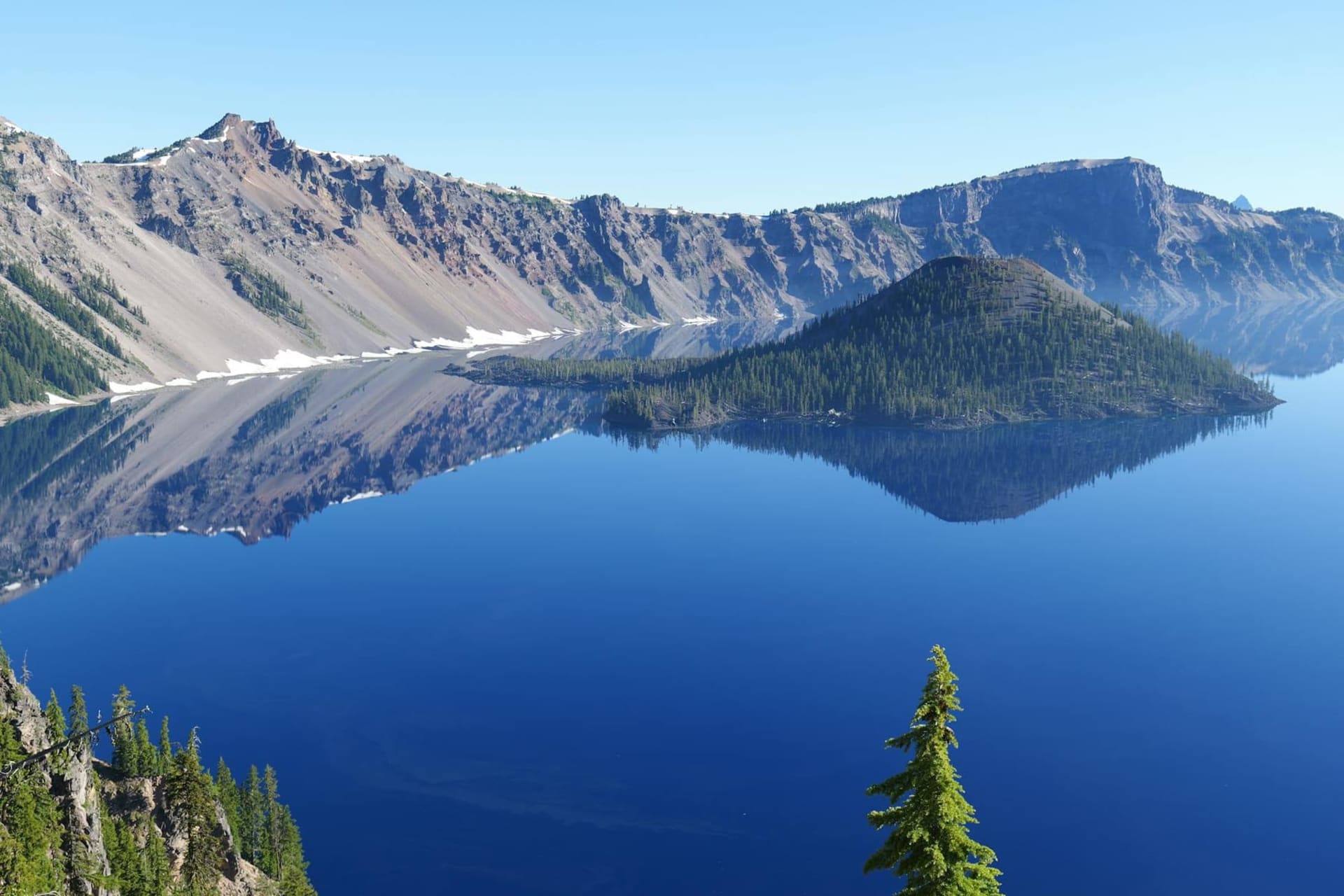
Crater Lake
"Crater Lake's blue is not a color — it's an argument about what water can become."
I had seen photographs. I thought I understood what I was driving toward. Then the road crested the rim of the caldera on the south entrance off Highway 62, and every photograph I had ever seen became irrelevant.
The lake doesn’t reveal itself gradually. It simply appears — a disc of color so saturated it registers as wrong, like a rendering error in the landscape, like someone had replaced the water with a swatch from a paint catalog labeled Impossible. Lia grabbed my arm without saying anything. That, I think, is the correct response.
The Rim and What the Light Does to It
Crater Rim Drive circles the caldera for thirty-three miles, and the temptation is to drive it quickly, stopping at overlooks, treating it like a checklist. We resisted this, mostly because the late-afternoon light made stopping mandatory. Around five o’clock, when the sun drops toward the western rim, the blue shifts — deepens into something closer to violet at the center, while the shallows near Wizard Island go almost turquoise. The lake has no inlet or outlet. Every drop of water in it arrived as rain or snowmelt and has been there long enough to forget anything else. That isolation is what makes the color. No sediment, no runoff, nothing borrowed from anywhere else.
We walked the Watchman Peak Trail — a short, steep two miles up to a fire lookout on the northwest rim — and watched a cloud shadow move across the surface below us like a slow thought crossing a face.
Wizard Island and the Unexpected Cold
The ferry to Wizard Island runs only in summer, which surprised me. I had assumed such a place would feel ancient and accessible simultaneously, a permanent invitation. Instead, it operates on a season, like a restaurant. We arrived in early July and the snow was still patchy on the upper rim at seven thousand feet. The air tasted like granite and pine resin and cold that had been stored somewhere since March.
What genuinely surprised me: the silence. I expected wind, the way high places usually whistle and press. Instead, the caldera created a kind of acoustic stillness I haven’t experienced anywhere else — the water too far below to make a sound, the trees back from the edge, the world withheld from itself.
We ate sandwiches on a basalt ledge above the boat dock and watched a Clark’s nutcracker work the pines below us with mechanical efficiency, unbothered by the thousand feet of blue nothing behind it.
When to go: July through September is the only reliable window — the rim road typically opens fully by late June after snowplows clear the forty-foot drifts. Come in early July for snowfields still framing the caldera; come in September for smaller crowds and the first cold clarity of autumn light.