Kent
"In Kent, the Housatonic sets the pace and nobody seems in a hurry to argue with it."
A Litchfield Hills village where waterfalls thunder beside the road and antique dealers outnumber traffic lights. Lia and I came for one afternoon and stayed two nights, pulled in by the Housatonic River and the smell of woodsmoke from the covered bridge at Bulls Bridge.
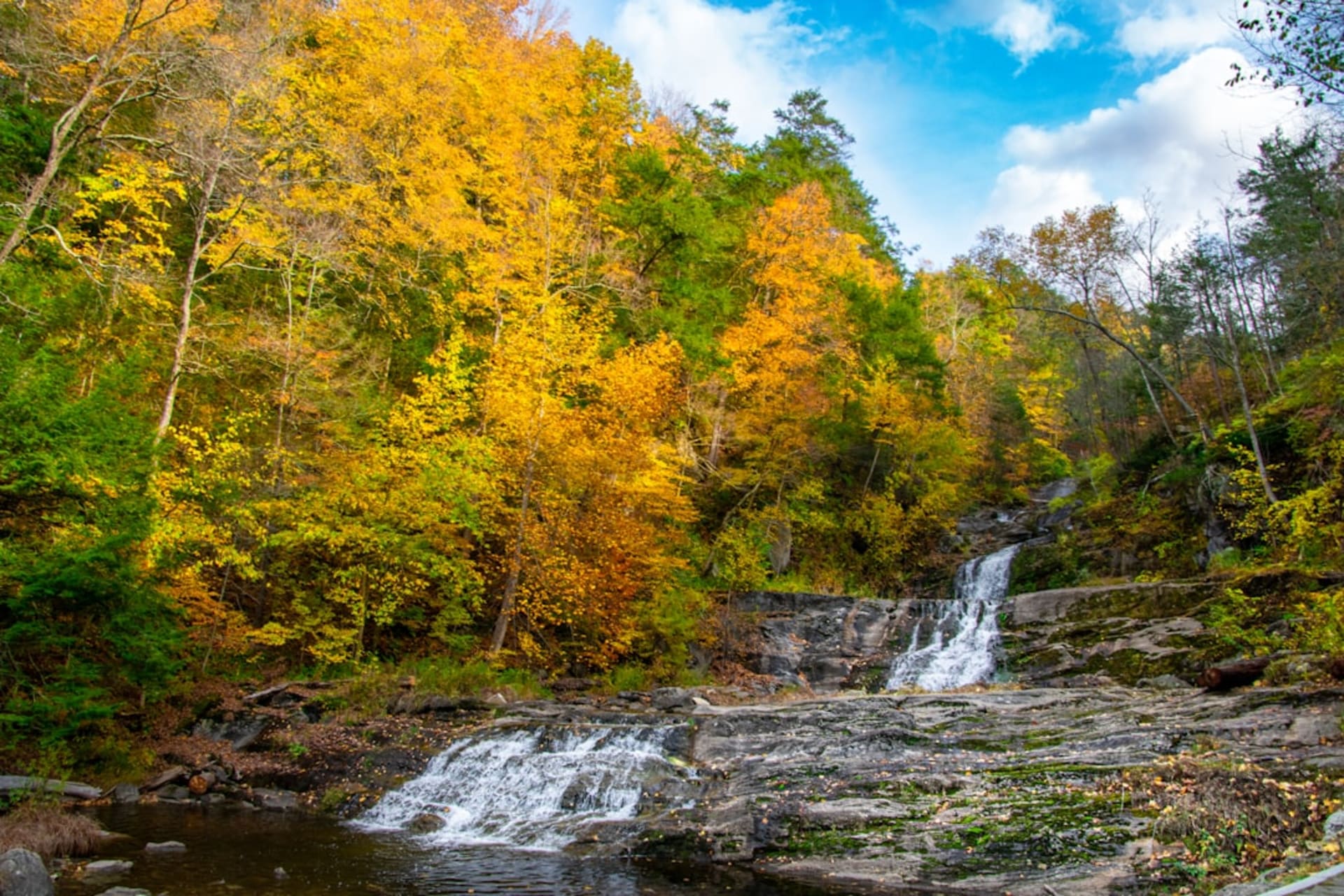
We came up Route 7 from Cornwall Bridge with the windows down, and the first sign that Kent was different from the rest of the Litchfield Hills was the sound — running water, loud and constant, even before we could see it. Kent Falls announces itself. Lia grabbed my arm and pointed at the parking area filling up with a mix of Subarus and motorcycles, everyone here for the same reason: a state park built around a single, generous waterfall tumbling two hundred feet down a wooded hillside. This is a town of about three thousand people, half of them seemingly connected to Kent School up the road, and it wears its prep-school polish lightly, softened by the river and the hills pressing in on all sides.
Kent Falls and the Appalachian Trail
The falls themselves are free to walk up alongside, a series of cascades and pools climbing the hillside on a well-worn path, and we spent a full hour just moving from ledge to ledge, Lia dipping her feet into a pool that was colder than either of us expected in July. What surprised me was learning the Appalachian Trail runs right through Kent — a footbridge crosses the Housatonic in the middle of town, and we watched a thru-hiker resupplying at the general store, backpack propped against the counter, looking almost embarrassed by how normal everyone treated his six-month journey. That’s Kent’s trick: it absorbs the extraordinary — hikers, waterfalls, museums — into an unbothered small-town rhythm.

Bulls Bridge and Eric Sloane’s barn
A few miles south, Bulls Bridge is one of Connecticut’s last two covered bridges still open to cars, a narrow wooden tunnel over churning rapids where, according to a plaque nobody reads twice, George Washington’s horse once nearly slipped into the river. We parked and walked out onto the gorge overlook instead of driving through, watching kayakers pick their way between boulders. Later we stopped at the Sloane-Stanley Museum, a low stone building holding painter Eric Sloane’s collection of hand tools — adzes, drawknives, plane after plane worn smooth by use — arranged with a reverence that made even Lia, who claims no interest in woodworking, linger over the display cases.
Main Street’s quiet trade
Kent’s Main Street runs maybe half a mile, lined with white clapboard storefronts that turn out to be some of the best antique and gallery shopping in the Northeast — furniture dealers who ship to Manhattan apartments, a bookstore with a cat asleep in the window, a bakery that sold out of its last morning bun before we got there at ten. We had dinner at a small bistro where the owner recognized half the room by name, and it was easy to understand why weekenders from New York keep buying up the farmhouses in the surrounding hills.
Getting There
The nearest airport with meaningful service is Bradley International (BDL) near Hartford, about an hour and forty minutes northeast, though many visitors fly into New York’s LaGuardia or JFK and drive roughly two and a half hours north on the Taconic State Parkway and Route 7. A car is essential — there’s no rail or bus service into town, and the falls, the bridge, and the surrounding trailheads are all spread along winding two-lane roads best explored at your own pace.
Keep exploring
More of Connecticut