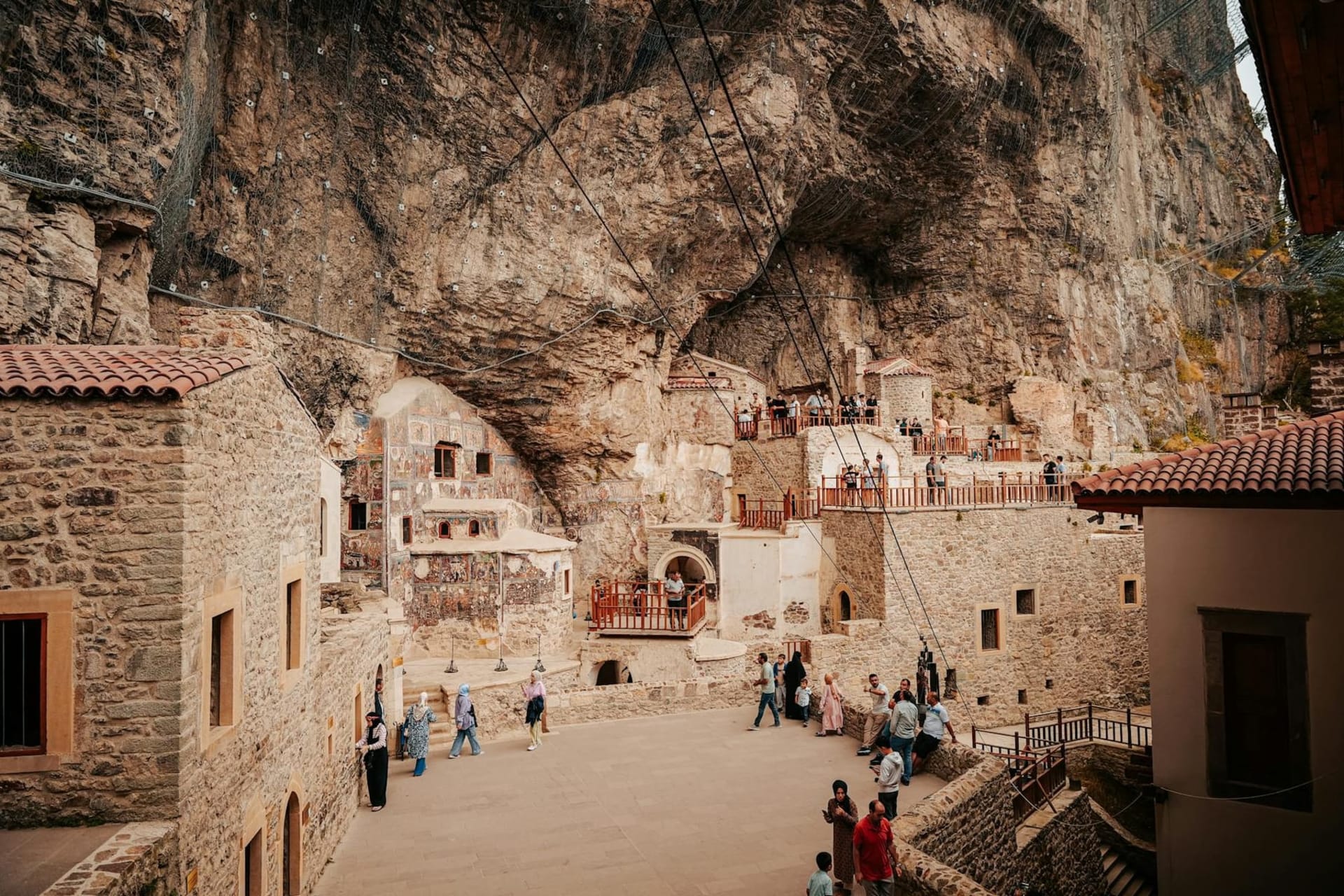
A 4th-century Byzantine monastery clings to a sheer cliff face in the Black Sea Mountains, vivid with frescoes.
The road up from Trabzon climbs through tea gardens and fog. Not the romantic coastal mist I had imagined but a dense, wet ceiling that closes over the valley like a lid, muffling the engine, softening the switchbacks. By the time we reached the Altındere National Park entrance, visibility had narrowed to maybe fifty meters. Lia pressed her face against the passenger window and said she couldn’t see anything. I told her that was probably the point.
The Cliff
Nothing prepares you for the moment the path turns and the monastery simply appears — not on the ground, not standing free, but growing out of the rock face at an altitude of roughly 1,200 meters, anchored to the cliff like something deposited there by an ancient flood and forgotten. The limestone above it is sheer and grey and enormous. The structure itself is painted the color of old cream, its arched galleries stacked in tiers, and somewhere behind all of it the waterfall that first drew the monks here in the 4th century is still audible, a low hiss beneath the wind.
I stood at the base of the 300-odd steps cut into the rock and understood, for the first time, the specific theology of inaccessibility. The monks of the Pontus did not come here despite the difficulty. They came because of it.
The Frescoes
What I did not expect was the color. The interior chapels are covered floor to arch in Byzantine frescoes — New Testament scenes, saints in ochre and cobalt and a deep mineral red that has survived Ottoman conquest, Greek exile, and a hundred Anatolian winters. The paint has cracked and faded in places, figures missing their faces, but the overall effect is overwhelming rather than diminished. There is a scene of the Last Judgment on the rock church’s south wall where the blessed and the damned are still clearly legible, the damned rendered in contorted postures that feel almost contemporary.
The surprise was a smell: beeswax and candle smoke and something older underneath, mineral and cold, rising from the stone itself. A monk had been here this morning. Someone had lit candles. The monastery was consecrated again as a Greek Orthodox site in 2010 after decades of use as a museum, and the difference between a holy place and an exhibited one is exactly that smell.
Getting There
The nearest city is Trabzon, about 46 kilometers northwest. From there, minibuses run to the town of Maçka, and shared taxis continue up the valley to the park entrance. The final ascent is on foot. Allow at least half a day, more if the fog lifts and you find yourself unwilling to leave.
When to go: Late spring (May–June) and early autumn (September–October) offer the best balance of passable weather and manageable crowds. Midsummer brings bus tours that fill the narrow galleries; winter closes access entirely after heavy snowfall.