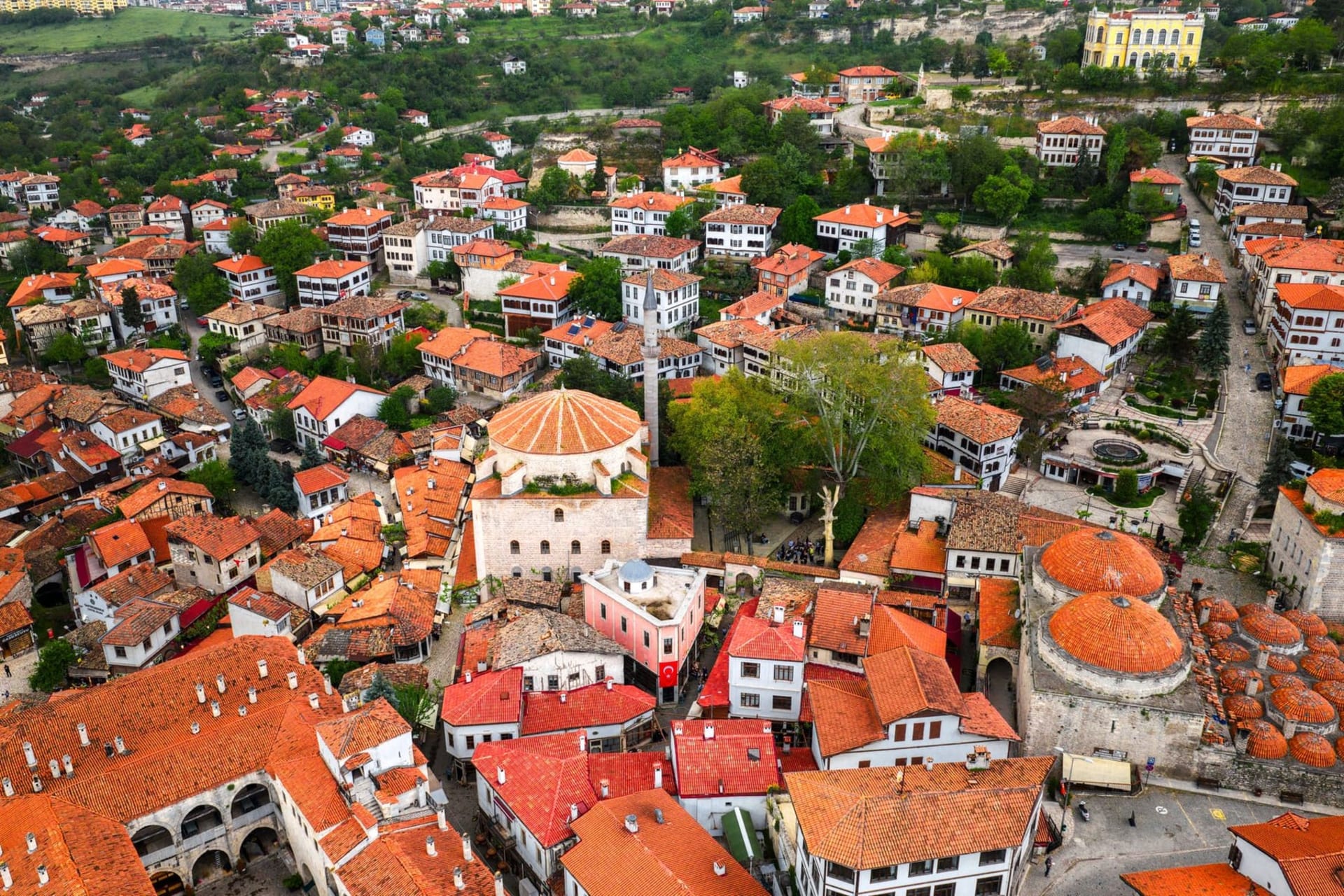
A UNESCO Ottoman trading town in northern Turkey with 1,000 preserved timber-framed houses and a saffron market.
There is a moment, somewhere between the bus depot and the first cobblestone, when you realize the postcards were not exaggerating. I had that moment on Hisarönü Caddesi, looking up at a stack of overhanging timber-framed houses — each floor jutting out slightly further than the one below, like a slow-motion argument with gravity — and I stopped walking for long enough that Lia bumped into me from behind and asked if I was okay. I was better than okay. I was somewhere that felt genuinely unseen.
The Houses That Stayed
Safranbolu survived the twentieth century through a combination of geographic stubbornness and economic irrelevance. When the railway bypassed the town in the 1930s, the merchants left. The roads stayed bad. The houses — roughly a thousand of them in the Çarşı quarter alone — simply stayed too. UNESCO arrived in 1994 and recognized what neglect had accidentally preserved: the most complete ensemble of Ottoman civilian architecture in existence. What strikes me is not the grandeur but the domesticity of it. These are not palaces. They are houses built for merchants and tanners, with stables on the ground floor and latticed bay windows on the upper floors so that women could watch the street without being seen. The social logic embedded in the architecture is as intact as the beams themselves.
Saffron and the Coppersmiths’ Bazaar
The Arasta Çarşısı, the covered market near the Köprülü Mehmed Pasha Mosque, still functions as a working bazaar. I spent an afternoon there watching a coppersmith beat a tray into shape with a rhythm so steady it sounded like a slow clock. The shops sell saffron — Safranbolu’s namesake spice, harvested from crocuses grown in the surrounding valleys — in small paper envelopes stamped with the town seal. I bought two. The vendor, an older man with excellent French, told me that real Safranbolu saffron turns a glass of water yellow within twenty seconds. He demonstrated. It did. I also ate lokum from a tray at the entrance to the bazaar: rose-water flavored, dusted with powdered sugar, cut thick. Nothing like the versions sold in Istanbul tourist shops. Softer, less sweet, gone in one bite.
What the Night Quiets Down To
By nine in the evening, Çarşı empties almost entirely. The day-trippers from Karabük have gone home. The streets smell like woodsmoke and damp stone. I walked out past the Cinci Han, the seventeenth-century caravanserai that once housed merchants traveling the saffron road between Istanbul and the Black Sea, and found the whole facade lit by a single streetlamp. No crowds, no audio guides, no context boards. Just the building and the dark and the sound of someone’s television through a cracked shutter three floors above.
When to go: Late April through early June, when the saffron crocus has finished blooming and the spring light hits the hillside houses at a low, warm angle. Late September through October is equally good and significantly quieter than summer.