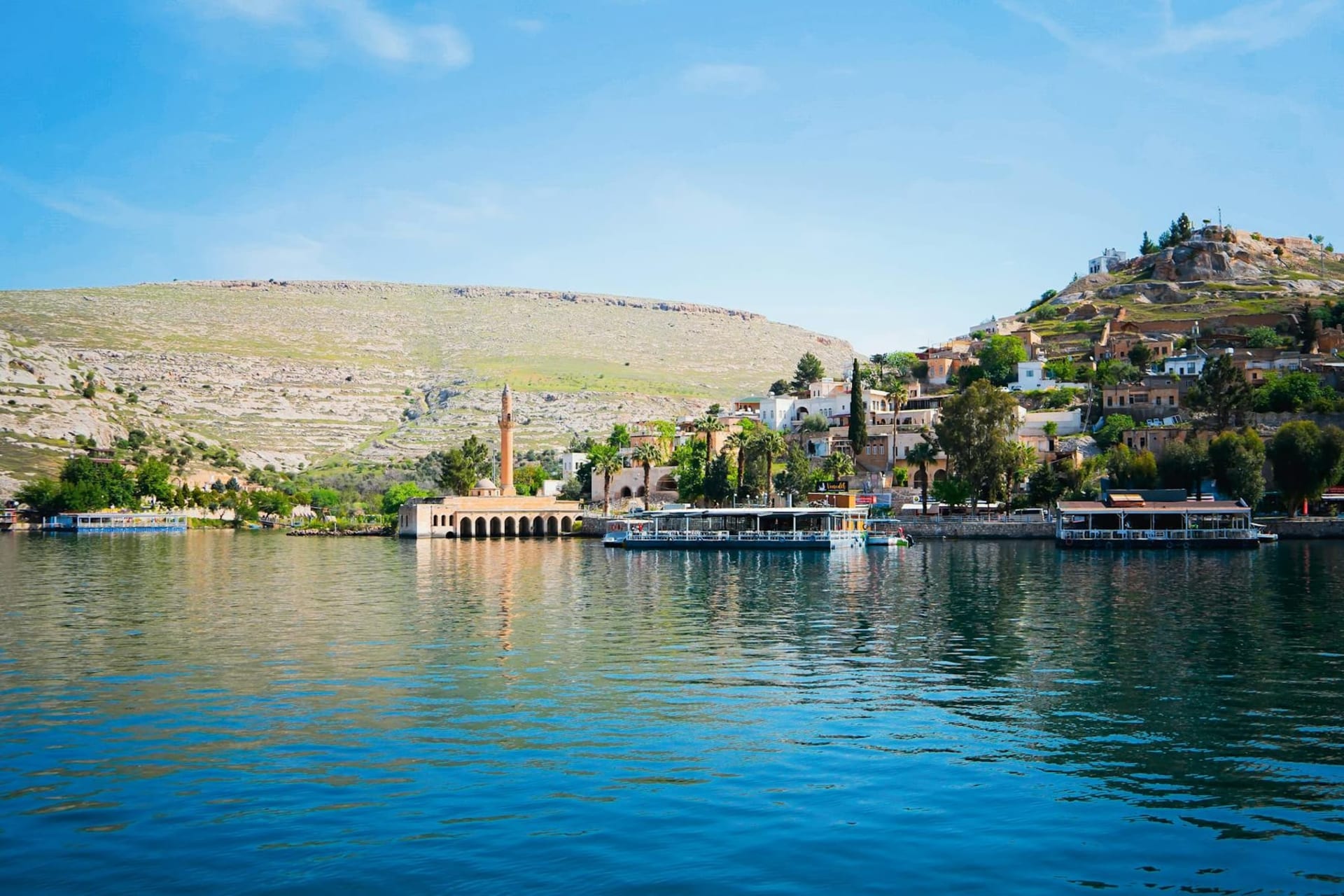
A flooded town on the Euphrates in southeastern Turkey where the minarets of the old village still rise from the reservoir.
The boat engine cuts and we drift. Beneath us, seven or eight meters down, there are streets. There are doorways. There are the foundations of houses where people were born, raised children, buried their dead — and then, in 2000, packed whatever fit on a truck and watched the Euphrates swallow the rest.
This is Halfeti. Or half of it.
What the Water Kept
The reservoir is an unsettling shade of green — the kind of green that suggests depth rather than algae. As we move through it on one of the small wooden tour boats that leave from the new village’s dock each morning, the minarets of the old mosque at Savaşan come into view first. They break the surface like fingers. The boatman, a lean man in his fifties who told us his grandfather’s house is directly below where we’re floating, doesn’t say much. He lets the geometry speak.
Lia sat at the bow and didn’t take a single photo for the first ten minutes. That’s how I knew it was working on her the same way it was working on me.
The old village of Halfeti — the flooded one — sits under the water of the Birecik Dam reservoir. The new village was built higher up on the same limestone cliffs, a grid of concrete houses that have the blunt functionality of emergency construction, which is exactly what they are. But people stayed. That’s the thing that surprised me most: they didn’t just stay in the region, they stayed in view of what was taken.
The Black Rose and the Tea Garden
Halfeti is also known for something stranger: the black rose. It grows here and almost nowhere else on earth — a dark crimson so concentrated it reads as black in certain light, blooming in spring from the iron-rich soil of these cliffs. I found them in a small tea garden perched above the water, the kind of place with plastic chairs and a gas burner and a woman who appeared from nowhere to bring us çay without being asked. The roses were in a clay pot by the railing, over the water. I leaned in close enough to smell them. They smelled like roses. That was the surprise — I’d expected something more dramatic, some note of the uncanny. Just roses. Deep, good, ordinary roses, in a place that is anything but.
We ate lahmacun from a street stall near the new village square, the flatbread thin enough to fold twice, the meat spiced with isot pepper — the dark, oily dried chili that comes from Urfa, forty kilometers west. Everything here orbits Urfa. The heat, the food, the history.
Getting There, Staying Longer
Halfeti sits about an hour northwest of Şanlıurfa on a road that hugs the reservoir for the last stretch. There is no reason to rush through it. The light off the water in late afternoon turns the limestone gold, and the minarets cast long shadows across the surface that point toward whatever they’re marking below.
When to go: Spring (April to mid-May) for the black roses and mild temperatures; avoid July and August when the heat comes off the stone and the water both, and the thermometer regularly clears 40°C.