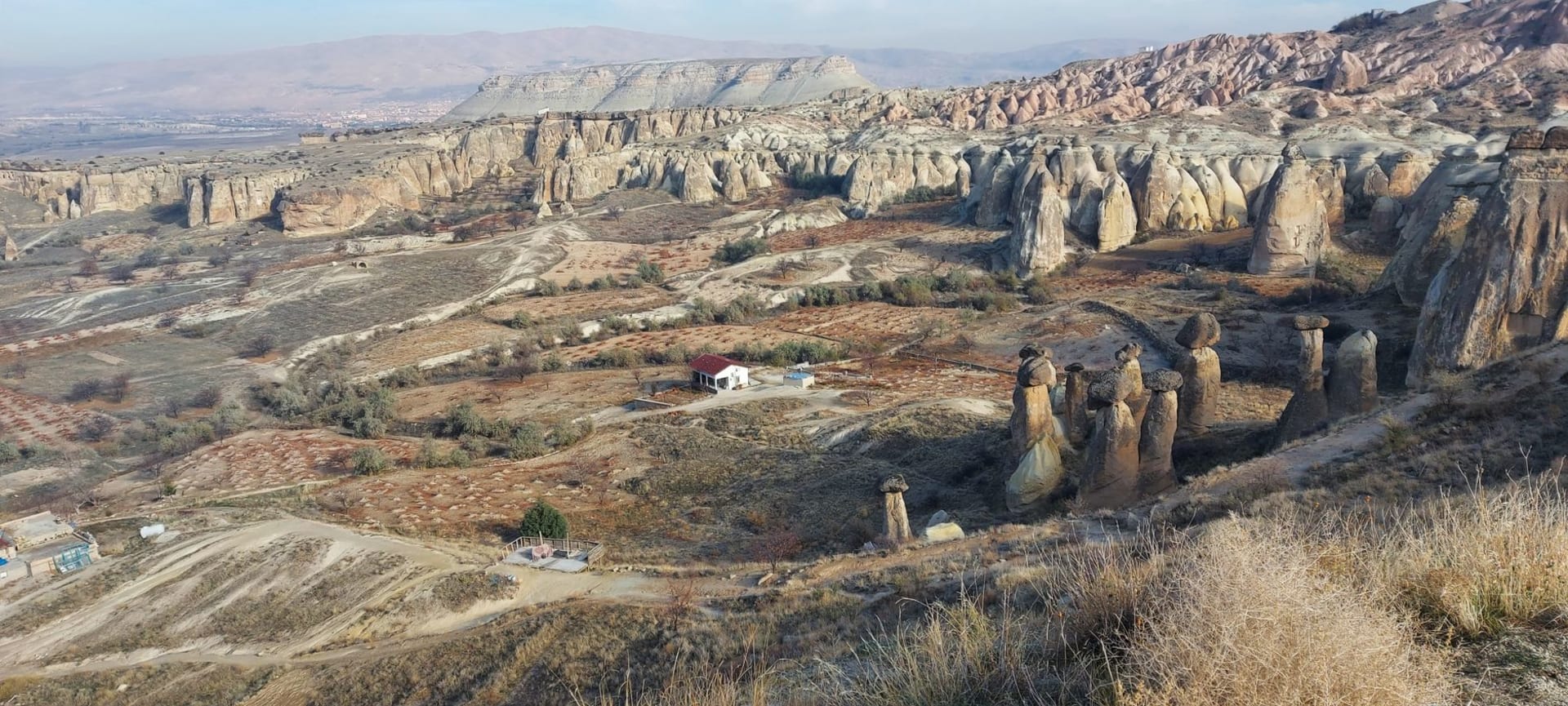
Cappadocia Fairy Chimneys
"The landscape looks like it was designed for a dream and then left behind."
The volcanic valleys of Goreme where volcanic tuff was sculpted by wind into chimneys, monks carved into churches.
I had seen photographs. Everyone has seen photographs. And still nothing prepared me for standing at the edge of the Rose Valley at five in the morning, watching dozens of hot-air balloons lift in silence from the dark earth below — each one glowing from within like a paper lantern — and feeling that the world I thought I knew had quietly been replaced with a better one while I slept.
Cappadocia is the result of violence rendered gentle by time. Millions of years ago, volcanic eruptions buried this plateau in thick ash that hardened into soft tuff. Wind and water carved it for millennia into cones, columns, and mushroom caps — the so-called fairy chimneys that crowd the valleys around Goreme. Then humans arrived and did what humans do: they moved in. They hollowed out the stone for churches, monasteries, entire underground cities. The chimneys became homes. The rock faces became frescoed walls.
The Valleys and What Lives in Them
The best way to understand Cappadocia is on foot through its valleys. The Pigeon Valley — named for the dovecotes carved into the cliffs to collect fertilizer — connects Goreme to Uchisar, the rock-cut fortress that dominates the skyline for kilometers in every direction. The path winds through orchards and past abandoned cave dwellings whose dark openings feel like held breath. The Love Valley has the most dramatically phallic chimneys, which the Turks name with cheerful directness. The Devrent Valley — also called Imagination Valley — has chimneys shaped like camels and seals and things you can only name if you’re willing to commit to the metaphor.
In Goreme itself, the Open-Air Museum holds the densest concentration of rock-cut Byzantine churches, their interiors still vivid with tenth- and eleventh-century frescoes: dark-eyed saints, pale Christs, scenes of the Annunciation rendered in ochre and cobalt. The smell inside is cool stone and dust, an underground church smell that exists nowhere else on earth.
The Surprise of Underground Kaymakli
Lia and I had skipped the underground cities on our first full day, assuming they were tourist traps. We went the second morning, early, to Kaymakli — one of the largest underground cities in the region, with eight accessible levels descending into the earth — and found ourselves genuinely unsettled. The corridors are low and close, carved for bodies smaller than modern ones. The ventilation shafts, which the Hittites and early Christians used to hide from invaders, still pull cold air from somewhere far below. At one point we were alone on the third level, crouched in a passage barely wide enough for my shoulders, and the silence was the silence of something very old that has survived a great deal. Neither of us spoke for a few minutes after we came back up.
That evening we ate at a small place on Muze Caddesi in Goreme village — pottery kebab slow-cooked in a sealed clay pot, cracked open at the table in a curl of fragrant steam, the lamb falling apart into a sauce of tomato and pepper that tasted like it had been cooking since the Byzantine era. We ordered bread and ate until we couldn’t.
When to go: April through June or September through November. The balloon flights run year-round but are most reliable in spring and fall, when winds are steady and the light on the valleys is best. July and August are hot and crowded; winter can be beautiful if you’re willing to risk fog.