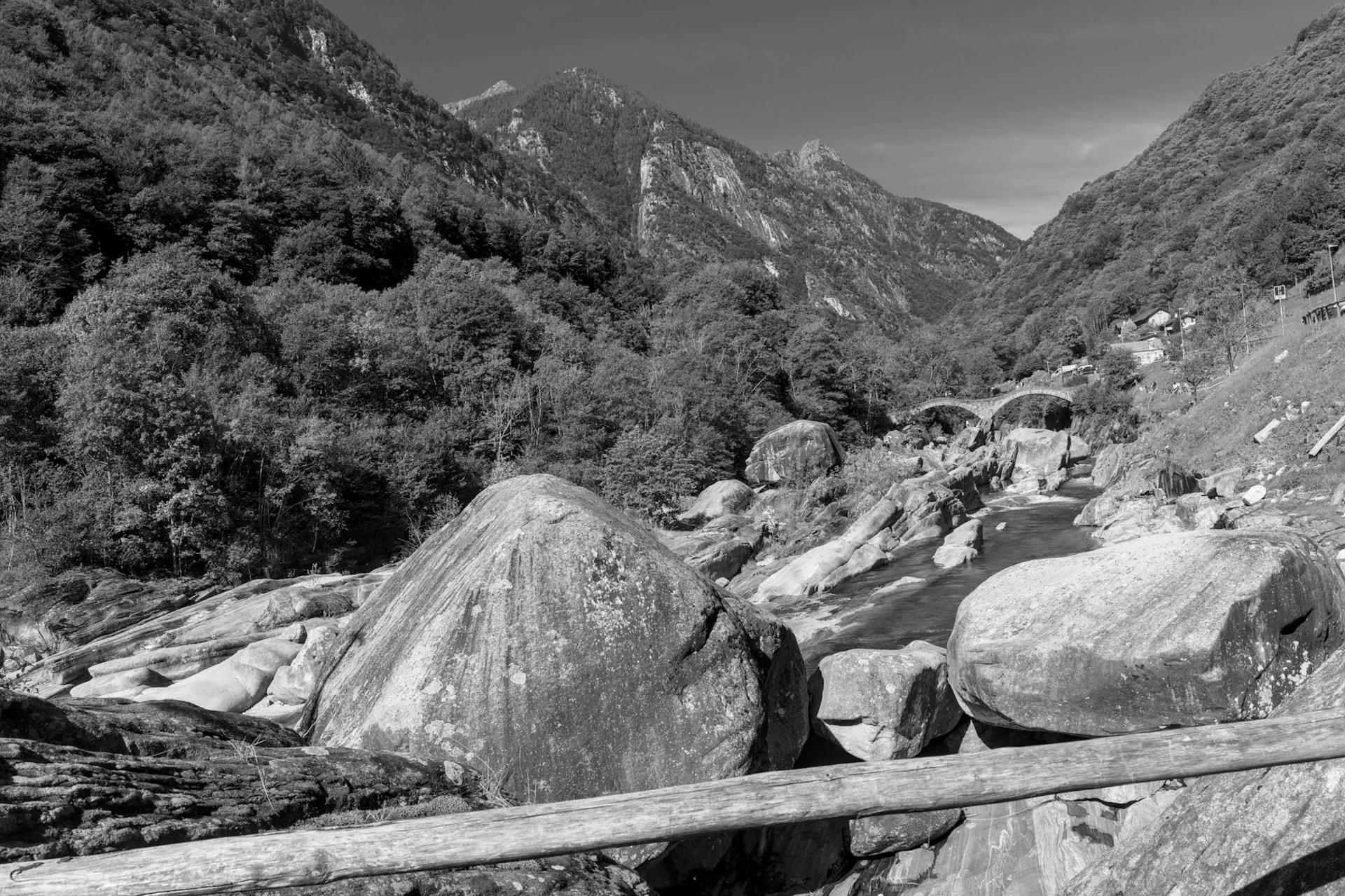
A Ticino valley of emerald pools and double-arched Roman bridges descending from granite peaks above the Italian lakes.
I kept telling myself the photographs were filtered. Some Instagram saturation trick, a teal slider pushed too far. Then we rounded the bend past Lavertezzo on the cantonal road and I stopped talking.
The Verzasca is the color of a jeweler’s velvet cloth, a green so deliberate it seems like a decision someone made. Lia grabbed my arm without saying anything. That was enough.
The Bridge That Earns Its Postcard
Ponte dei Salti is the image that circulates — the Roman double-arch thrown across the river at Lavertezzo, locals leaping from its parapet into the pools below on summer afternoons. We arrived early enough to have it almost to ourselves, mist still pooling in the valley’s narrower upper reaches, the granite walls of the Verzasca gorge dripping with last night’s rain.
What the photographs never capture is the sound. The river moves through polished stone channels with the specific low register of something ancient and indifferent to you. Standing on the bridge’s crown, looking down into fifteen feet of water so clear I could count the individual rocks on the riverbed, I had that rare sensation of feeling genuinely small — not diminished, just correctly proportioned.
Granite, Vernacular Stone, and a Plate of Polenta
The valley’s villages are built from the same grey rock that lines the riverbed, as if the architecture simply grew from the hillside without anyone’s intervention. We ate lunch in Sonogno, the valley’s last village, at a small locanda where the polenta came in a wooden bowl still steaming from the copper pot, served alongside a brasato that had been cooking since morning. The woman who brought it to us spoke Ticinese dialect and some Italian and seemed pleased we’d made it all the way to the end of the road.
What surprised me, genuinely: the valley was a working landscape long before it was a scenic one. Chestnuts were the currency here for centuries — dried, milled, eaten through winter. Walking the old mulattera paths between villages, I kept finding abandoned stone buildings with chestnut-drying platforms, the sorbi, slowly being reclaimed by lichen and moss. A whole forgotten economy written in stone.
The Light After Four
Ticino light behaves differently from anywhere I’ve been in Switzerland — warmer, more Italian, the afternoon sun catching the valley walls at an angle that turns even the granite amber. By late afternoon, when the day-trippers have mostly cleared, the pools near Lavertezzo belong to a handful of swimmers and the shadows are long and precise.
When to go: June through early September for swimming; late May or October for fewer crowds, cooler air, and the valley’s more contemplative face.