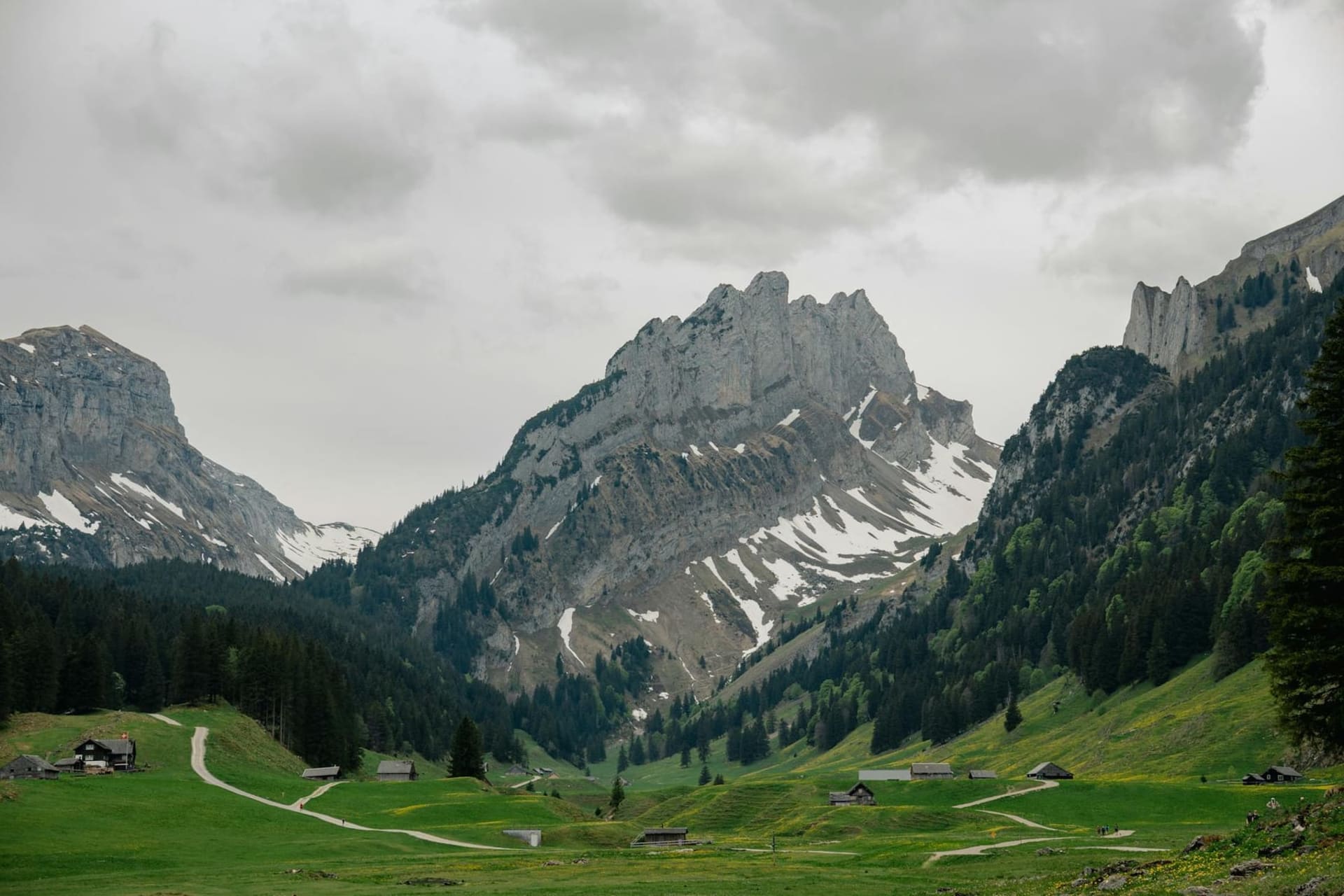
A painted-facade village in eastern Switzerland where the last outdoor democracy in the world once voted in the town square.
I came to Appenzell expecting a postcard. What I found instead was a village that had quietly refused to become one.
The train from St. Gallen deposits you at a station so tidy it looks staged — flower boxes trimmed to the centimeter, the platform swept clean of any existential doubt. Then you walk five minutes into the Hauptgasse and your breath catches. The facades are not merely painted; they are narrated. Each house tells something about the family that built it, rendered in ochre and rust and cobalt, with oriel windows jutting out like ears straining to hear the square below.
The Square That Still Votes
The Landsgemeindeplatz is smaller than I imagined. On the last Sunday of April each year, the citizens of Appenzell Innerrhoden gather here in their thousands — many of the men with short daggers or ceremonial swords at their belts — to vote on cantonal laws by raising their hands. Or their blades. It is the oldest and last surviving open-air parliament of its kind in Switzerland, and standing in the empty square on a Thursday in October, I felt the weight of all those raised arms like a physical thing.
Lia laughed when I stopped mid-step and just stared at the cobblestones. “You look like you’ve seen a ghost,” she said. I had, in a way — the ghost of a political form so ancient that Athens would have recognized it.
Cheese, Bitters, and the Smell of the Cellar
The thing about Appenzeller cheese is that no one outside the region makes it correctly, and the locals will tell you this without a trace of arrogance. It is simply a fact they live inside. I ate a raclette at Gasthof Hof on the Weissbadstrasse and understood immediately what they meant — the cheese had a grassy funk, a kind of alpine memory baked into each bite, nothing like the shrink-wrapped version I’d bought in Paris years ago.
Then came the Alpenbitter. The herbal digestif has been made here since 1902 from 42 mountain herbs, and the recipe remains locked away somewhere in a building that looks like every other building on the street. The barman poured it without asking whether I wanted it. I did want it. I hadn’t known that yet.
The Unexpected Quietness
What surprised me most was not the painted houses or the swords-and-democracy ceremony, but the silence past nine in the evening. The Hauptgasse emptied out completely. No bar noise, no tour groups, no ambient city hum. Just the sound of the Sitter river running somewhere below the hill and Lia reading by lamplight in a room whose ceiling was older than the French Republic.
When to go: Late April to catch the Landsgemeinde vote, or September when the alpine herds descend from the high pastures in the Appell procession — cowbells audible from the valley floor long before the animals appear.