Anuradhapura
"The sacred Bo tree has been tended without interruption for over two millennia."
Anuradhapura was a capital for over a thousand years, and its ruins sprawl across the northern plains of Sri Lanka with a grandeur that rivals anything in Southeast Asia. I had been to Angkor, to Bagan, to Borobudur, and I thought I understood what ancient Asian cities looked like. Anuradhapura corrected me. The scale here is different — not the concentrated intricacy of Angkor but a vastness that requires a bicycle and an entire day to even begin to comprehend. The sacred city covers forty square kilometres of stupas, monasteries, palaces, and bathing pools, most of them still in active use by Buddhist devotees who come here not as tourists but as pilgrims.
The Ruwanwelisaya stupa is the site’s emotional centre — a massive white dome surrounded by a wall of stone elephants, gleaming in the sun, devotees in white circling its base with offerings of flowers and oil lamps. It was built in the second century BCE and has been restored, damaged, abandoned, and rebuilt so many times that the structure is less a single monument than a continuous act of faith spanning two millennia. I walked the circumference barefoot on hot stone, my shoes in my hand, and the devotion around me was so palpable it changed the temperature of the air.
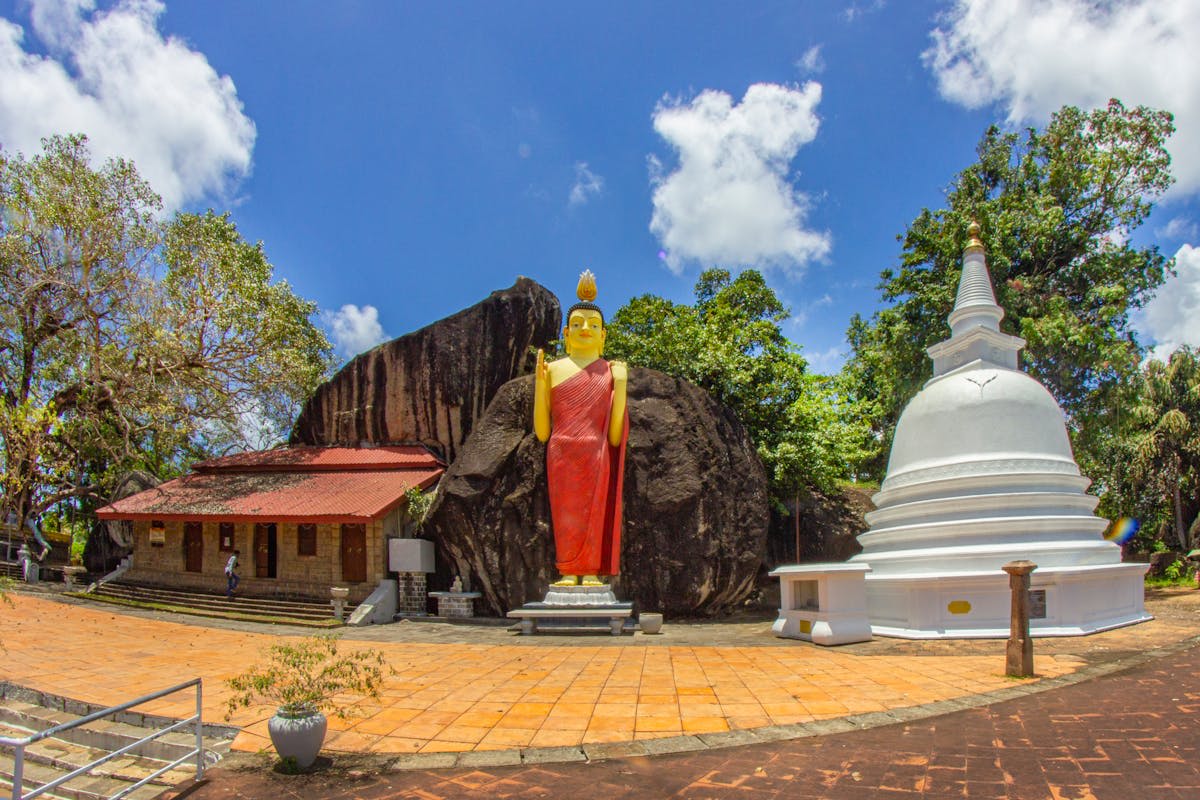
The Sri Maha Bodhi — a cutting from the tree under which the Buddha attained enlightenment, brought to Sri Lanka in the third century BCE — is the oldest historically authenticated tree in the world. It has been tended continuously for over 2,300 years, guarded by an unbroken line of caretakers, and it stands today behind gold railings with prayer flags fluttering in the breeze. The tree itself is not particularly large or visually dramatic. Its power is temporal — the sheer weight of uninterrupted human attention focused on a single living thing for longer than most civilisations have existed. I sat beneath it for twenty minutes and thought about what it means for something to be cared for without pause for twenty-three centuries.
We rented bicycles and spent the day circling the ancient city, stopping at moonstone-carved entrances so detailed they look like lace cut from stone, bathing pools still filled with water and used by monks, and dagobas rising from the forest like mountains made by human hands. Jetavanaramaya, once the third-tallest structure in the ancient world — taller than all but two of the Egyptian pyramids — stood in brick silence, its mass almost incomprehensible when you realise it was built entirely by hand. Trees grow from its upper levels now, roots gripping the brickwork like fingers.
Pilgrims in white moved between the sites with a reverence that made us lower our voices instinctively. Children placed flowers at the base of statues. Monks in saffron robes walked barefoot along paths that monks have walked for two thousand years. This is not a museum. It is not a ruin in the way that Western archaeology understands ruins — something dead, preserved, interpreted by plaques. Anuradhapura is a living sacred city, and the devotion that built it has never stopped.
When to go: February to September is driest. The site is vast — rent a bicycle and allow a full day, carrying water and sunscreen because shade is scarce between monuments. Poya full moon days, held monthly, bring the most devotees and a spiritual atmosphere that transforms the ruins. Remove shoes at every sacred site, which is most of them.