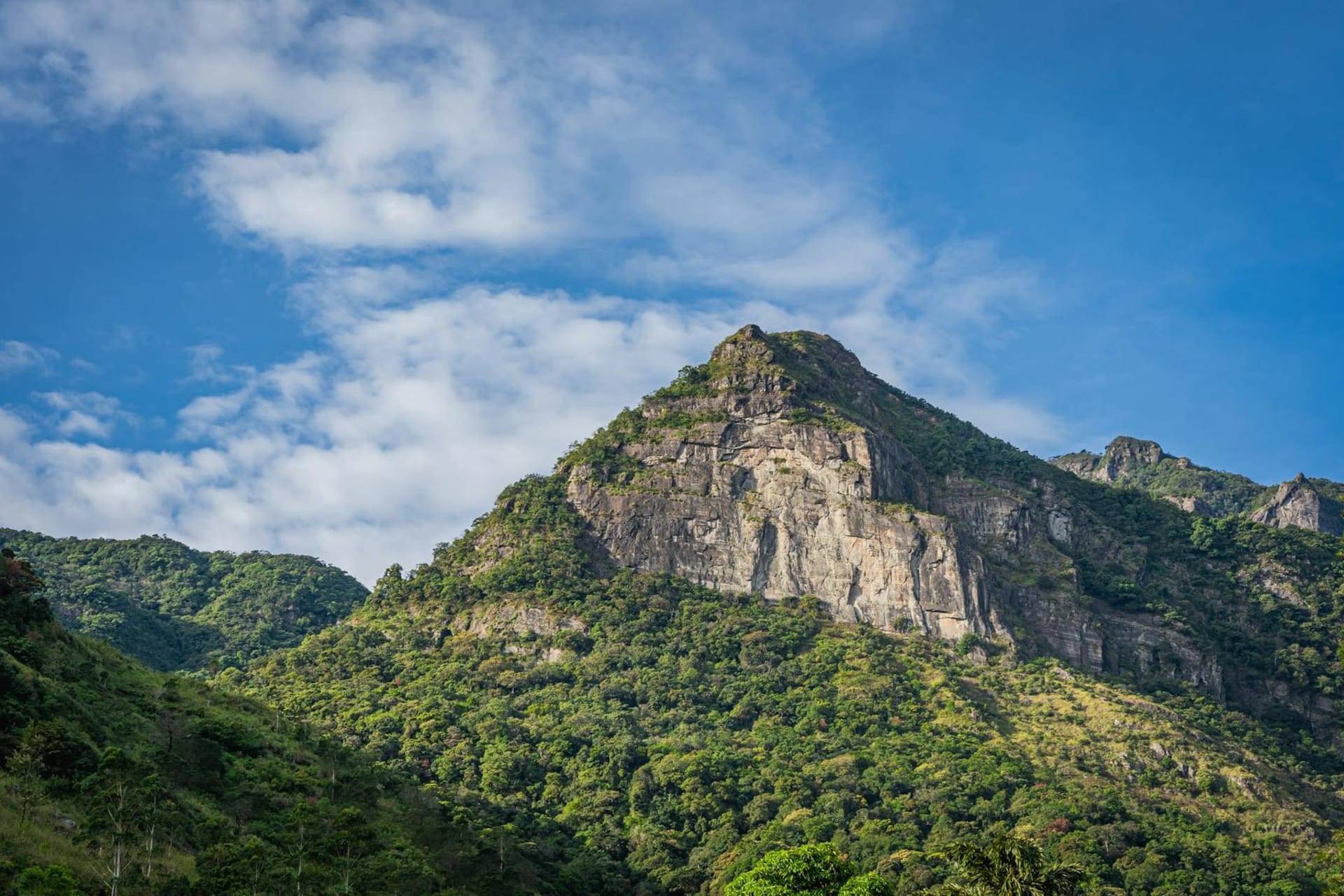
A UNESCO biosphere of cloud forest ridges and forgotten villages east of Kandy, named for their knuckled appearance from below.
I came to the Knuckles Range because a man in Kandy told me not to bother. He was running a guesthouse near the Temple of the Tooth and had a laminated map of recommended excursions pinned to the wall — Sigiriya, Dambulla, Pinnawala. No Knuckles. When I asked why, he shrugged and said the roads were rough and there was nothing much to see. That is almost always the right direction.
Into the Cloud Line
The range begins east of Kandy where the road narrows and starts climbing in earnest. The air changes before the landscape does — cooler and wet-smelling, laced with something green and slightly medicinal, the kind of air that feels like it’s doing something useful to your lungs. By the time we reached the village of Riverston, clouds were sitting on the ridgeline like furniture, thick and still. Lia pulled out every layer she’d packed. This is cloud forest: the temperature drops ten degrees from the valley floor, the vegetation is dense and dripping, and the light arrives in diffuse silver sheets rather than direct sun.
The trails here are not manicured. The main trekking routes — including the path up toward Mini World’s End, a cliff-edge plateau that drops away into valley fog — are narrow, root-crossed, and genuinely demanding. Leeches appear after rain, which is to say, always. But the reward is forest that feels genuinely remote: tree ferns five meters tall, waterfalls appearing unexpectedly off the path, and ridge views that open suddenly onto a landscape of folded green ridges dissolving into low cloud.
The Villages Below the Ridges
What surprised me was the human scale of the place. I’d expected wilderness; what I found was a patchwork of small villages threaded between the forest. Below the cloud line, in the Meemure valley — reachable by a jeep track that fords a river twice — a handful of farming families grow rice and cardamom in terraced fields hacked from the hillsides. The smell of woodsmoke drifts from cooking fires at dusk. Old women dry spices on woven mats outside front doors. We ate rice and dhal in someone’s kitchen while their youngest daughter did homework at the same table, and I thought: this is what most of Sri Lanka looked like before the resorts found the coast.
The cardamom is worth noticing. The Knuckles is one of the primary growing regions, and the pods here are harvested green, piled into sacks that lean against every wall. The scent of it — sharp, resinous, faintly sweet — is in everything: the air, the food, the fabric of guesthouse pillows.
The Unexpected Discovery
The thing I did not expect was the silence. Not absence-of-sound silence, but the particular quiet of a place insulated by mist and altitude and forest canopy — birdcall, water, wind — without road noise or human machinery. I sat on a flat rock above Meemure at first light and felt, with some embarrassment, genuinely moved by it. The clouds were moving through the valley below me like slow traffic. The Knuckles had named themselves well: those ridges, seen from below in Kandy, do look like a clenched fist. From inside them, they feel like cupped hands.
When to go: The best trekking conditions fall between January and April, when the northeast monsoon has cleared and trails are dry enough to be passable without wading. Avoid May through August when the southwest monsoon brings persistent heavy rain to the range.