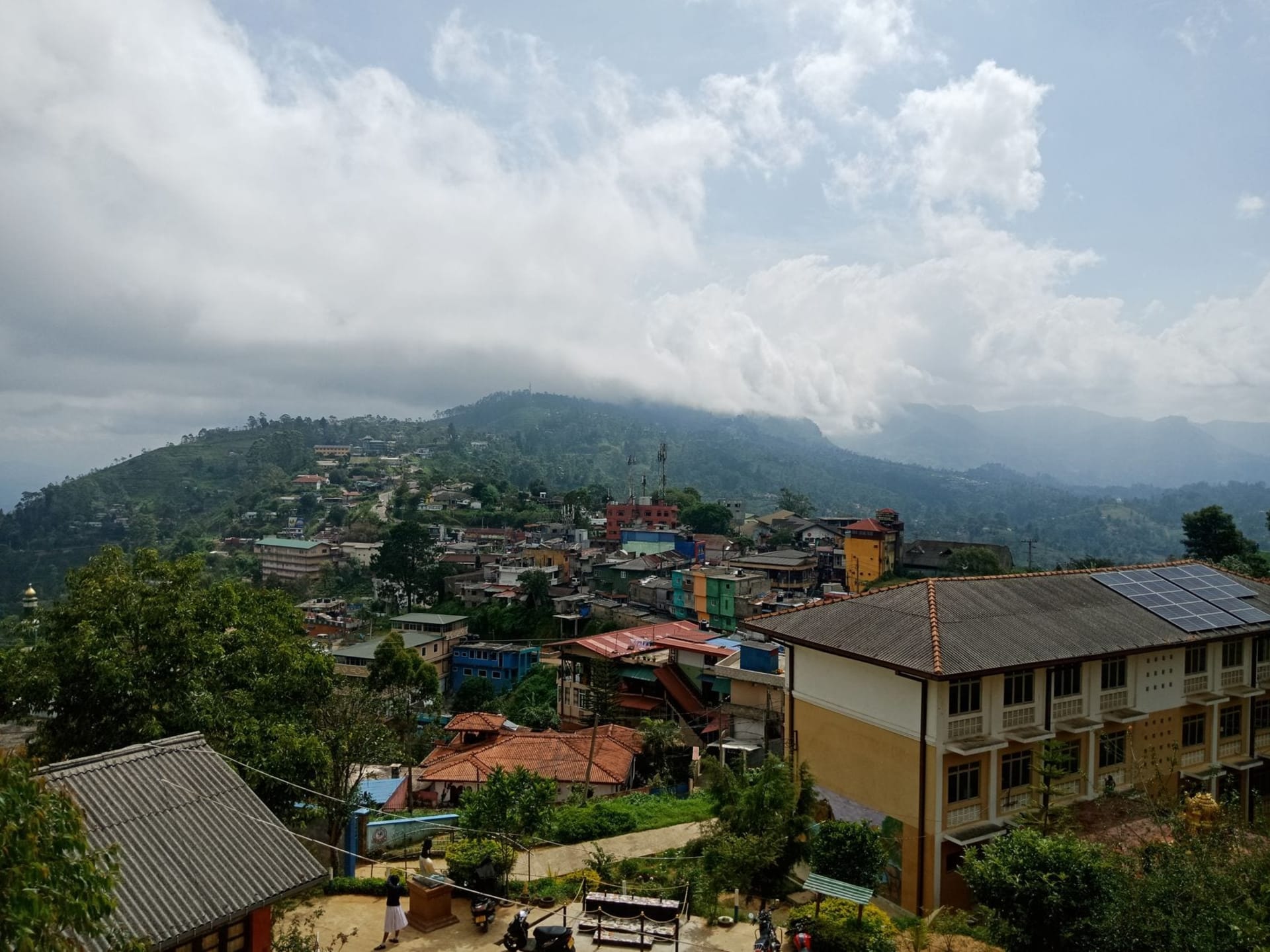
Haputale
"Haputale sits on a ridge so narrow that the sunrise hits both coasts simultaneously from your teacup."
A ridge-top hill station where the whole of southern Sri Lanka spreads below the cloud line each morning.
The train from Ella slows to almost nothing before Haputale, as though the engine itself is unsure whether to commit. On one side of the track the land simply falls away — tea bushes stitching down into cloud, then nothing visible until the coast somewhere far below. On the other side, the ridge continues barely wide enough for a street and a row of shopfronts painted the washed-out yellow of old postcards. I had expected a hill town. I had not expected the sensation of standing on a knife’s edge above an entire country.
The Ridge at Dawn
We were staying at a guesthouse on Thambapillay Road, a narrow lane that runs along the crest above town, and the first morning I woke before light and stepped out to find the valley on the southern side already filling with cloud while the eastern sky ran orange above Lipton’s Seat. Lia came out wrapped in a bedsheet and said nothing for a long time. By the time our landlady brought tea — strong, milky, poured from a height in the Jaffna style she learned from her mother — the cloud had closed entirely below us and we were floating, an island on top of an island. The tea, of course, tasted of the hill we were standing on.
Lipton’s Seat and the Adisham Walk
The road to Lipton’s Seat leaves Haputale past the small Dambethenna tea factory where you can still smell the drying leaves from fifty metres away — vegetal and faintly smoky, like a very good oolong left in a warm room. The walk takes about two hours through managed plantation and patches of eucalyptus that drop the temperature another few degrees. What nobody told me — the genuine surprise of Haputale — is the small Tamil shrine tucked into the rock face halfway up, bright with fresh marigolds, entirely unmarked on any map I had seen. A woman was leaving a lamp there as I passed. We exchanged a nod. Some things are not for the guidebook.
The Adisham Bungalow, the old British planter’s house turned Benedictine monastery near the edge of town, is worth the walk for the vegetable garden alone: purple cabbages, dahlias, a monk moving between rows with unhurried purpose.
Eating on the Main Road
The main street through Haputale is unglamorous — hardware shops, lottery kiosks, a pharmacy. But the small Muslim restaurants near the bus stand do a rice-and-curry lunch that costs almost nothing and arrives on a banana leaf: dhal, bitter gourd, pol sambol, sometimes a dark mutton curry with curry leaves still in. Eat standing at the counter. Order a second tea.
When to go: January through April brings the clearest skies and the best views from the ridge; the southwest monsoon clouds everything in from May onward, though the tea is greener and the crowds thinner if you can tolerate the mist.