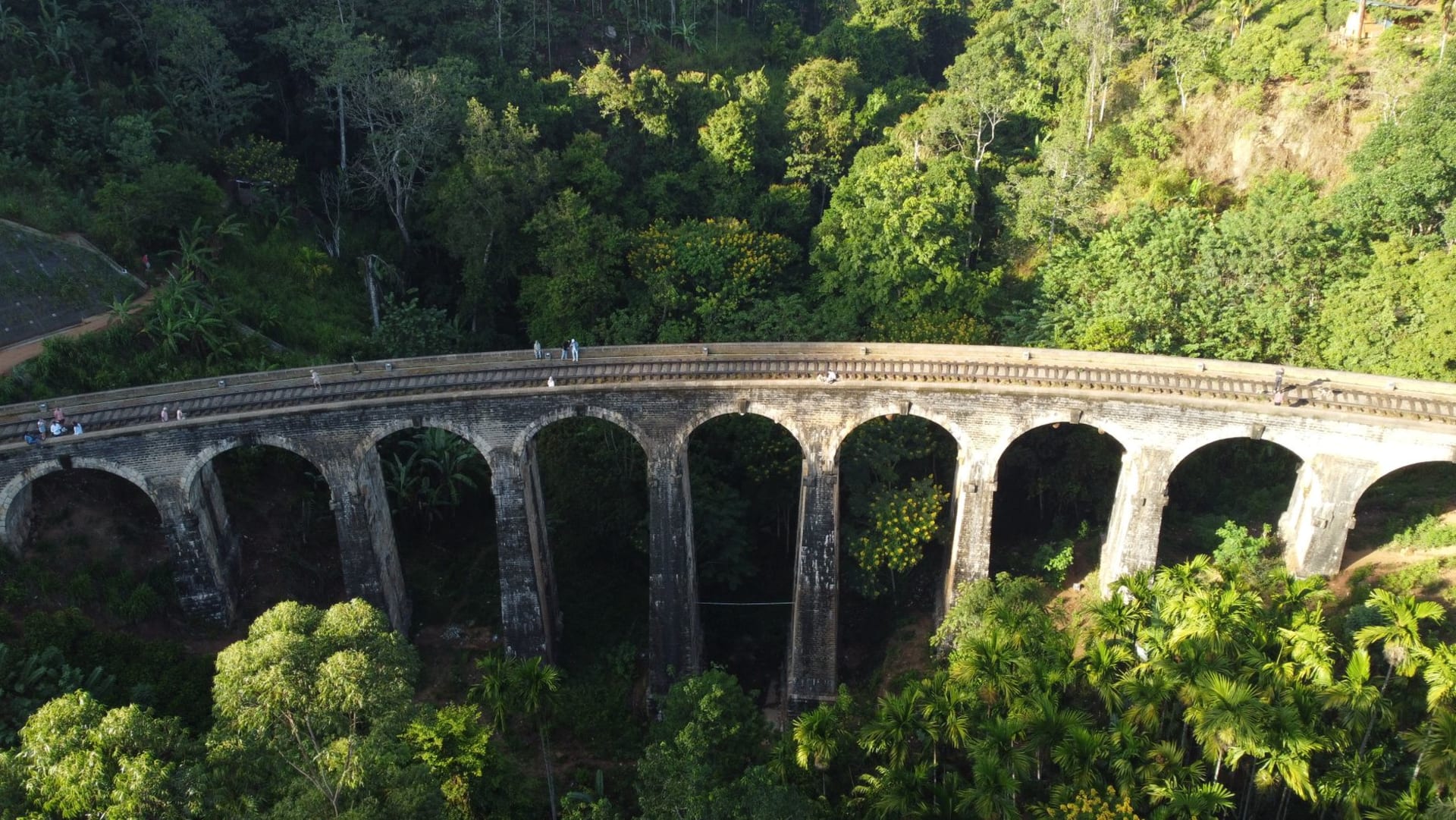
A hike through tea estates above the mountain village of Ella to a summit with views across the southern lowlands.
The guesthouse owner on Passara Road drew the route on the back of a receipt — no map, no numbered waypoints, just a line that bent around a railway crossing and disappeared into the hills. I folded the paper into my shirt pocket and we left before six, while Ella’s main strip was still shut and the air still carried the cold that comes only in those first minutes before the sun clears the ridgeline.
Through the Estates
The trail climbs quickly past the Little Adam’s Peak junction and then cuts into the tea. Not the manicured rows you see from a window seat on the Kandy train, but something wilder — chest-high bushes pressing against both sides of the path, the smell of wet soil and something faintly medicinal, like crushed green leaves left in a pocket. Tamil tea pluckers were already working the rows above us, their fingers moving faster than seemed possible, baskets slung low across their backs. We said good morning. One woman laughed at something we couldn’t hear.
The path is poorly signed, which is part of its character. We took a wrong fork above the railway tracks and ended up in a clearing with a single concrete bench and a view of nothing but more tea. Lia sat down and refused to be frustrated about it, which was the right call — we ate half our provisions there, watching a pair of scarlet minivets dart between the shade trees planted to protect the bushes. The detour cost us forty minutes and gave us the best stillness of the day.
The Summit
The final push through scrub forest is short but steep, the red clay slick from the night’s humidity. And then, without ceremony, the trees end.
The summit of Ella Rock sits at roughly 1,040 meters. What surprised me was not the scale of the view — I had expected that — but the silence. After three weeks of tuk-tuks and temple bells and the particular cacophony of Sri Lankan guesthouses, the top of the rock had almost no sound at all. Just wind, and somewhere far below, the nine-arch bridge at Demodara reduced to a toy. The southern lowlands stretched out in a haze that made distances impossible to judge. Lia sat on the edge with her feet hanging over and didn’t say anything for a long time.
We ate the rest of our food, watched two trains cross the bridge at different hours, and came down the same way we’d gone up — which is to say, partially wrong, and better for it.
On the Ground
Ella’s main street — a single block of guesthouses, rice-and-curry spots, and juice bars — rewards an evening more than a morning. After the hike we ate kottu roti at a place with plastic chairs and a blackboard menu, then walked back to our room with legs that had done their work. The village is small enough that you pass the same faces twice in an hour.
When to go: The best conditions for the hike fall between December and March, when the dry season keeps the clay trails firm and the morning views clear before the daily clouds build. April and May can be oppressively humid; the monsoon months bring genuine slipping hazards on the descent.