Dambulla Cave Temple
"Dambulla's cave murals have been renewed by the faithful for two thousand years, and they still look urgent."
Five caves of gilded Buddhas and ceiling murals at the Cultural Triangle's most dramatic site.
I had imagined the caves would feel like a museum — roped off, hushed, the kind of place where history is kept behind glass. Instead, I climbed 160 metres of pale granite in the noon heat, barefoot on stone worn smooth by two millennia of pilgrims, and arrived into something very much alive.
The Ascent and the First Cave
The path up the rock face at Dambulla winds past macaques who watch you with the detached authority of security guards. Lia pointed out one sitting on the low wall that borders the esplanade, eating a stolen banana with elaborate calm. By the time we reached the top, our feet were burning on the white stone and the plain below — paddy fields and coconut palms fading into a blue haze — stretched out as if the whole island had been laid flat for the occasion.
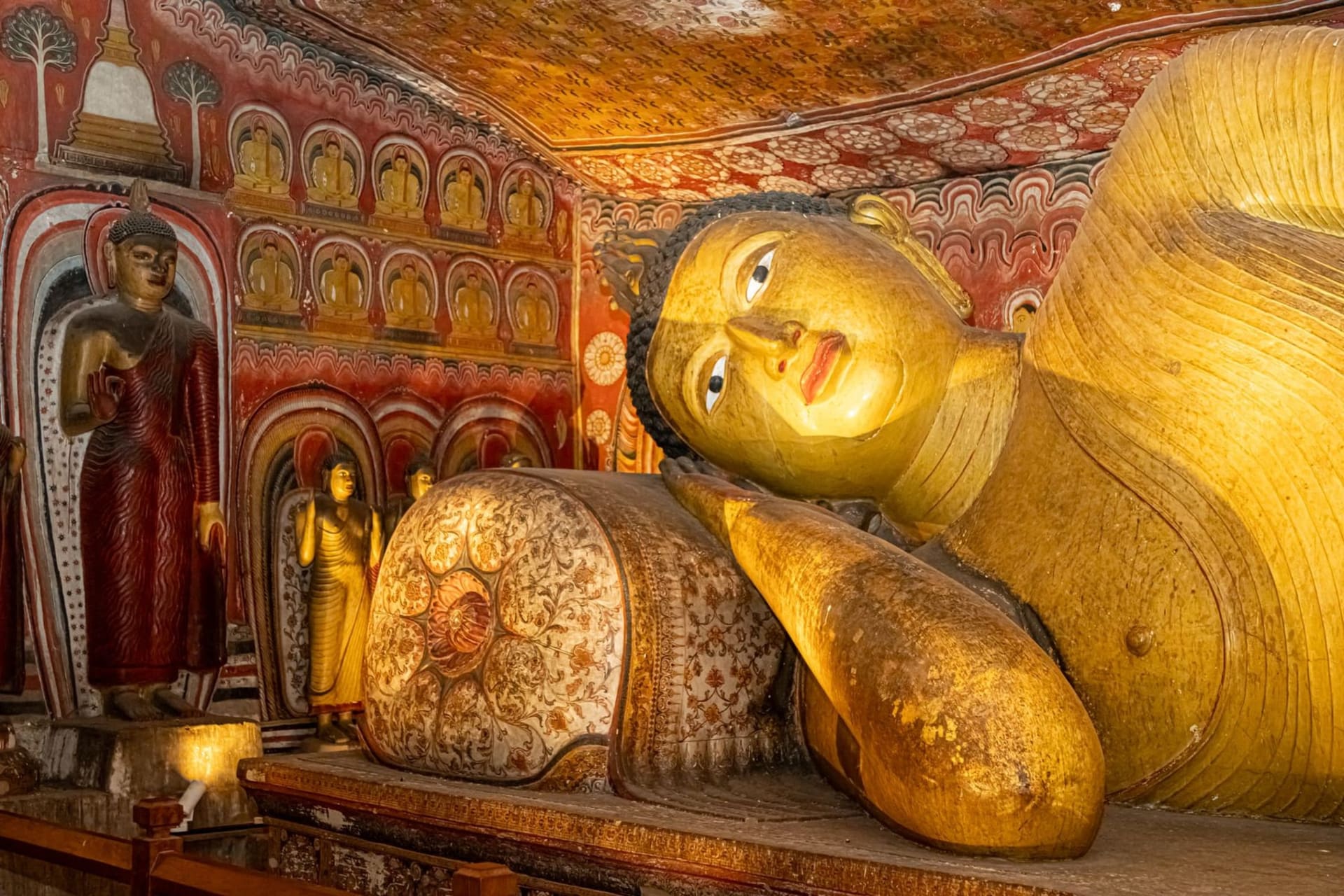
The first cave, Devaraja Viharaya, stopped me at the entrance. A single reclining Buddha, fifteen metres long, carved from the living rock, fills almost the entire space. The face is level with yours if you stand close. The expression is not serene in a decorative sense — it is concentrated, interior, like someone in the middle of a thought they have been thinking for a very long time. Incense smoke rose in a slow column toward the ceiling murals, and monks in saffron moved quietly around the perimeter.
Five Caves, One Continuous Devotion
What the guidebooks don’t prepare you for is the accumulation. Cave after cave — Maharaja Viharaya, Maha Alut Viharaya, Pachima Viharaya — each one distinct but all sharing the same quality of sustained attention. The ceiling frescoes in Cave Two depict the life of the Buddha in narrative panels, the pigments still vivid: mineral blues, brick reds, a yellow that reads almost electric under the light that falls through the entrance. Every figure was at some point repainted by a hand that felt the original still had something to say.
The unexpected thing was sound. I had expected silence or chanting, but what I found in Cave Three was a group of Sri Lankan schoolchildren, maybe ten years old, standing in a row before a line of Buddhas and singing — not solemnly but brightly, the way children sing when they mean it. Their teacher gestured at each statue in turn. I stayed longer than I had planned.
Practical Notes
The complex sits about 72 kilometres from Kandy on the Colombo-Trincomalee road, and tuk-tuks from Dambulla town reach the base in minutes. Leave shoes at the bottom, not the top — the stone on the esplanade reflects heat intensely by midday.
When to go: January through March, when the dry season keeps the rock dry and the light on the plain below especially clear. Arrive before 8 a.m. to beat both the heat and the tour groups.