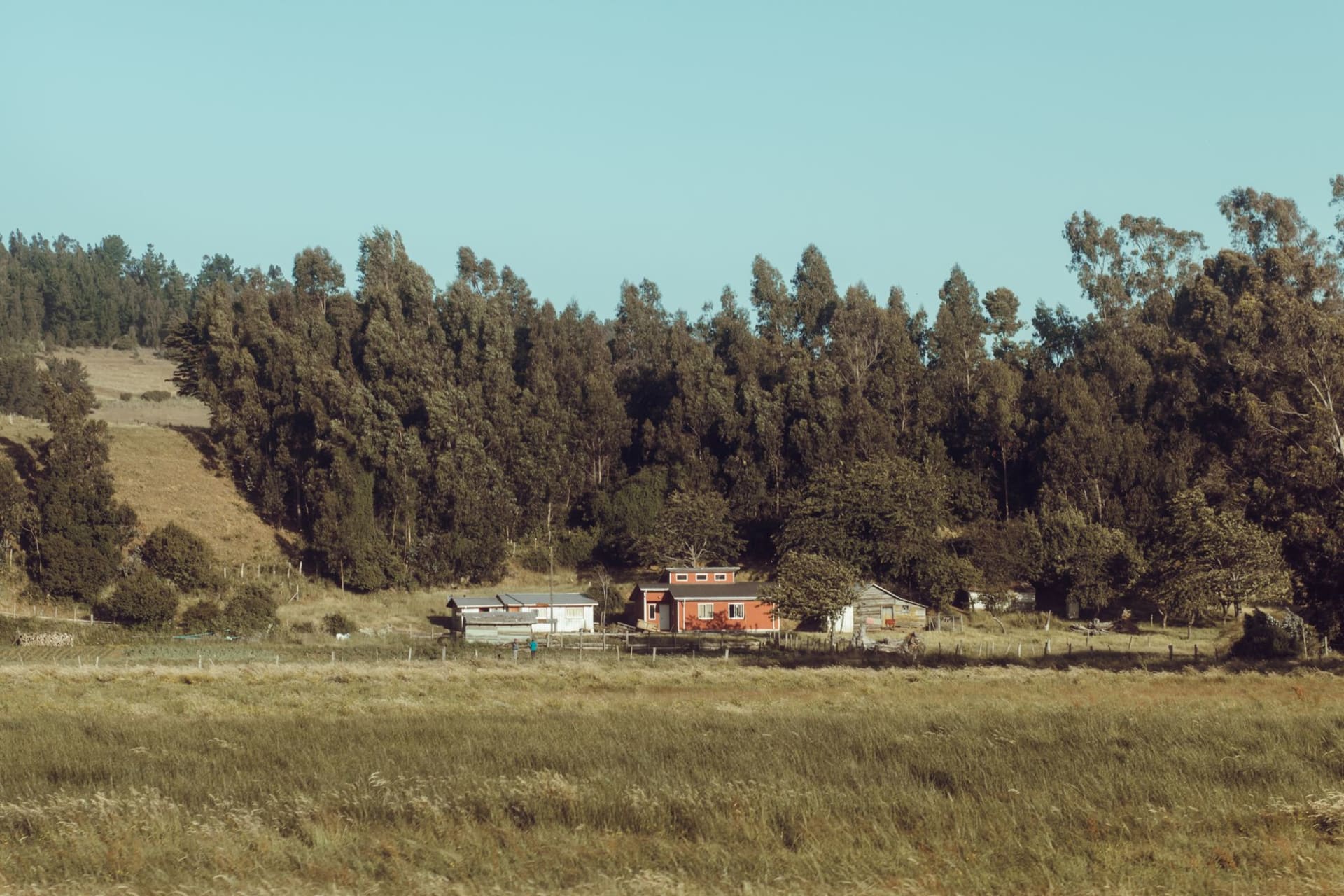
Chiloé
"The fog here doesn't feel like weather. It feels like the island's preferred state."
An Island That Runs on Its Own Logic
Chiloé operates differently from the rest of Chile. It took me half a day to understand the rhythm — slower, more lateral, less interested in efficiency. The ferry crossing from Pargua on the mainland takes about thirty minutes, and in that time the light changes from the clear coastal brightness of Puerto Montt to something muted, silvered, more intimate. The island makes its own weather, and the weather it prefers is fog.
The main island is large enough to require a few days to understand — Castro is the capital and the logical base, a city of around 45,000 built on a hillside above a bay full of the famous palafitos, the stilted wooden houses that extend out over the tidal flats. At high tide they float; at low tide they stand on their pilings above exposed mud and shellfish. I arrived at low tide and walked the path beneath them while a woman above me hung laundry from a second-floor window. The palafitos aren’t a museum exhibit. They’re where people live.
The Churches
UNESCO protects 16 of Chiloé’s wooden churches, and they represent something genuinely strange and specific: a fusion of indigenous Huilliche building techniques with Spanish Jesuit religious architecture, producing structures that look like they were designed by someone who had heard churches described but hadn’t seen one. The Church of Castro is the most photogenic — painted in chrome yellow and violet, somehow completely serious about it. The Church of Quinchao on Isla Quinchao, a smaller island accessible by a short ferry, sits in a village of about two hundred people and has the quiet authority of something that has been the center of community life for three centuries.
The wood used in these churches — alerce, mainly — is also used in the shingled exteriors of Chiloé’s houses, a cladding that weathers from pale gold to deep grey over decades. Walking through the smaller villages you see houses at every stage of this process, a natural color gradient from new to ancient that makes the whole island feel like a single ongoing project.
What You Eat Here
Chiloé’s food is specific and not widely understood on the mainland. The curanto is the definitive dish: a coastal stew of shellfish, smoked pork, chicken, and potato-based dumplings called chapaleles and milcaos, traditionally cooked in a pit over hot stones but more commonly available in restaurants as pulmay, the stovetop version. It smells of the sea and smoke simultaneously and tastes like it has been cooking since before your arrival. I ate it at a family restaurant outside Castro where the owner brought it out in a single enormous pot and explained each element with the patience of someone who has done this many times but hasn’t stopped caring about it.
The local potato variety deserves a mention. Chiloé has over 200 native potato cultivars, many of them still grown by small farmers. You encounter them in markets in shades of purple, red, and yellow, with textures ranging from starchy to almost waxy. Eating a simple boiled Chiloé potato with salt is a reminder that the potato we think we know is a simplified version of something much more interesting.
The Mythology Problem (Not Really a Problem)
Chiloé has an extraordinarily elaborate mythology involving sea serpents, ghost ships, witches who meet in caves, and a creature called the Trauco who seduces women in the forest. I say “problem” loosely — it’s actually a gift, because it means that nearly every local you speak with will eventually, given enough time and the right question, start telling you something genuinely strange. The mythology isn’t nostalgic or performative; people here grew up with these stories in a way that makes them feel present rather than historical.
When to go: November through March for the most reliable weather, though Chiloé’s mist and grey light are part of its appeal in any season. The Semana Costumbrista festival in February celebrates local food and music. Avoid July through September if you dislike persistent rain — though even then the island has a compelling desolation.