
Seoraksan is the mountain South Koreans speak about with reverence. The highest peak in the Taebaek range, it rises in jagged granite spires above forests that turn crimson and gold each October in a display of colour so intense it looks digitally enhanced. I went in mid-October, which every Korean I had asked confirmed was the right time, and they were right in a way that my expectations had not prepared me for. The colours were not an accent on the landscape. They were the landscape — every ridge, every valley, every slope burning with maple and oak and birch in a spectrum that ran from pale gold through amber to a red so deep it looked like the mountain was bleeding.

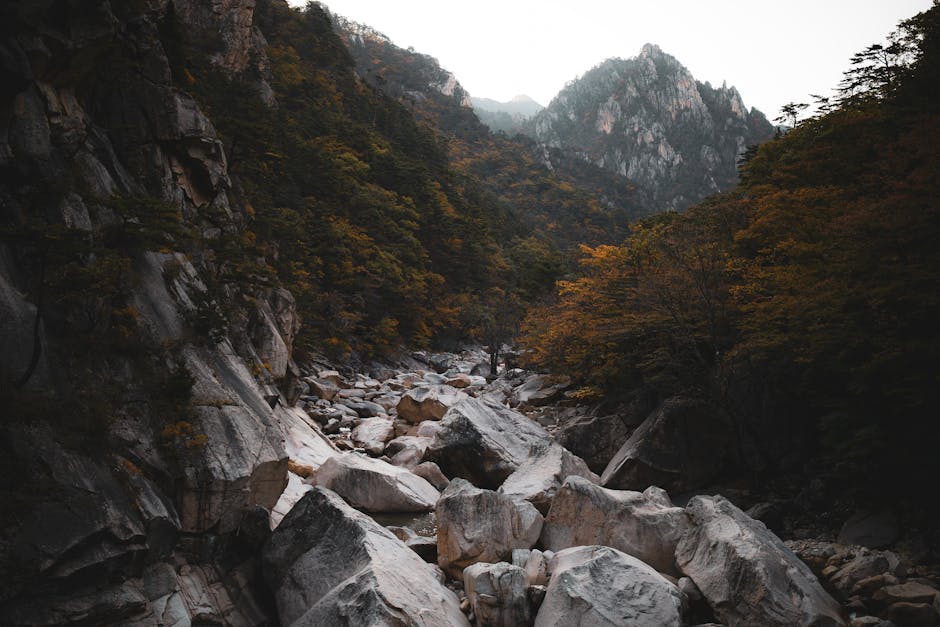
The national park surrounding it offers trails for every level — from the gentle walk to Biseondae Rock along a boulder-strewn stream to the demanding ascent of Daecheongbong, the third-highest peak in the country, where the views stretch to the East Sea. I chose the Biseondae trail as a warmup and found that even the easy route was extraordinary: the stream runs through a gorge of tumbled boulders, the water clear enough to see the stones at the bottom, the forest pressing in from both sides in a tunnel of colour. Wooden bridges cross the stream at intervals, and at each crossing the view changed — upstream, the gorge narrowed into something intimate; downstream, it opened into a valley where the scale of the mountains became suddenly apparent.
The cable car to Gwongeumseong Fortress is the accessible option, lifting you above the canopy to a Silla-era fortress ruin with panoramic views that justify every tourist crowd. I took it on a clear morning and the gondola rose above the treeline into a view that I do not have the vocabulary to describe accurately. Mountains in every direction. The autumn colours below like a carpet someone had designed with the specific intention of overwhelming the human eye. The East Sea visible as a silver line on the horizon. I stood at the fortress walls for twenty minutes and said nothing, because there was nothing to say.
Ulsanbawi Rock, an eight-peaked formation reached by a trail of metal stairs and granite paths, is the signature hike — physically challenging and scenically overwhelming. The eight hundred and eight stairs to the viewing platform test your legs and your commitment, but the reward is a view from the top that makes the stairs feel like a reasonable price. The rock formation itself is massive — six granite peaks clustered together like the fingers of a stone hand, the vertical faces streaked with lichen and weather. Legend says the rock was on its way to be part of the Diamond Mountains in the north but was turned back at the border. Standing at the top, looking at the peaks, I found the legend easier to believe than the geology.
Sinheungsa Temple at the base of the mountain anchors the spiritual dimension. The bronze Reunification Buddha — a seated figure gazing northward toward the divided country — sits beneath the peaks with a calm that feels both religious and political. The temple grounds are peaceful, shaded by ancient pines, and the monks who tend them move through the space with a quiet purpose that made me want to sit down and stay. I did sit down. I stayed until the light changed and the mountains above turned gold.

When to go: Mid-October for peak autumn colour — it is the best foliage display in Korea. Spring wildflowers bloom in May. Summers are green and humid; winters bring snow and ice-covered trails.