The Kalahari does not welcome you. It simply permits your presence, and the distinction matters. Drive north from Upington through the last scrubby farmland, past the final petrol station, past the gate where the tar road gives way to gravel and then to sand, and you enter a landscape so vast, so red, so profoundly empty of human noise that something in your nervous system recalibrates. The sky is not merely big here — it is the dominant feature of the terrain, a bowl of blue so deep it looks enamelled, stretching from horizon to horizon over dunes the colour of dried blood. This is the Kgalagadi Transfrontier Park, straddling the border of South Africa, Botswana, and Namibia, and it is one of the last great wilderness areas on earth where you can drive for hours and meet nothing but wind.
The dunes roll in parallel lines across the landscape, their crests sharp as knife edges in the morning light, softening to undulations by midday as the heat hazes begin. Between them, the dry riverbeds of the Nossob and the Auob — rivers that flow perhaps once a decade, if that — trace pale ribbons through the red, lined with camelthorn trees whose twisted silhouettes have become the visual shorthand for the Kalahari. It is along these riverbeds that life concentrates. The waterholes, some natural, some pumped, draw gemsbok in herds of twenty or thirty, their scimitar horns and painted faces absurdly beautiful against the red sand. Springbok pronk in the flats. Blue wildebeest gather in loose, nervous congregations. And where the herbivores gather, the predators follow.
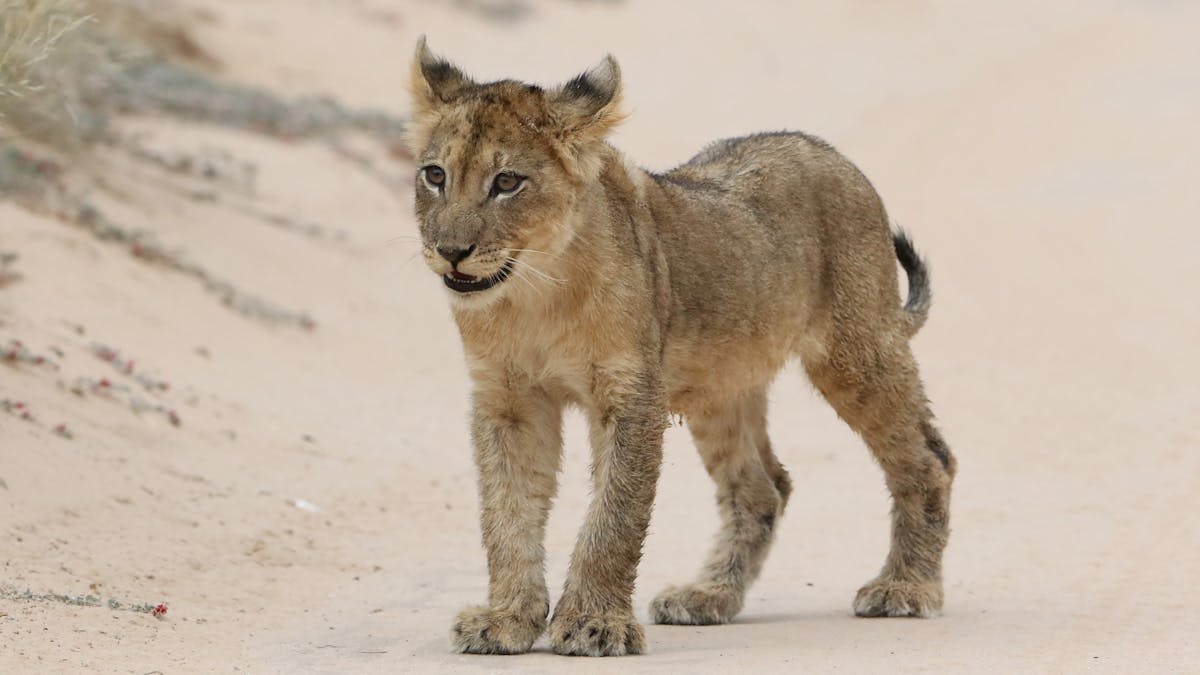
The black-maned Kalahari lions are the park’s most celebrated residents, and they earn that status every time you see one. The males carry manes so dark they appear almost black, cascading down their chests and along their bellies, magnificent and impractical in the desert heat. They are often found lying in the shade of camelthorn trees near waterholes, patient as stone, waiting for the gemsbok to let down their guard. The visibility here — no bush, no tall grass, just low scrub and open sand — makes predator sightings almost cinematic. You watch the entire drama unfold: the stalk, the explosive charge, the dust cloud, the outcome. Cheetahs thrive in these open flats, their speed finally given the stage it deserves. Leopards are less common but present, draped over the branches of the larger trees. And the brown hyenas — shy, shaggy, nocturnal — are seen here more reliably than almost anywhere else in Africa.
Night drives reveal the Kalahari’s second shift. Bat-eared foxes emerge from their burrows, their enormous ears swivelling like satellite dishes as they listen for termites. Aardwolves slink through the scrub on their improbable legs. The occasional Cape fox or African wildcat freezes in the spotlight. And if fortune truly favours you — it favours few — you might encounter a pangolin, that armoured, ancient, heartbreakingly endangered creature shuffling through the sand on business that predates humanity by millions of years.
But the Kgalagadi’s deepest gift is not its wildlife. It is the sky. Without light pollution, without moisture, without the visual clutter of civilisation, the night sky here is staggering. The Milky Way does not appear as a faint smear but as a river of light so dense and structured you can see its dust lanes with the naked eye. Satellites track across the vault. Shooting stars are routine. You sit outside your rest camp — the facilities are basic, the camps at Twee Rivieren, Nossob, and Mata-Mata offering simple chalets and campsites — and you look up, and the scale of the universe settles on you like a physical weight. The Kalahari, which spent the day reminding you of your smallness on the horizontal plane, now does the same on the vertical.
This is not a park for those who need comfort or crowd. It is a park for those who understand that remoteness is not an inconvenience but a gift — that the long, dusty drive and the basic accommodation and the absence of phone signal are the price of admission to a landscape that has not changed in millennia, and does not intend to.
When to go: March to May brings cooler temperatures and excellent predator activity as the summer rains taper off. June to August offers cold, crystalline mornings — temperatures can drop below freezing — but clear skies, concentrated wildlife at waterholes, and the most spectacular stargazing of the year.