The name undersells it. A garden suggests cultivation, neatness, borders — and the Garden Route is none of these things. It is three hundred kilometers of the southern Cape coast where the Indian Ocean throws itself against cliffs of folded sandstone, where ancient forests descend to the waterline in canopies so dense the light beneath them turns green, and where every bend in the road delivers a view that makes you brake involuntarily and reach for whatever device might capture it, though none ever quite does. This is not a garden. It is a wilderness that happens to be beautiful enough to stop you in your tracks.
Begin at the eastern end, where the road runs out of gentle and turns dramatic. Tsitsikamma National Park is the route’s exclamation point — a stretch of coast so rugged it seems to belong to a younger, more volatile planet. The suspension bridge at Storms River Mouth swings above a gorge where the river meets the sea in a churn of green and white, the spray carrying the mineral scent of ancient rock. The forest trails behind the coast wind through stands of yellowwood trees that were old when European ships first rounded this cape — their trunks massive, their canopies cathedral-high, their roots wrapped around boulders like the fingers of something unwilling to let go. Old man’s beard lichen hangs from every branch, giving the forest the quality of a place that exists slightly outside of time.
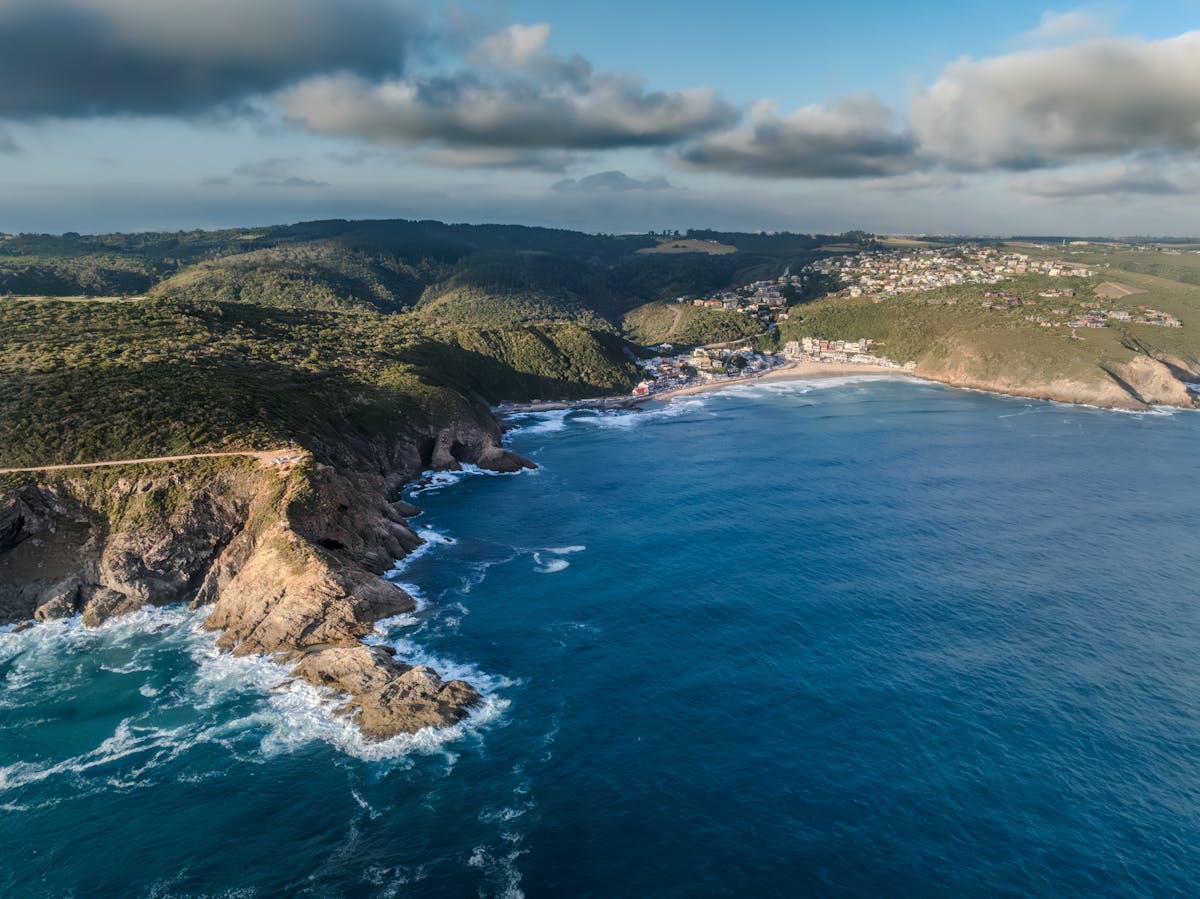
West from Tsitsikamma, the coast softens without losing its force. Plettenberg Bay — Plett, to those who know it — curves in a long white arc between rocky headlands, its waters visited from June to November by southern right whales that breach and blow close enough to shore that you can watch them from the cliffs with a coffee in hand. The bay’s Robberg Peninsula offers a circular hiking trail that delivers seals, fynbos, and vertigo in equal measure, the path narrowing to a spine of rock above the ocean before descending to a beach where the sand is so fine it squeaks underfoot.
For those who require their landscapes served with a jolt of adrenaline, the Bloukrans Bridge obliges. At 216 meters above the river gorge, it hosts the world’s highest commercial bungee jump — a seven-second free fall through a void of forest and mist that rearranges your relationship with gravity. Even watching from the bridge deck, as the jumpers disappear and the cord snaps taut, produces a visceral response. The Garden Route does not lack for quiet beauty, but it is not above the theatrical.
Knysna sits at the route’s heart, a town built around a lagoon of extraordinary stillness. The Knysna Heads — two massive sandstone cliffs guarding the lagoon’s narrow mouth — frame views of the open ocean beyond, and the waterfront serves fresh oysters from beds that have made the town’s name synonymous with the shellfish. The forests behind Knysna are among the last remnants of the great southern Cape woodlands, home to the near-mythical Knysna elephants — a population so small and so elusive that a sighting is closer to rumor than reality.
Further west, Wilderness earns its name more honestly than any town on the route. The beach stretches empty in both directions, backed by a system of lakes and rivers that invite kayaking through corridors of reeds where kingfishers flash blue and the only sound is the dip of a paddle. The town itself is barely there — a scattering of guesthouses and a general store — and that absence is the point. Wilderness is the Garden Route’s exhalation, the place where the coast slows its pulse and invites you to do the same.
Drive the route in a day and you will see scenery. Drive it in a week — stopping for the forest walks, the whale watching, the roadside farm stalls selling biltong and preserves and flowers so vivid they look artificial — and you will understand why the Garden Route is not a destination but a way of travelling. The road itself is the point. The views from each headland are the point. The particular quality of light along this coast, soft and luminous and tinged with sea salt, is the point.
When to go: The Garden Route’s mild climate makes it a year-round destination. December to February brings the warmest swimming weather and the longest days. June to November is whale season, with September and October adding spring wildflowers to the equation. Winter brings occasional rain but also dramatic skies and solitude.