Caribbean
Saint Lucia
"The Pitons made me feel small in the best possible way."
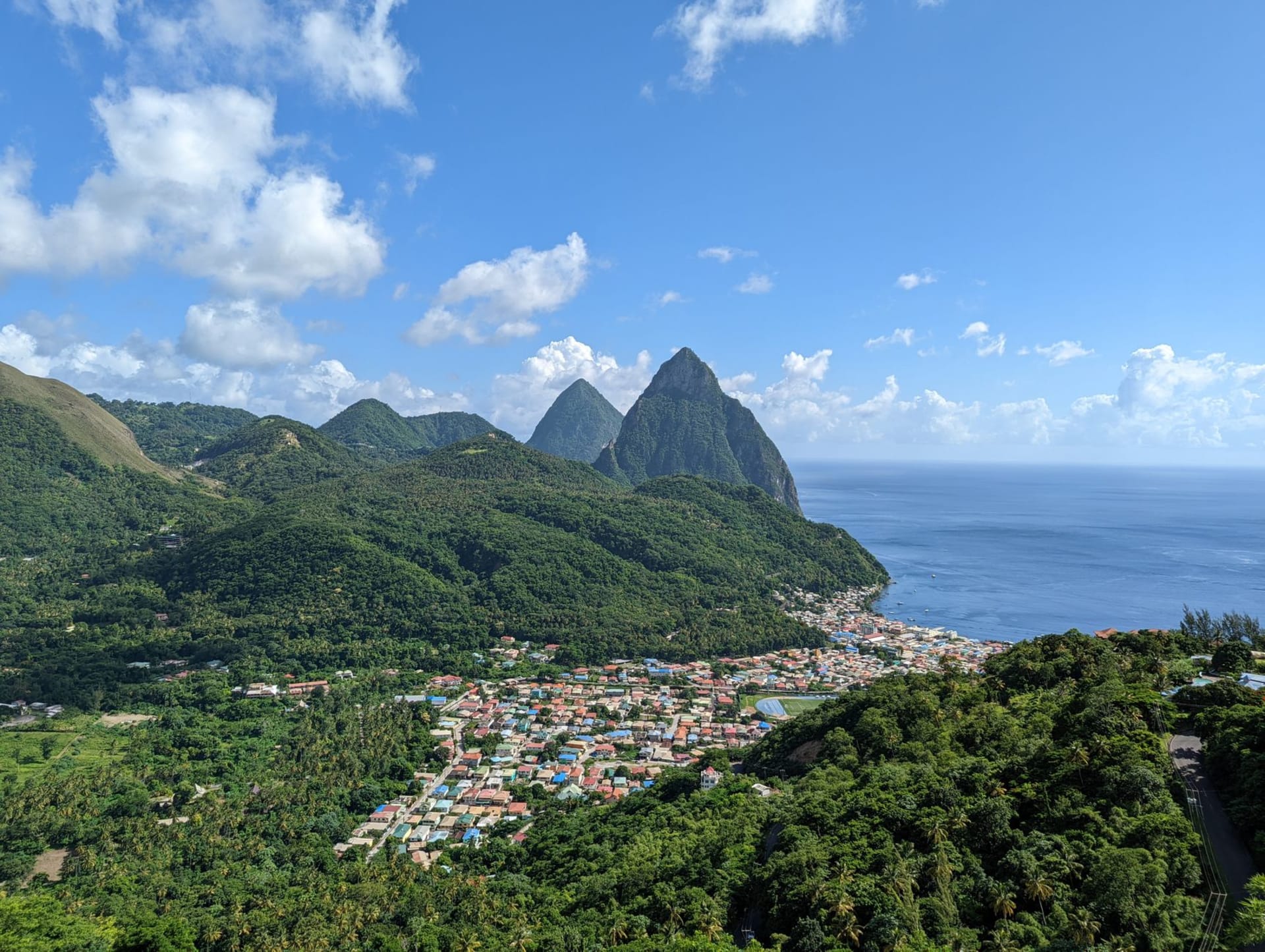
I flew in from Barbados on a tiny prop plane, and the descent into Hewanorra gave me my first look at the Pitons from above — two volcanic cones jutting out of the water like something a child drew and then decided was too dramatic. I’d seen the photos, of course. Everyone has. But seeing them from the air, with the jungle pressing right down to the shoreline and the Caribbean impossibly blue underneath, I understood immediately that Saint Lucia operates at a different register than most Caribbean islands. It’s not trying to be a beach destination. It’s trying to be everything at once.
I stayed in Soufrière, the old French colonial town that sits between the two peaks, and I recommend it over the resort strips to the north without hesitation. The town smells of sulphur from the drive-in volcano nearby, the streets are narrow and chaotic, and the market women sell breadfruit and dasheen alongside phone cases and plastic flip-flops. I ate grilled fish on a plastic chair at the waterfront and paid almost nothing for it. The Pitons were right there the whole time, watching. Most visitors race through Soufrière on a day trip from their resort. That’s a mistake. The island’s soul is here, not in Rodney Bay’s nightclubs.
The hiking is serious. The trail up Gros Piton takes two to three hours each way, with a local guide mandatory — not just for safety but because the guides actually know the ecology, the bird names, the history of the old plantation paths. My guide stopped twice to identify trees by smell alone. I was drenched in sweat from the first fifteen minutes, slipping on volcanic rock under a canopy so thick the light came through in shafts. At the top, the whole island opened up beneath me. I’ve stood on summits that took days to reach and felt less rewarded. Chocolate is another thing Saint Lucia does quietly well — the Rabot Estate and Hotel Chocolat’s property near Soufrière are worth a visit, and a cocoa tour here puts every supermarket chocolate bar in a different light permanently.
When to go: January through April is the dry season and the most popular window — reliable sunshine, low humidity, and the best conditions for hiking. May and June are shoulder months that I’d actually recommend: cheaper rates, greener landscape, and fewer crowds on the trails. Hurricane season runs July through November; September and October carry real risk.
What most guides get wrong: Saint Lucia is constantly marketed as a luxury honeymoon island — overwater bungalows, couples’ spa packages, champagne at sunset. That’s real and it exists, but it obscures the fact that this is also a genuinely rugged, culturally alive island with serious hiking, local rum culture, and Creole food that has nothing to do with resort menus. The drive between Castries and Soufrière alone — the winding coast road with sea views dropping off both sides — is more interesting than most Caribbean itineraries I’ve seen. Rent a car or hire a driver. Get out of the resort. The island rewards it.