Machu Picchu
"No photograph prepares you — when the clouds part, you simply stop breathing for a moment."
The Inca citadel emerges from morning clouds above the Sacred Valley in a vision that still defies explanation.
We arrived on the first train from Aguas Calientes, that small town of hot springs and souvenir stalls wedged between river and cliff at the base of the mountain. The bus ride up the switchbacks took twenty minutes through dense cloud forest, the mist thick enough to bead on our jackets. I remember thinking: there is nothing here. Then the bus stopped, we walked through a gate — and everything I thought I understood about scale and human ambition collapsed.
The Citadel at Dawn
The clouds at Machu Picchu do not behave like clouds elsewhere. They move in from the valleys below, swallowing entire terraces and then releasing them, as if the mountain is deciding how much to reveal. I stood at the Guardhouse — the watchman’s hut at the highest agricultural terrace, the postcard viewpoint — and waited. For long minutes there was nothing but white. Then a gap opened. The Temple of the Sun materialized first, its curved stone wall and trapezoidal windows catching the low light. Then the Intihuatana Stone, the ritual hitching post of the sun, rose out of the grey. Then the full citadel — three hundred hectares of perfectly fitted granite, terraces, plazas, and temples balanced on a ridge between two mountains at 2,430 meters. Lia grabbed my arm without saying anything.
Stone Fit for No Mortar
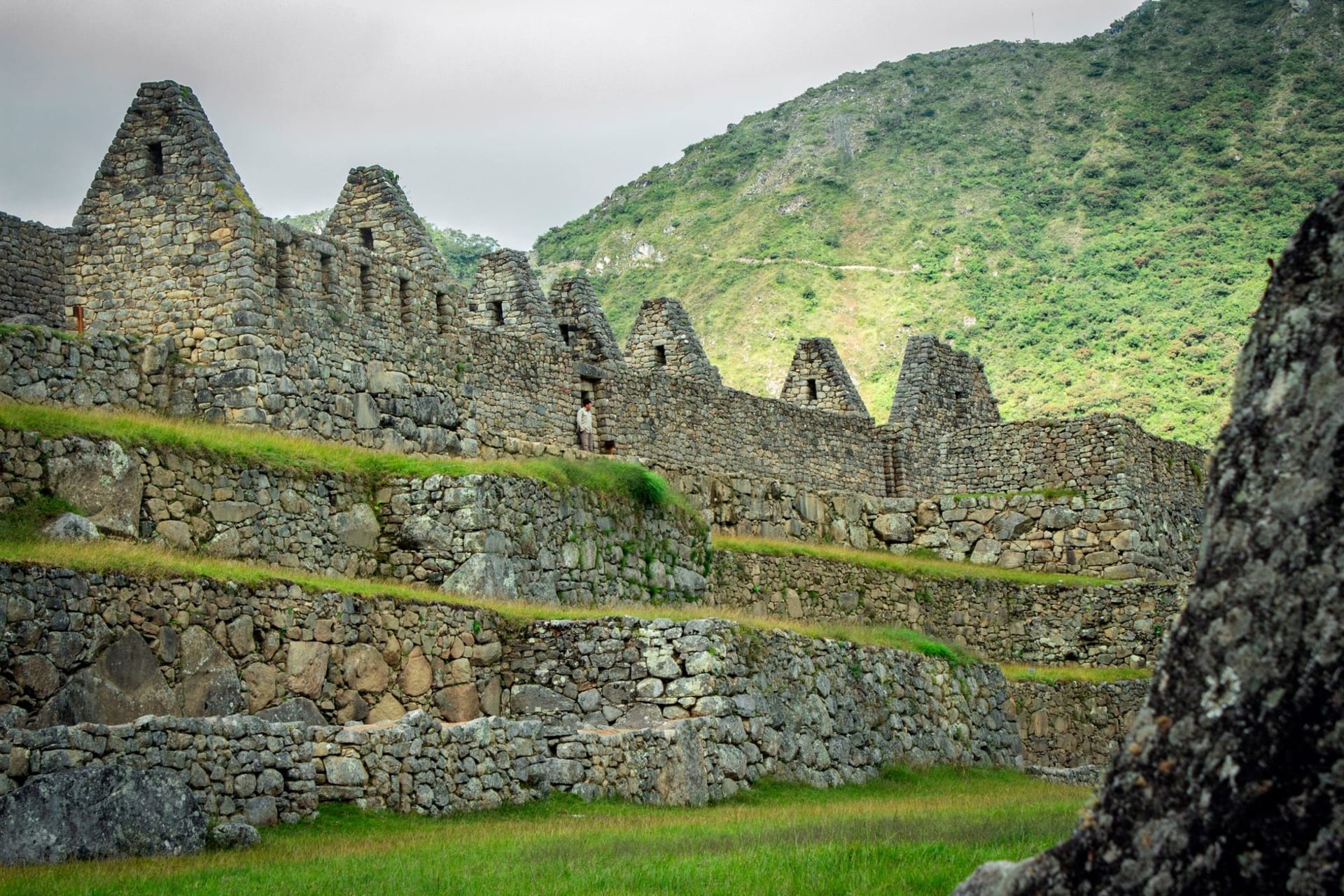
What undoes me about Machu Picchu is not the altitude or the drama of the setting — it is the stonework. The Incas cut granite blocks without metal tools, without mortar, without the wheel. In the Temple of the Three Windows, the joints between stones are so tight you cannot slide a sheet of paper between them. Six centuries of earthquakes have not shifted them. I ran my hand along one wall in the Royal Sector and felt what seemed like a single continuous surface — each block shaved and fitted against its neighbor with a precision that architects today would use lasers to achieve. The smell around the stones in the early morning is cold and mineral, like a cave, undercut by the green sweetness of the cloud forest pressing in at every edge.
The unexpected discovery came in the afternoon, when the tour groups had thinned. I followed a narrow path beyond the Industrial Sector toward the Inca Bridge — a wooden walkway clinging to a sheer cliff face, a retractable entrance that defenders could remove to seal the mountain. Almost nobody makes the thirty-minute walk to see it. We stood on the ledge above the void and looked back at the citadel from an angle that appears in no guidebook photo, the whole structure reduced to a grey spine on a green ridge, impossibly high, impossibly still.
Aguas Calientes, After
The descent returns you to ordinary life abruptly. Back in Aguas Calientes, we ate in a small restaurant off the Plaza de Armas — a bowl of chupe de camarones, a rich prawn chowder with potatoes and aji amarillo, steam rising in the cold air. The town is unremarkable but it earns its function: it exists entirely to let people sleep close to something extraordinary.
When to go: The dry season, May through October, offers the clearest skies — June and July are peak months, with morning mist that burns off by mid-morning. The wet season from November to April brings daily rain but dramatically fewer visitors and luminous green terraces worth the trade.