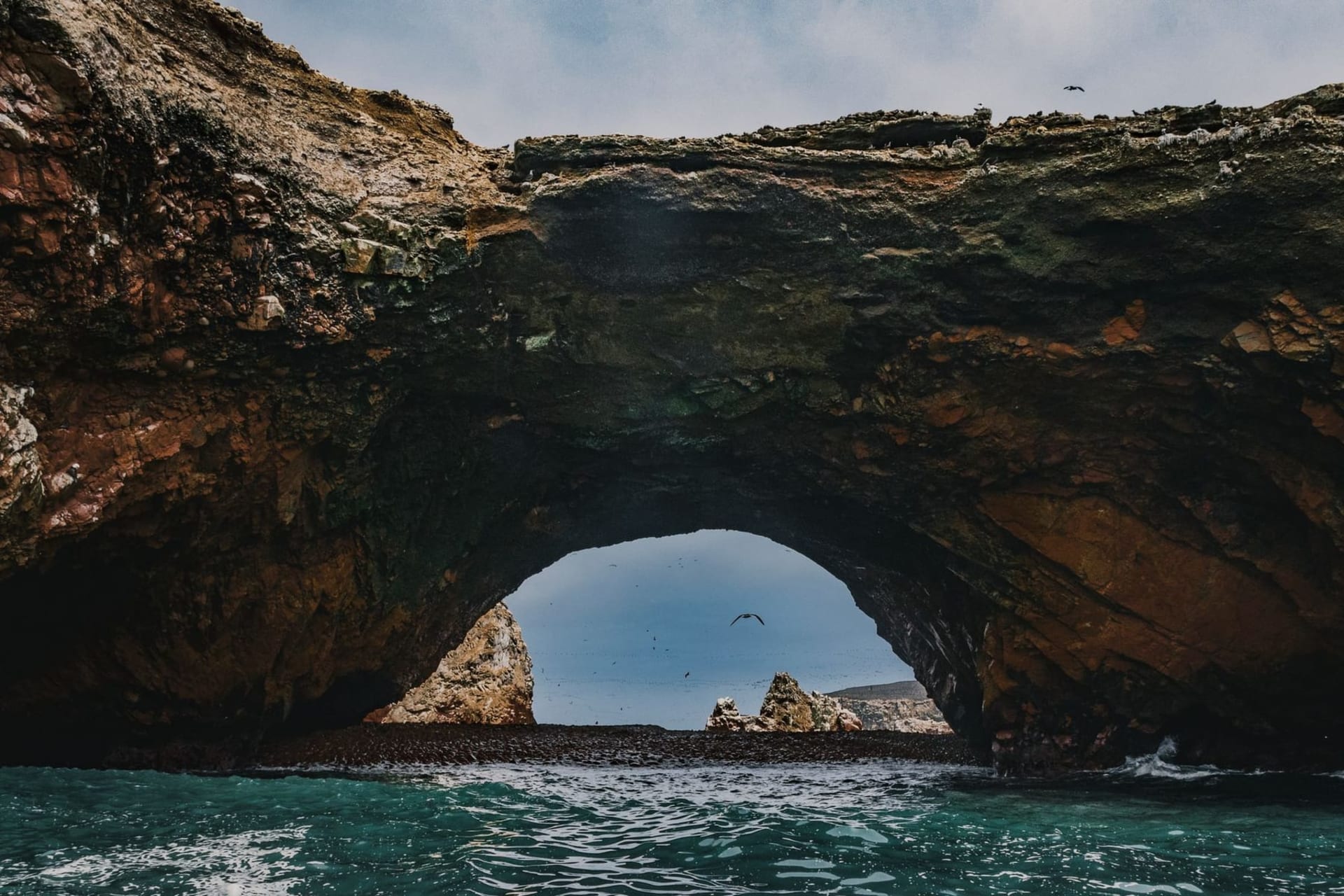
Rocky islands near Paracas carpeted in sea lions, penguins and boobies, reached by a short boat ride through cold Pacific mist.
We left the dock at El Chaco before seven, when the mist off the Pacific still had weight to it — the kind of cold that settles into your collar and stays. The speedboat crossed the bay fast, sending spray over the bow in sheets. Lia pulled her hood tight and laughed. Within twenty minutes, the Ballestas islands rose from the grey water: three ragged chunks of eroded granite, their cliffs stained yellow-white with a century of guano, screaming with life.
The Noise Before the Sight
Nothing prepares you for the sound. Before the rocks are close enough to read in detail, the noise arrives — a layered roar of barking sea lions, the machine-gun clatter of Peruvian boobies, the low groan of swells pushing through sea caves below. The smell follows shortly after: ammonia and salt and something older, the accumulated biology of thousands of animals going about their business on a Tuesday morning.
The boat idles below a ledge where bull sea lions sprawl across one another in boneless heaps, their dark bodies gleaming wet against the pale rock. Some raise their heads and bellow at nothing in particular. Others simply slide off into the water, vanishing with a smoothness that makes their land-bulk seem impossible. The Humboldt penguins stand apart in small groups on a lower shelf — smaller than I expected, formal-looking, unimpressed by us. A boatload of tourists is not a predator. We don’t merit alarm.
The Candelabro and the Cold Pacific
On the way out, the captain swings north to pass below the Candelabro — a geoglyph cut into the coastal hillside, three hundred metres tall, its origin still debated. From the water it reads as a massive fork pressed into the pale desert slope. Nobody knows with certainty who made it or why, though theories involve the Paracas culture, the Inca, even eighteenth-century sailors. Standing at the bow, binoculars useless at this scale, I felt the particular pleasure of a mystery that hasn’t been tidied into an answer.
What caught me off guard entirely was the moment a sea lion surfaced alongside the boat, close enough that I could have reached down and touched its whiskered face. It looked up with enormous liquid eyes, held the gaze for three full seconds, then dove without ceremony. The guide said they do it constantly. I still thought about it for the rest of the day.
The Paracas Base
The town of Paracas itself is small — a single waterfront street of cevicherías and tour operators, pelicans walking the jetty with the proprietary air of locals who have seen many tourists come and go. After the boat returned, we ate leche de tigre at a place called El Chorito, the ceviche marinade arriving in a shot glass, the fish somewhere between raw and cured by lime, the cold of it bracing after an hour on the water. The Paracas National Reserve begins at the edge of town and stretches south along some of the most barren coastline on the continent — worth at least an afternoon.
When to go: May through November is the driest and clearest period; December through April brings more cloud and occasional rain. The boat tours run year-round but seas can be rough in winter. Morning departures are best — the mist burns off by midday, and the sea lions are most active before the heat settles in.