
Caleta Tortel
"In Tortel you don't walk anywhere — you arrive at things by a sequence of staircases, and every one leads to a view you weren't expecting."
There is no square in Caleta Tortel, no central street, no grid of any kind. The village is built on a hillside so steep that the only reasonable infrastructure was boardwalks — narrow wooden passageways mounted on cypress pillars above the ground or the water, connecting house to house and level to level by staircases that creak under your weight and smell of resin and salt. When I arrived after a long dirt road from Cochrane, I stepped out of the truck and immediately there was no truck-logic anymore. You leave your vehicle at the parking area above the village and descend into a world that moves at walking pace, where every direction involves stairs, and where the sound of the Baker River pushing silty blue-grey meltwater into the fjord is always present under everything else.
The Baker River is one of Chile’s most powerful rivers, draining the Northern and Southern Patagonian Ice Fields, and it enters the sea here with enough force and volume that the fjord water around Caleta Tortel is visibly stratified — fresh turbid meltwater over salt sea water, the colors not quite mixed, a tidal interface that shifts hour by hour. The village sits at the edge of this meeting, on an inlet between two river arms, and the light it receives has the quality of light over water: diffuse, reflective, arriving from unexpected angles. In the mornings, mist sits in the hills behind the village and the boardwalks are slick with condensation and the mountains across the inlet are barely visible, and the whole effect is of a place that keeps its distance from definition.

The village has maybe five hundred permanent residents and the economy is fundamentally simple: fishing, some tourism, the cypress wood industry that gave the village its boardwalks in the first place. The cypress here — ciprés de las Guaitecas — is a particularly dense and durable wood that resists rot and sea salt for decades, which makes it the only sensible building material in a village that has been wet every single day of its existence. The boardwalks are not uniform — they have been built and rebuilt and extended by different hands over generations, and the widths vary and the heights vary and there are sections so narrow two people pass each other sideways. Walking the full network takes most of a day if you go slowly, which is the only way to go.
Food in Tortel is centered on what comes from the water, and the centolla — the southern king crab, a creature of almost absurd size and sweetness — is the ingredient to seek. A half-centolla ordered from a small restaurant on the lower boardwalk level comes split and steamed, its legs the length of your forearm, the meat in the claws so dense it requires a moment’s actual effort. I ate one for lunch and then lay in a hostel hammock for two hours listening to the river and watching a pair of austral parakeets in the cypress above me and felt no guilt about any of it.
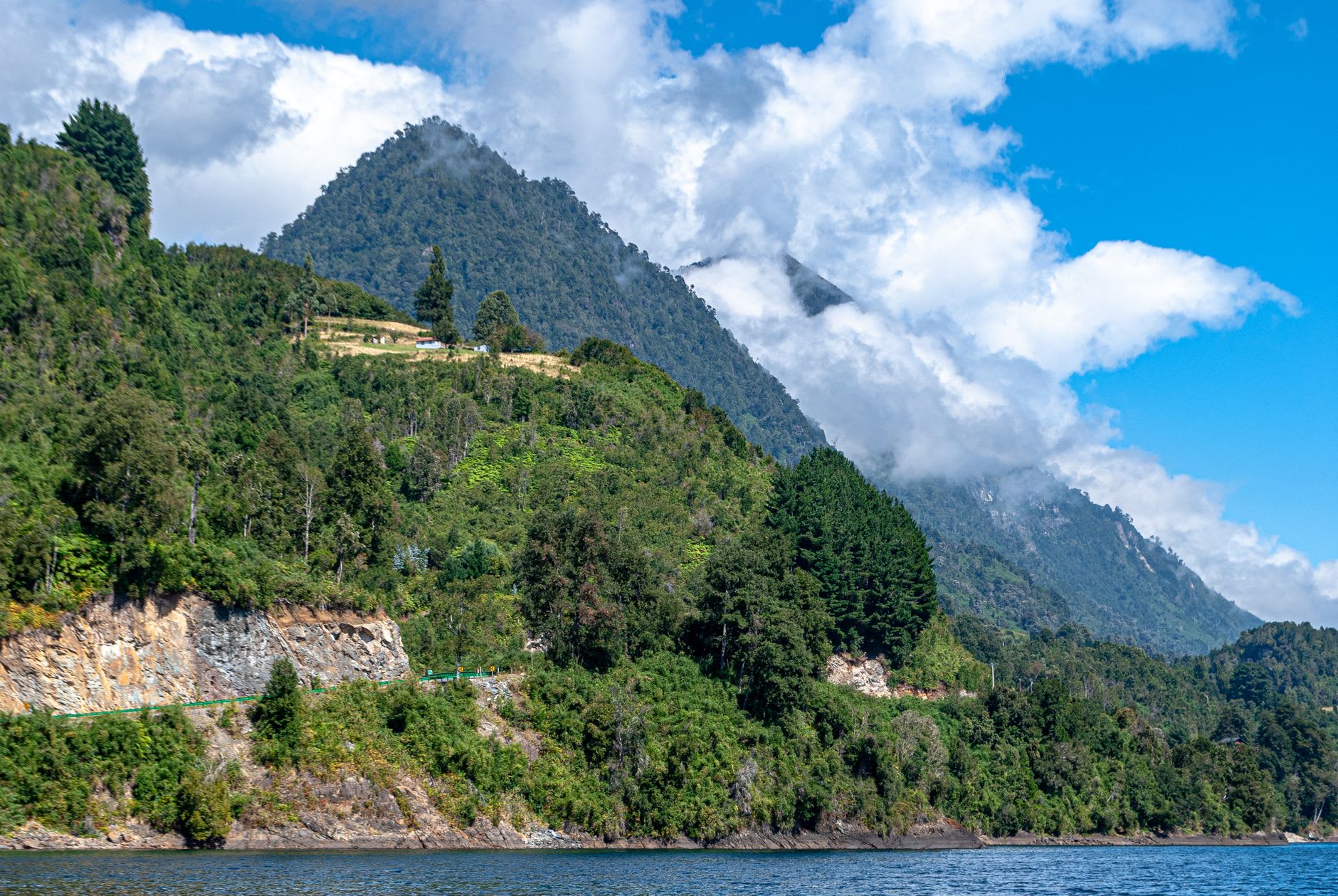
The sunsets here, when they happen, are worth waiting for. The inlet faces west and the mountains frame the light in a way that concentrates it. I watched one from a railing above the water, the Baker River running copper-grey below me, the ice-blue of the fjord beyond, the whole thing going pink and then orange and then a specific shade of red-purple that I associate now entirely with this village and nowhere else.
When to go: November through March for passable road access and longer days. The dirt road from Cochrane to Tortel (approximately 130 km) can be impassable after heavy rain. Tortel can also be reached by a long boat journey from other fjord points. The village has a small number of hospedajes; book ahead in January and February when it fills with Chilean travelers.