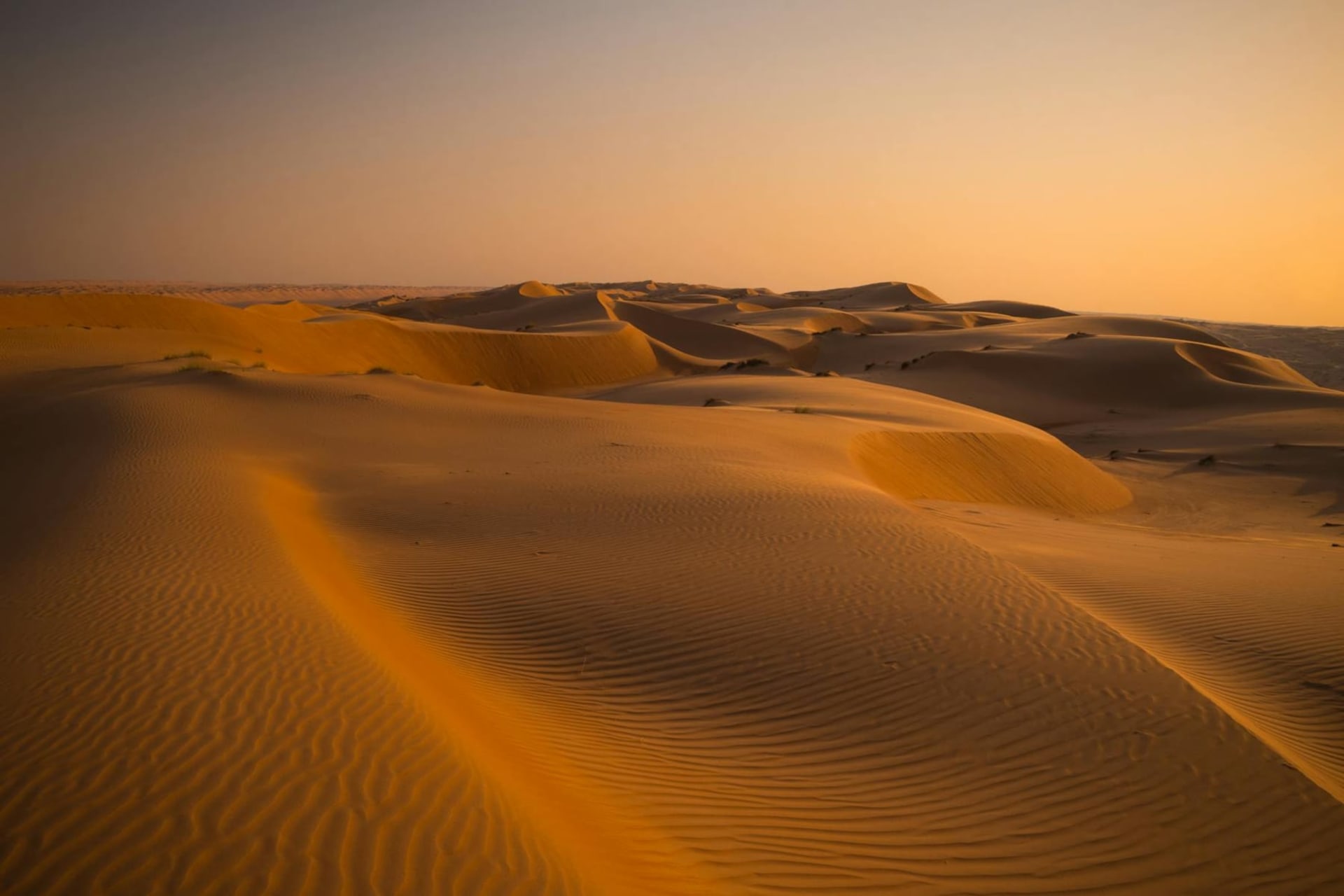
Deep orange dunes stretching to the horizon, where Bedouin camps flicker under a sky thick with stars.
I had been warned about the heat. What I hadn’t been warned about was the silence — the specific, physical silence of the Wahiba Sands in late afternoon, when the wind drops completely and the desert stops pretending to be anything other than what it is: a place that exists entirely on its own terms.
We drove in from Bidiyah along the Al Sharqiyah road, the tarmac giving way to a compacted sand track that our driver, a soft-spoken man named Hamad, navigated with one hand on the wheel and apparent boredom. The dunes appeared suddenly — not gradually, as I expected, but all at once, as if someone had simply decided the flat gravel plain was over.
Into the Sands
The Wahiba — properly called the Sharqiyah Sands — covers roughly 12,000 square kilometers of the eastern Arabian Peninsula. The numbers don’t help. What helps is standing at the crest of a dune somewhere near the northern edge of the sands, the wind having sculpted the ridge into something blade-sharp, and watching the colour shift from burnt sienna in the light to a deep arterial orange in the shadow. Lia crouched at the top and ran her palm across the surface. The sand was finer than anything we’d touched before — it moved in sheets, almost liquid, and left a faint mineral smell on her skin she kept noticing for the rest of the evening.
The Bedouin camps along the northern fringes — near the village of Al Wasil — are semi-permanent structures now, low black goat-hair tents alongside concrete guest rooms. We ate there that night: slow-cooked shuwa, lamb sealed in a banana-leaf parcel and buried in an earth oven for the better part of a day. The fat had rendered into the meat completely. I ate too much and felt no guilt about it.
What the Dark Reveals
The genuine surprise came after midnight. I had stepped outside the tent expecting stars — Wahiba is famous for its skies, far from any significant light pollution — and found instead that I could hear the dunes. Not wind. The sand itself, settling and shifting in microscopic increments, producing a low, steady whisper that wasn’t quite sound and wasn’t quite silence. I stood there for a long time trying to decide which it was.
The camels tethered near the camp made soft sounds. Somewhere further in, a fire was still burning.
Getting There
Most visitors arrive via a 4WD from Muscat — roughly three hours southeast along the highway through Ibra. The desert is technically accessible from multiple entry points, but the northern camps near Al Wasil offer the easiest logistics without sacrificing remoteness.
When to go: October through March, when daytime temperatures stay manageable and the nights turn genuinely cool. Avoid June through August entirely — midday in the Wahiba in summer is a different proposition entirely.