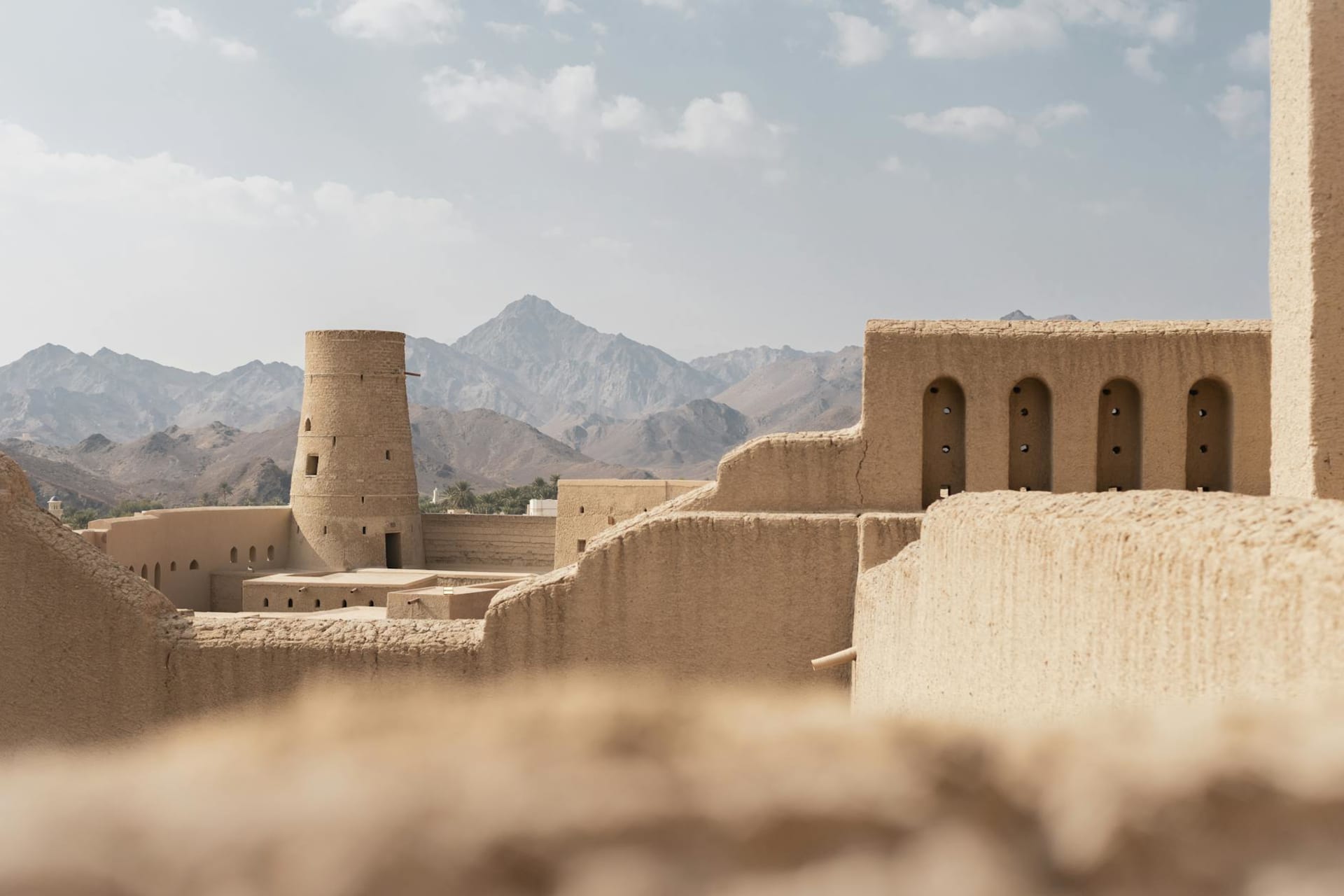
Oman's ancient capital, home to a magnificent round fort and a Friday souq where goats and silver are traded.
I had not expected the quiet. After Muscat’s motorways and the long drive southwest through the Al Hajar range — limestone walls turning amber in the afternoon light, the road threading hairpin after hairpin — Nizwa arrived with an almost provincial stillness. A minaret. A roundabout. A single street of shops selling halwa and honey from roadside stalls. The fort appeared before I had even registered the town.
The Fort at the Centre of Everything
Nizwa Fort sits at the heart of the old quarter like a geological fact. Its central tower — the Burj al-Nizwa — is a near-perfect cylinder, seventeen metres in diameter, dating to the seventeenth century, when the Ya’arubi imams built it to repel the Portuguese. From a distance it reads as almost brutalist: nothing ornamented, nothing wasted. Up close, the scale undoes you. I climbed the ramp inside the tower and emerged onto a terrace of cannon ports and falaj irrigation channels and, far below, the dusty grid of the souq.
What no photograph prepares you for is the smell: old stone heated through by sun, and underneath it, faintly, the ghost of dried dates from the storerooms cut into the rock. The fort was never just a military installation. It was a granary, a court, a treasury. It still holds everything it was built to hold, minus the imams.
Friday at the Souq
The livestock souq begins before seven. Lia and I drove over from our guesthouse on Al Alam Street while the light was still horizontal and gold, and found the pens already crowded — Omani men in white dishdashas and turbans assessing goats with the same focus a jeweller brings to stones. Shouted numbers in Arabic. A handshake. The animal passes hands. It is ancient commerce conducted with complete seriousness, and we stood at the edge of it feeling like accidental witnesses to something that had nothing to do with us, which was precisely the point.
The silver souq opens later and smells of metal polish and sandalwood incense drifting from a nearby stall. Nizwa silver — khanjar daggers, incense burners, heavy bracelets — is some of the finest in the Gulf. The craftsmen here have been working the same techniques for generations. I watched one older man burnish a dagger handle with a piece of leather no bigger than his thumb, his attention absolute.
The surprise came in the honey stalls. Oman produces over forty varieties of honey — sidr, samr, ghaf — and the sellers set out small wooden spoons for tasting with the confidence of winemakers. We bought a jar of sidr honey from the Dhofar mountains, dark and resinous, and ate most of it on bread back at the guesthouse.
Birkat al-Mawz and the Drive Back
A few kilometres north of Nizwa, the ruined village of Birkat al-Mawz unfolds along the road: a mud-brick settlement abandoned mid-century, its watchtowers still standing among working date plantations threaded by falaj channels. The late afternoon light turns the mud walls the same colour as the mountains behind them. I stayed longer than I planned.
When to go: October through March, when temperatures in the interior drop to something reasonable — Nizwa sits at 570 metres and is considerably cooler than the coast, but summer heat is still punishing. The Friday souq runs year-round; arrive before 8am for the livestock market.