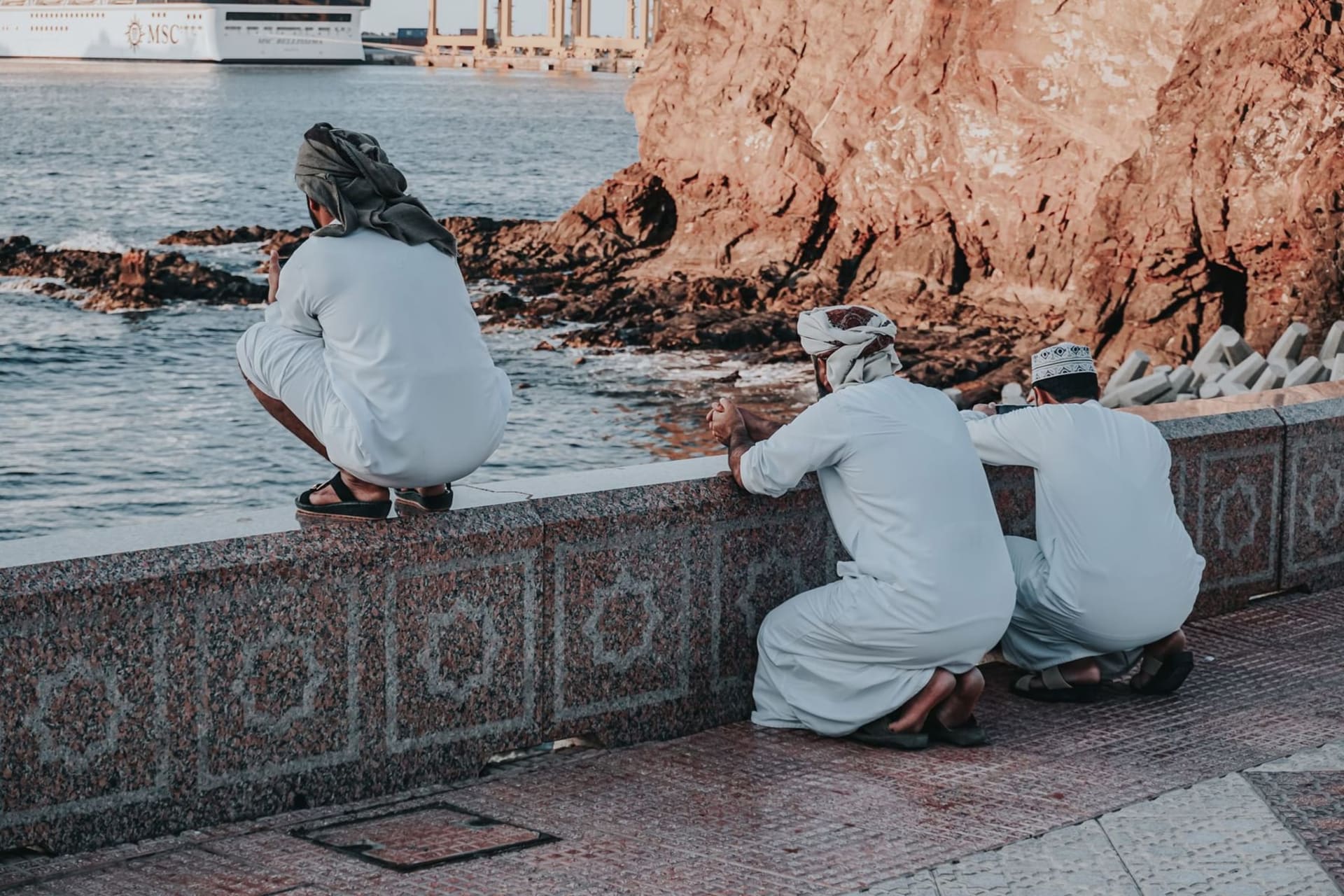
Whitewashed houses, a corniche-hugging harbour, and the perfume of the Muttrah souq at dusk.
There is a particular quality to the light in Muscat just before the azan sounds from the Al-Khawr mosque — something between amber and bone, laying itself flat across the whitewashed walls of Muttrah like it has nowhere better to be. I stood on the corniche with my hands in my pockets and understood, for the first time, what people mean when they say a city carries itself with dignity.
The Souq at Dusk
The Muttrah Souq is one of the oldest markets in the Arab world, and it smells like proof of that fact. Frankincense burns in brass censers near every entrance — not as theatre for tourists, but because it always has. I followed Lia through the covered arcade off Al Mina Street, past bolts of Kashmiri wool and pyramids of dried limes, until we lost each other entirely and agreed, wordlessly, that this was the correct way to experience it.
What stopped me was a stall selling silver Khanjar daggers — the curved blades that appear on the Omani flag — arranged in a glass case with the care of museum pieces. The shopkeeper, an elderly man in a white dishdasha, didn’t press me to buy. He simply lifted one out and let me hold the weight of it. That restraint felt like its own kind of luxury.
Along the Corniche
The Corniche de Muttrah curves for about three kilometres along the water, lined with date palms and the occasional wooden dhow preparing for the night crossing. Walking it at dusk, the Al Mirani and Al Jalali forts bookend the old harbour from opposite headlands — sixteenth-century Portuguese strongholds that Muscat absorbed and made its own, the way it seems to absorb everything without fuss.
I had expected souvenir shops and postcards. What I found instead, tucked behind the fish market near the port entrance, was a small tea house where fishermen drank karak chai from handle-less glass cups. I sat down. Nobody questioned why. The chai was cardamom-heavy and sweet in a way that made conversation unnecessary.
The Old Neighbourhoods
Beyond the souq, the older residential quarter of Al Waljat folds into narrow lanes wide enough for one donkey, maybe two thin people. The doors here are carved wood, often indigo or terracotta, hinged with iron rings. The silence is profound in a city that otherwise hums with traffic and construction cranes along the newer boulevard of Sultan Qaboos Street. Muscat keeps its oldest self tucked away from the main road, which is perhaps the point.
When to go: October through March, when temperatures hover between 20–28°C and evenings on the corniche are genuinely pleasant. Avoid June through August — the humidity off the Gulf of Oman turns the air into something close to solid.