Dawki
"I've seen clear rivers before. I have never seen water that reads as the absence of itself."
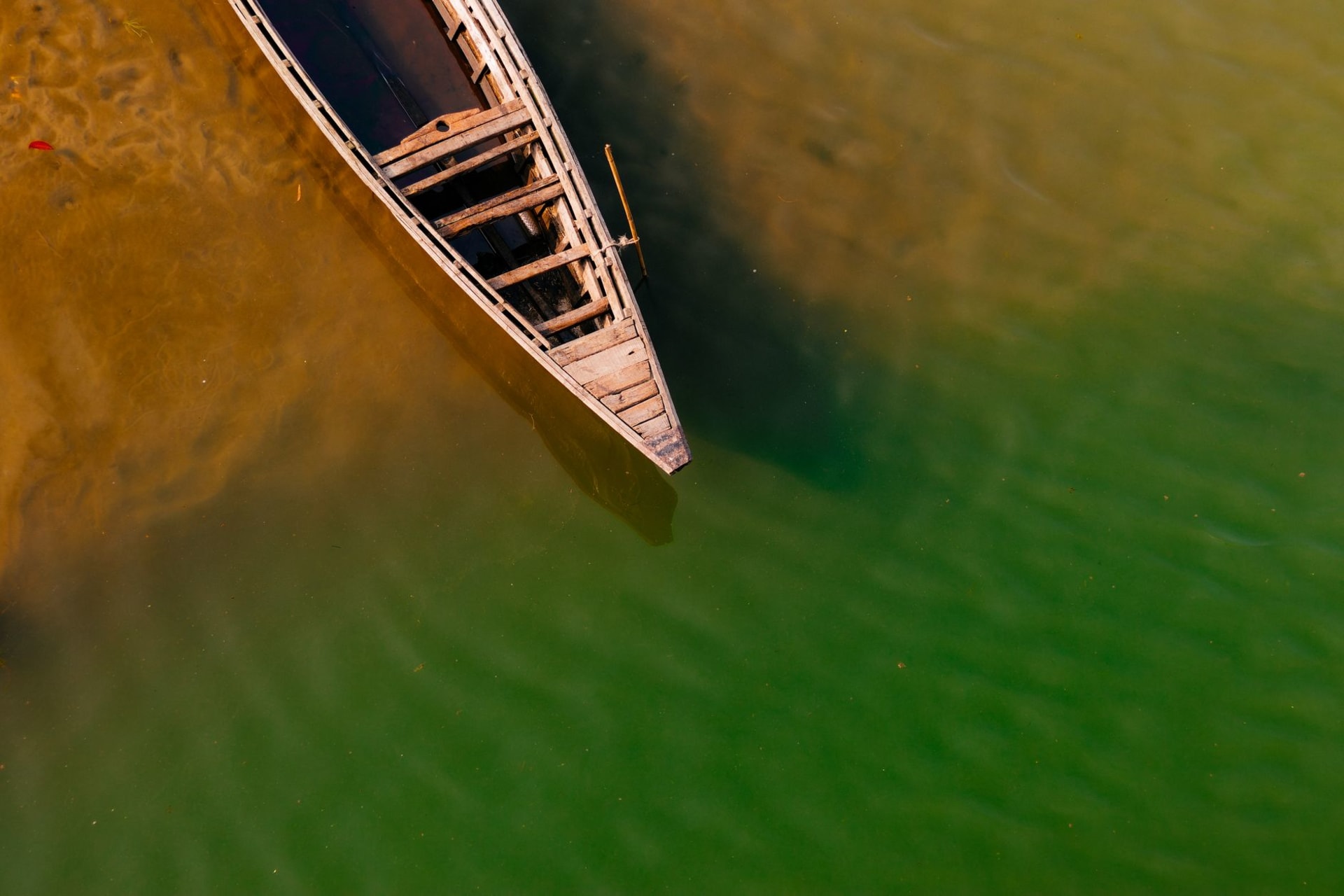
The photographs had prepared me for something impressive. They had not prepared me for the specific sensation of watching a boat row across what appears to be nothing — or rather, what appears to be glass above a mosaic of grey and white and amber stones, so sharply detailed in the water’s refraction that you can see individual pebbles tumble in the current ten metres below the surface. The Umngot River at Dawki is not a trick of light or camera settings. It is simply the cleanest river I have ever stood beside, and standing beside it produces a visual cortex error I couldn’t quite resolve even after an hour of staring.
Dawki is a small border town in the Jaintia Hills district, in Meghalaya’s south, where the Umngot crosses from India into Bangladesh. The town has a certain rough-edged frontier quality — concrete stalls selling snacks, trucks queuing for the border crossing, the general productive noise of a place that exists because of commerce rather than scenery. But walk down to the river and the noise drops behind you, and what’s in front of you is one of those geological accidents so specific and so beautiful it seems like it should require an explanation.

I hired a wooden rowboat for an hour — the rate was negotiated in two minutes by a young man with excellent English and a total lack of interest in haggling theatrics — and we went upstream, away from the main boat cluster, into a section of the river where the banks close in slightly and the forest overhangs the water. The boatman stopped rowing and let us drift. I hung my arm over the side and watched my shadow fall perfectly on stones four metres below as though the water had no refractive index at all. The current moved us slowly. Kingfishers flashed in the peripheral vision. At one point a group of local kids jumped from a rock into the river and the splash they made was the only evidence that the water was actually there.
The river is fed entirely by rainwater and springs from the surrounding limestone hills — no agriculture upstream, no industrial runoff, the whole catchment somehow still intact. The Jaintia Hills people who live along it have historically treated the river as sacred, which may be the practical reason it has survived. Sacred things get managed differently than ordinary ones. The clarity is not natural in some fixed geological sense — it is the product of human behaviour across multiple generations, and the fact that it’s still this clear in 2026 is either a miracle of local governance or a fragile grace period running out. I didn’t ask which.

The suspension bridge over the Umngot at the edge of town is old and springy and crossed with more faith than engineering confidence, and from its midpoint you look straight down through the water at the riverbed as though through aquarium glass. I stood there for a long time while trucks and motorcycles crossed around me. Nobody else stopped. Familiarity is its own kind of sight problem.
After the river I ate at a dhaba back in the main town — dal fry, rice, a chicken preparation spiced with something dried and smoky — and caught a shared jeep back toward Shillong in the late afternoon. The mountains came up fast as you climb from the Bangladesh plain. Meghalaya assembles itself above you from below like a world appearing from mist.
When to go: October through May for the clearest river. The Umngot floods in monsoon — June through September — and becomes brown and opaque with runoff, losing its entire point. The peak clarity window is November through February, when rainfall is minimal and water levels drop enough to see maximum depth. Dawki pairs naturally with Mawlynnong — they’re half an hour apart — and makes a logical full-day excursion from Shillong.