Penang Street Art
"Penang's street art turns navigating a city into something between a treasure hunt and a museum visit."
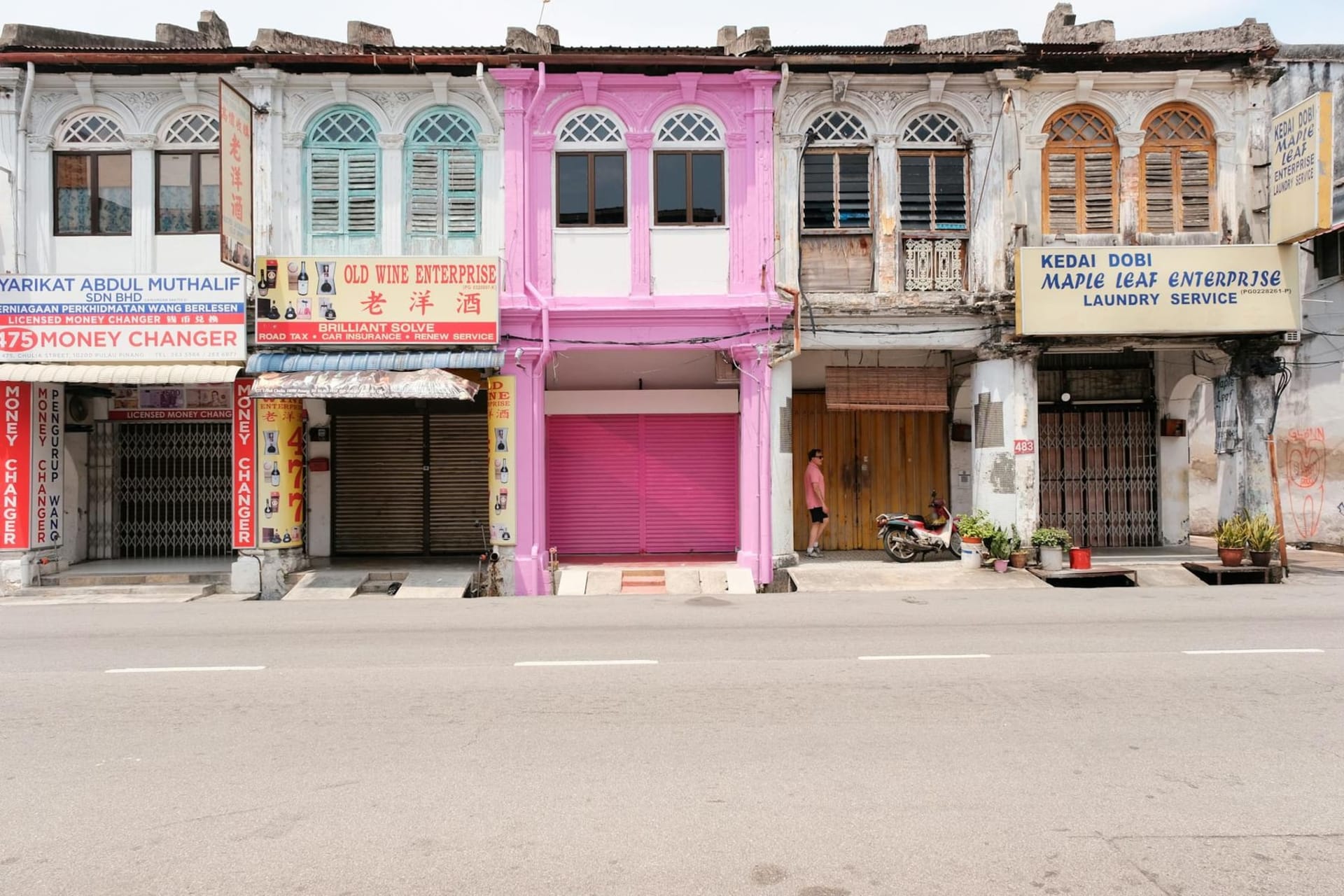
George Town's UNESCO shophouses turned into outdoor gallery with commissioned murals and iron sculpture.
I arrived in George Town with a paper map and a coffee, which felt appropriate. The map had small camera icons scattered across it like breadcrumbs — each one marking a mural, a wire sculpture, a painted door. Within an hour I had abandoned the map entirely and was simply walking, which is, I think, exactly what the art wants you to do.
The Walls on Armenian Street
The murals most people come for are Ernest Zacharevic’s commissions along Armenian Street and the surrounding lanes. They are not small. A boy rides a bicycle across a shophouse wall at human scale, his front wheel a real wheel bolted into the plaster. Two children swing on a real wooden swing mounted between windows. The detail is such that I kept stopping to check whether I was looking at paint or at something that had actually happened to the building. Lia stood in front of the girl on the swing for a long time without saying anything, which is her version of being impressed.
The light in George Town is thick and equatorial — even at nine in the morning it comes in at a low, golden angle that makes the colors on the walls seem warmer than they are in photographs. The smell is frangipani and drain water and the char from a char kway teow stall on Chulia Street two blocks over.
Iron Caricatures and Hidden Lanes
What surprised me was the iron rod art — small, flat, welded silhouettes mounted at eye level on walls throughout the heritage zone. They are everywhere once you start looking: a trishaw driver, a woman hanging laundry, a man reading a newspaper. Each sculpture has a caption in English and Jawi script that explains a fragment of George Town’s social history. I found one I hadn’t read about in any guidebook tucked behind a temple on Cannon Street, illustrating a scene from the tin trade. No tourist in sight. I stayed longer there than at any of the famous murals.
The art is densest between Armenian Street and Ah Quee Street, with quieter work extending south toward Muntri Street and Love Lane. The UNESCO core zone is compact enough to cover on foot in a morning, but not if you stop, which I did, constantly.
Moving Through the City
Walking the art circuit in George Town is less about ticking locations off a list and more about letting one wall lead to the next alley, the next coffee shop, the next unexpected painted door. By midday the heat becomes serious. I ducked into a kopitiam on Penang Street, ordered kopi-o and a roti canai, and sat for forty minutes watching other people navigate outside with their own maps, their own abandoned plans.
When to go: November through February is the coolest and driest stretch, with mornings that stay below thirty degrees long enough to walk the full circuit comfortably. Avoid public holidays if possible — the narrow lanes around Armenian Street fill quickly, and the murals deserve more space than a crowd allows.