Xijiang
"At five in the morning, with the mist still in the valley, Xijiang belongs only to itself."
I set an alarm for four-thirty. My guesthouse host — a Miao woman named Aying who spoke no English and communicated entirely through gestures and a mobile translation app — had told me through the phone screen that I would regret sleeping past six. She was right. By nine the tour buses start arriving from Kaili, and the village reconfigures itself, subtly but unmistakably, into something that performs its own existence. But at five in the morning, walking the wooden walkways between houses that lean out over the valley on their stilts, with wood smoke rising from a hundred cooking fires and a dog somewhere barking at nothing, Xijiang is entirely, completely itself.
The village is enormous — more than a thousand households spread across two hillsides facing each other across a river. The houses are all built in the same style, dark timber on stone plinths, with upturned eaves and galleries where laundry hangs and corn dries in fat yellow bundles. Seen from the observation platform at the ridge, the village looks like it grew organically from the mountain, which in a sense it did — the Miao have been here for over a thousand years.

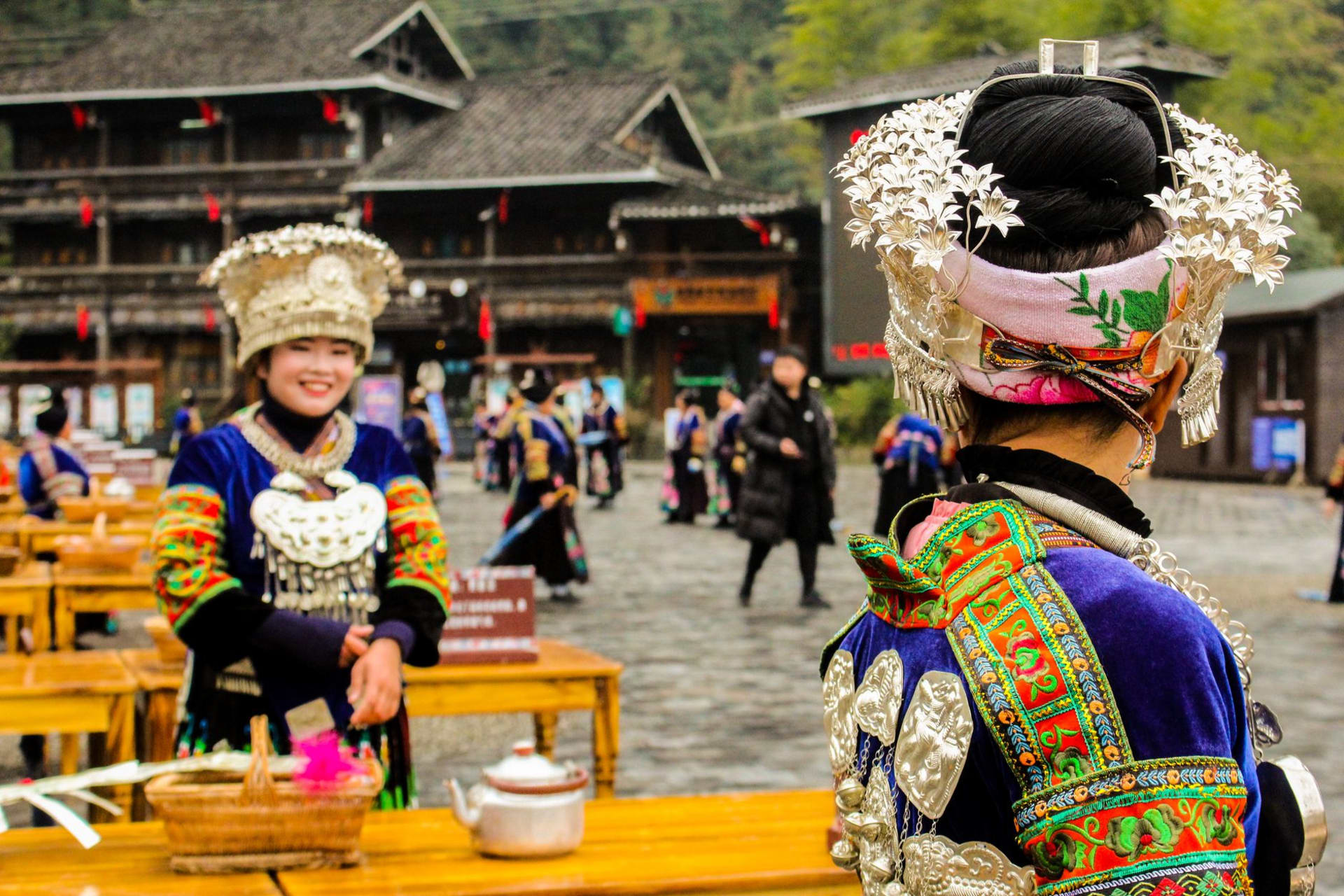
The women’s dress here is what first arrests you. The Xijiang Miao are known for their long skirts and their silver — not just headdresses but elaborate chest pieces, earrings, and multiple-strand necklaces that jangle as they walk. For daily life, most women wear simpler modern clothes, but at festivals and on weekends when buses bring visitors, the full dress comes out. I watched a grandmother help her granddaughter into a headdress that must have weighed three kilograms, settling it with practiced hands, and the girl — maybe ten years old — stood straighter immediately, as if the silver itself reminded her of something.
The food follows the Guizhou playbook: sour, spicy, fermented. But in Xijiang there is a specific preparation I could not find elsewhere — glutinous rice cakes pounded with chili and dried sour plum, sold from flat bamboo baskets by women who balance them on their heads. The texture is dense and chewy, the flavor somewhere between sweet, sour, and hot, and I ate three before understanding I had already ruined my appetite for lunch.

Staying overnight changes everything. The guesthouses are basic — wooden rooms with thin walls through which you hear the whole village breathe — but being there after dark, when the terraced hillside lights up with lanterns and the sound of lusheng pipes drifts up from the river, is one of those travel experiences that does not compress into photographs. You are simply inside it, and that is enough.
There is a performance staged each evening for visitors — dancing, music, the ceremonial welcome with rice wine drunk from buffalo horns — and it is frankly theatrical. But the sincerity underneath the performance is real, and when the elderly musicians play, their concentration is complete. They are not playing for you. You are overhearing something.
When to go: April and October are optimal — mild temperatures, clear light, and the rice terraces either flooded and reflective or turning toward gold. The Miao New Year (usually November by the lunar calendar) transforms Xijiang into something genuinely overwhelming, thousands of people in full silver dress, worth any amount of logistical difficulty to attend. Avoid the summer months — the humidity settles into the valley like a lid.