Lake Manyara
"The lion was asleep in the fig tree with the authority of something that has never needed to justify its choices."
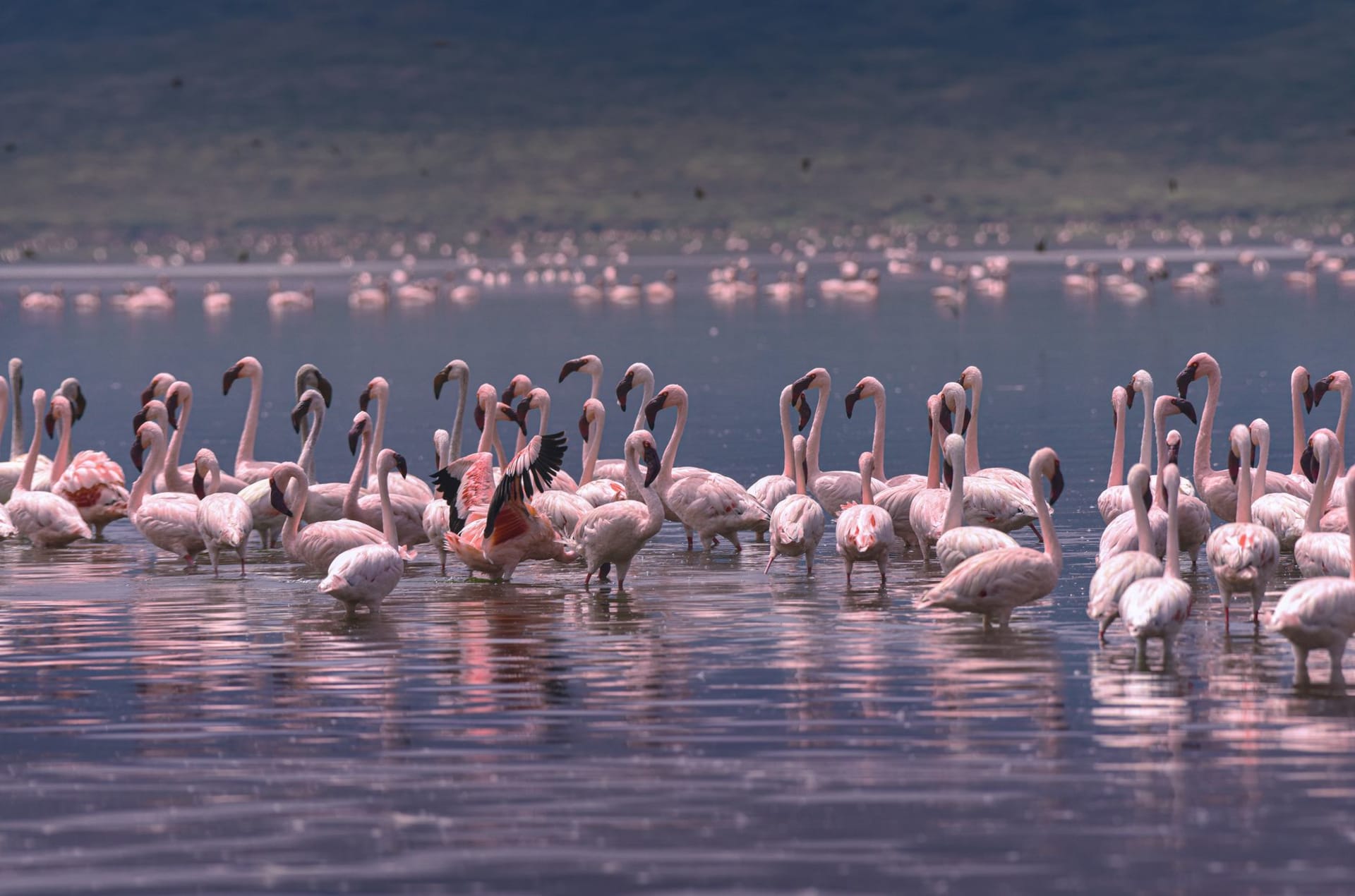
Descending into Lake Manyara National Park from the Rift Valley rim is one of those transitions that the body registers before the mind catches up. The road drops through the escarpment wall in a series of tight curves, the vegetation thickening as you lose altitude until suddenly you are inside a forest — proper forest, not savanna parkland — of mahogany and strangler fig and fever trees with a canopy so full it reduces the afternoon light to something dim and greenish. Then the trees open and the lake appears, stretching south to a flat horizon, with flamingos in the distance doing their usual thing of turning the shallows the color of a sunset.
The tree-climbing lions are the most famous thing about Manyara and, fairly, the most surprising. Lions are not supposed to climb trees. They do not have retractile claws good enough for it, and their center of gravity is all wrong for arboreal life. But the lions here do it anyway, sleeping in the branches of the yellow-barked acacias and the figs with an expression of complete indifference to the contradiction they represent. I found a pride spread across three trees one afternoon — two large females in the lower branches, cubs higher up in positions that looked both implausible and deeply comfortable. The guide said they climb to escape the flies and the heat, which is a prosaic explanation for something that looks ancient and deliberate.
The groundwater forest runs along the base of the escarpment where subterranean water seeps from the rock and keeps the soil saturated year-round. This explains the density and diversity of the trees, and it explains the baboons — troops of olive baboons move through the forest with the purposeful chaos of rush-hour commuters, young ones riding their mothers’ backs, dominant males walking with a slow possessive dignity through territories they clearly regard as theirs. Colobus monkeys, black and white and moving in the high canopy, are harder to see but audible as a series of explosive calls that echo off the escarpment wall.
The lake itself is alkaline — the Rift’s chemistry reasserting itself — and supports significant flamingo populations that move between Manyara and the other nearby soda lakes of northern Tanzania depending on conditions. On the southern shoreline, pelicans roost in the yellow-barked acacias that lean over the water. The lake level has fluctuated significantly over the decades, and in recent years high water has reduced the accessible shore, but the birding around the forest edge and the lake margins remains exceptional regardless.
What Manyara has that many more famous parks don’t is a sense of compression — the forest, the lake, the escarpment, the open grassland where buffalo graze in muddy-hooved herds, all packed into a relatively small area that produces an extraordinary density of encounters. The park is often treated as a one-night stop before the Serengeti or Ngorongoro, and it rewards that logic while deserving more.
When to go: June through October is the dry season in northern Tanzania, with reliable wildlife viewing and clear skies. The wet seasons — November through December, and March through May — bring lush vegetation and good birding, though some tracks become muddy. The flamingos are most numerous from December through March when water levels suit their feeding.