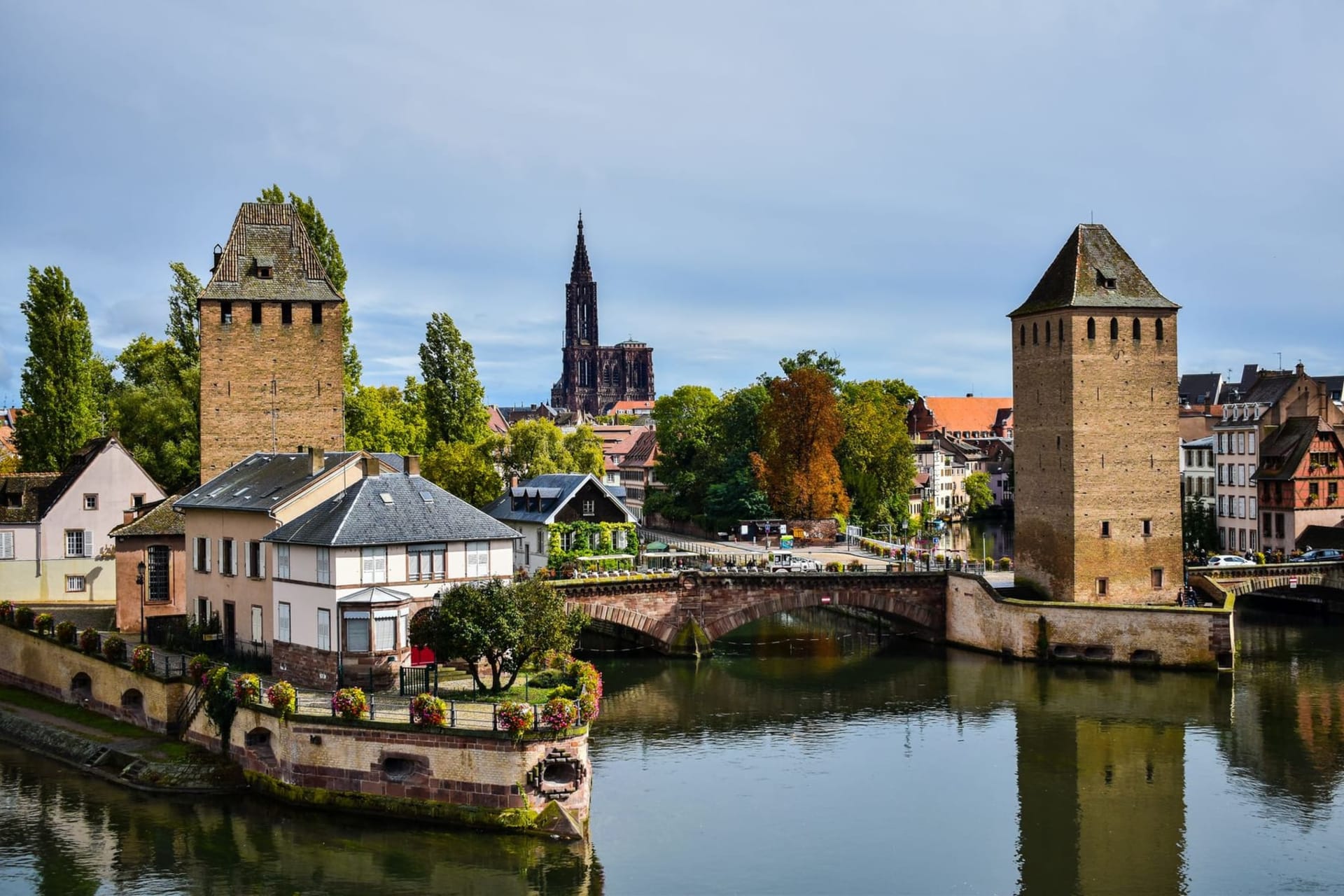
I arrived in Strasbourg in November, when the city smells of mulled wine and wet stone and something faintly sweet that turns out to be tarte flambée emerging from a wood-fired oven on Rue des Dentelles. The light at that hour was amber and low, filtered through bare plane trees along the Ill, and the cathedral — the Cathédrale Notre-Dame de Strasbourg — was already lit from below, its rose sandstone turning a shade that has no clean name in French or German.
Between Two Languages
The first thing you notice is that menus exist in both languages without apology. A choucroute garnie arrives at the table just as confidently as a Flammkuchen. Street signs read “Rue du Vieux-Marché-aux-Poissons” and below them, in smaller lettering, the Alsatian. Lia picked up a tourist pamphlet translated into four languages and said it felt less like a compromise and more like a city that had simply stopped explaining itself. She was right. Strasbourg does not perform its duality. It inhabits it.
We stayed in the Petite France quarter, where the canals are narrow enough to shout across and the half-timbered houses lean toward each other overhead. The reflections in the water in the morning, before the tour groups arrived, had the quality of an old oil painting left in a warm room — slightly softened, colours deeper than they should be.
The Cathedral’s Astronomical Clock
What surprised me was not the cathedral’s height — I had seen photographs — but the astronomical clock on its south transept wall. Built in the sixteenth century and still running, it performs a small mechanical pageant every day at noon: figures of the apostles circle past a figure of Christ while a mechanical rooster crows three times. I had read about it and expected to feel nothing. Instead, standing in the crowd watching gears turn that have turned for five hundred years, I felt the particular vertigo that comes from understanding that time is not yours.
Afterward I ate a kougelhopf from a boulangerie on Place de la Cathédrale — a ring-shaped brioche studded with raisins and almonds, dusted with powdered sugar — and walked back to the canal by a different route each time, trying to get lost, mostly failing.
When to Go
When to go: Late November through December brings the Marché de Noël, which has operated since 1570 and fills Place Broglie and Place Kléber with warm light and the smell of bredele biscuits. Spring — April and May — is quieter and genuinely beautiful, the canal banks green and the cathedral crowds still manageable before summer peaks.