
Sarlat-la-Canéda
"We turned a corner in Sarlat and Lia said, only half joking, that it looked fake — too intact to be real."
The golden-stone heart of the Périgord Noir, a medieval town so perfectly preserved that half of France's costume dramas seem to have filmed here, with a Saturday market that swallows the entire old center.
Sarlat was our first stop in the Dordogne, and it recalibrated what I thought a medieval town could look like. The whole old center is built from a warm ochre limestone that turns almost gold in late afternoon, roofed in heavy limestone lauze tiles instead of the slate or tile you see further north, and it has survived so completely intact that film crews use it constantly as a stand-in for pre-Revolutionary France. Lia’s first reaction, walking into the Place de la Liberté, was to ask if it was a reconstruction. It isn’t. It just never got knocked down.
A town saved by neglect, then by decree
Sarlat’s preservation is partly an accident of geography — the town was bypassed by the main trade routes and railway lines that reshaped so many French towns in the nineteenth century, which meant it was simply too poor to modernize. By the 1960s the old quarter was genuinely decaying, and it became one of the pilot towns for André Malraux’s landmark 1962 law protecting historic urban centers, the first serious national framework for this kind of preservation in France. The restoration that followed is why the town now looks the way it does: honest stonework, no aluminum shopfronts, streets narrow enough that we regularly had to step into doorways to let a delivery cart pass.
We spent an aimless morning just wandering the lanes around the Cathédrale Saint-Sacerdos, ducking into the Cour des Fontaines and past the strange, bullet-shaped Lanterne des Morts, a twelfth-century tower whose original purpose nobody has definitively settled — a symbol of a canonization, a funerary monument, and a plague memorial have all been proposed, and the town seems to enjoy not knowing.
The Saturday market and a duck-fat education
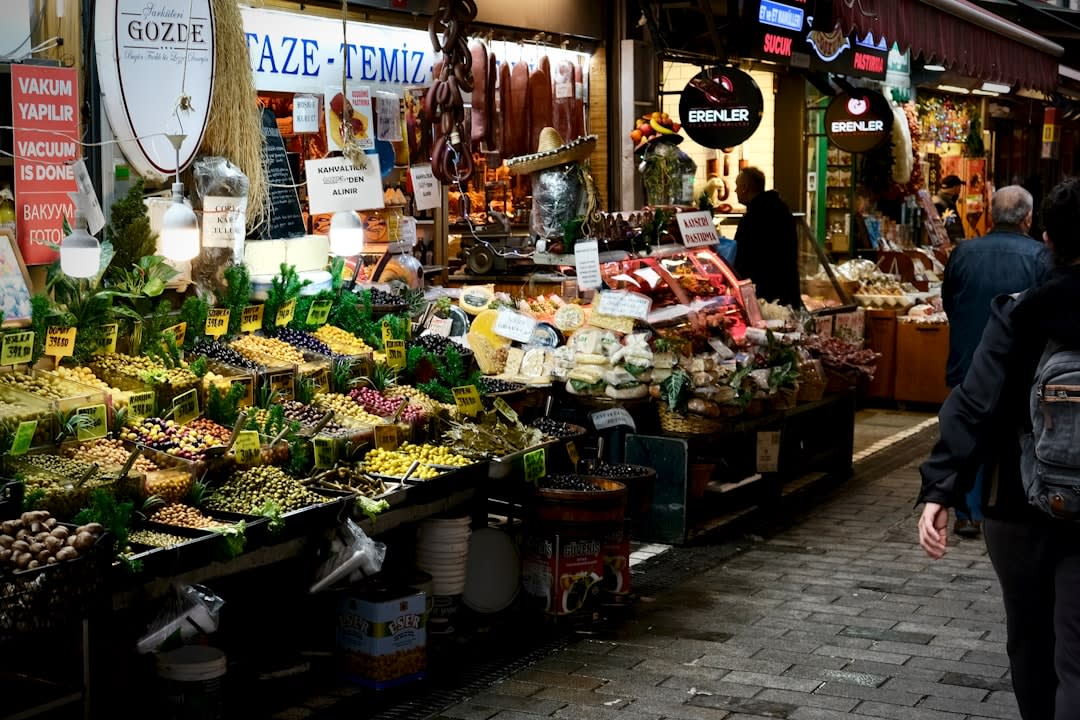
Saturday morning in Sarlat is not a quiet occasion. The market spreads through the entire old town, stalls of foie gras, cèpes when in season, walnuts, black Périgord truffles in winter, and duck in every conceivable form — confit, magret, rillettes, gizzards fried and tossed into salad. We arrived with no plan and left two hours later having eaten our way through half of it, standing at a stall counter with a woman who sold us a jar of duck confit and gave Lia a five-minute lecture on rendering the fat properly at home, which Lia has since actually followed.
That evening we ate at a small restaurant just off Rue de la République, sharing a plate of pan-seared foie gras with a fig compote, and agreed it was the best meal of the whole Dordogne trip, which is a genuinely competitive category in this region.
When to go: Saturday, without question, for the market — but come outside July and August if you can, since the old town’s narrow streets get genuinely uncomfortable at peak summer capacity. Autumn brings the best food, with truffle and mushroom season overlapping.